





























Paperboard Thickness Chart: Points to Inches and Millimeters
Updated · Vorex Packaging
Paperboard thickness is given in points in the US: 1 point is 0.001 inch, or 0.0254 mm. So 16pt board is 0.016 in (about 0.41 mm) and 18pt board is 0.018 in (about 0.46 mm). We print folding cartons on 18pt SBS paperboard and cards, tags and sleeves on 16pt card stock; corrugated and rigid boards are much thicker.
The short answer
In the US, paperboard thickness (its caliper) is given in points, and 1 point is 0.001 inch, or 0.0254 mm. So 16pt board is 0.016 in (about 0.41 mm) and 18pt board is 0.018 in (about 0.46 mm). We print our folding cartons, such as tuck end boxes, on 18pt SBS paperboard and our cards, tags and sleeves on 16pt card stock. Corrugated board and rigid chipboard are far thicker and are described differently: corrugated by its flute, for example E-flute at about 1/16 in.
What does a point mean?
A point is one thousandth of an inch. It measures thickness, not weight: two boards of the same point size can weigh different amounts, because some board types are denser than others. That is why US carton makers usually specify caliper in points, while many suppliers elsewhere quote paper weight in grams per square metre (GSM). Our glossary entry on caliper, points and GSM explains the difference.
Paperboard thickness chart: points to inches, millimetres and microns
| Caliper | Inches | Millimetres | Microns | Sheets per inch | Note |
|---|---|---|---|---|---|
| 10 pt | 0.010 | 0.254 | 254 | 100 | - |
| 12 pt | 0.012 | 0.305 | 305 | 83 | the usual line between paper and paperboard (about 0.30 mm) |
| 14 pt | 0.014 | 0.356 | 356 | 71 | - |
| 16 pt | 0.016 | 0.406 | 406 | 62 | listed on our printed cards, tags, sleeves, belly bands and folders (16pt card stock) |
| 18 pt | 0.018 | 0.457 | 457 | 56 | listed on our folding cartons (18pt SBS paperboard) |
| 20 pt | 0.020 | 0.508 | 508 | 50 | - |
| 22 pt | 0.022 | 0.559 | 559 | 45 | - |
| 24 pt | 0.024 | 0.610 | 610 | 42 | - |
| 26 pt | 0.026 | 0.660 | 660 | 38 | - |
| 28 pt | 0.028 | 0.711 | 711 | 36 | - |
| 30 pt | 0.030 | 0.762 | 762 | 33 | - |
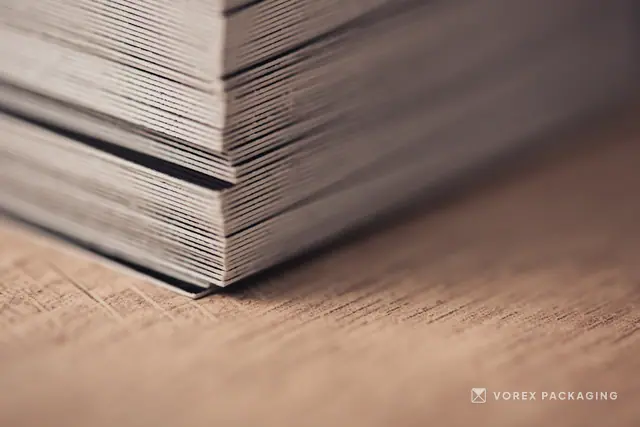
Millimetres are points x 0.0254, rounded to three places; microns are millimetres x 1,000; sheets per inch is 1,000 / points (a stack check, not a weight). Points measure thickness only: two boards of the same caliper can differ in weight (grammage, g/m²) and stiffness, so a points value is not a gsm value. Our glossary entry on caliper, points and gsm explains the difference.
Which thickness do we use for what?
- 16pt card stock: flat printed pieces such as hang tags, thank-you cards, belly bands, table tents and sleeves.
- 18pt SBS paperboard: folding cartons: tuck end boxes, two-piece boxes, sleeves and trays. SBS (solid bleached sulfate) is white all the way through, which gives clean print and bright edges.
- Kraft paperboard: the natural brown option for cartons such as kraft tuck top boxes.
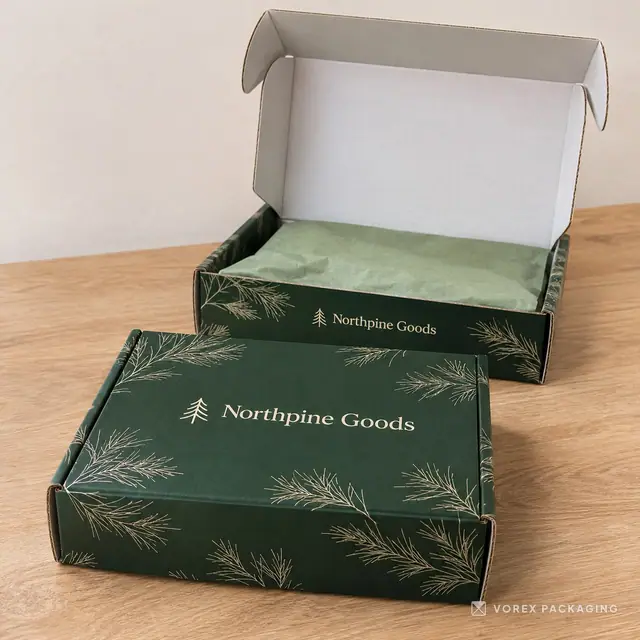
- Corrugated board: mailers and shipping boxes, chosen by flute and strength rating rather than by points; see ECT vs Mullen.
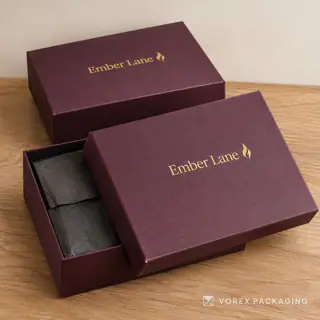
- Rigid chipboard: setup boxes wrapped in printed paper; the board thickness is confirmed on your quote.
How does board thickness change a box's outside size?
Box sizes are quoted inside, so the outside is larger by the board on each side. With 18pt board that is 0.018 in per wall: a 3 x 3 x 7 in inside tuck end box is about 3.04 x 3.04 in across the outside, before counting the extra layers where flaps fold over at the ends. For thin paperboard the difference is small; for corrugated and rigid board it matters, so ask for the outside size on your proof when it has to fit a shelf, a display or a shipper.
How do you measure board thickness?
Use a micrometer or a digital caliper on a single flat layer, not on a fold or a glued seam, and close the jaws gently so you do not squash the board. Measure in a few places and average. Printing and coatings add a little, so a finished, laminated sheet can measure slightly thicker than the plain board.
When is paperboard not enough?
Paperboard cartons are retail packaging: they hold, show and protect a product on a shelf or inside a shipper. If the box itself travels through a parcel network or carries weight, move to corrugated: printed mailer boxes for light products, shipping boxes for heavier ones. For a premium feel that keeps its shape, rigid boxes are the next step up.
How to use the chart in a dieline
- Read the caliper on the spec (for example 18 pt SBS) and find its row for the mm or micron value a supplier abroad or a dieline file may ask for.
- Use the mm value as the board thickness in a dieline: folds and tuck flaps are offset by about one board thickness, which the free dieline generator handles for you.
- For shipping strength, caliper is the wrong measure: corrugated board is rated by flute and edge crush, so use the ECT calculator and E-flute vs B-flute instead.
Download and credit
Download the chart as a spreadsheet: paperboard-thickness-chart.csv. You are welcome to use the table on your own site, in a course or in a spec sheet; please credit it as Source: Vorex Packaging, Paperboard thickness chart with a link to this page.
Box sizes in this guide
Each size has its own page with the box styles and products at that size, a dieline and a quote form with the size filled in.
Sources
Checked on 4 Nov 2026 (Lamitech) and 11 Nov 2026 (Wikipedia, NIST):
- Lamitech, What is Paperboard Point Thickness? (one point = 0.001 in = 0.0254 mm).
- Vorex Packaging product pages: boards used for each listed product (16pt card stock, 18pt SBS paperboard, kraft paperboard, E-flute corrugated).
- Paperboard, caliper in points and the 0.30 mm / 12 pt paper-board line: en.wikipedia.org/wiki/Paperboard.
- The inch is exactly 25.4 mm: NIST, nist.gov/pml/owm/si-units-length.