










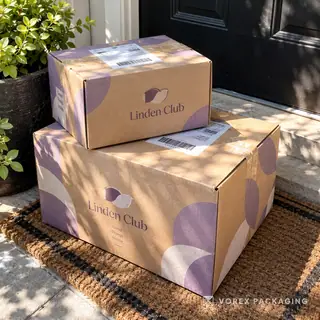









Bakery Box Sizes: How to Pick the Right Box for Cakes, Pastries and Cookies
Updated · Vorex Packaging
A bakery box fits when its inside length and width are slightly larger than the cake board or the row of bakes it holds, and its inside height clears the tallest frosting or topping. Measure the board, not the cake, and order by inside L x W x H. Our standard sizes: 8 x 8 x 5 in cake box, 8 x 4 x 4 in pastry box, 9 x 8 x 2 in donut box, 6.5 x 6.5 x 3 in four-cupcake box, 6 x 6 x 2 in cookie box and 8.25 x 2.5 x 2 in macaron box.
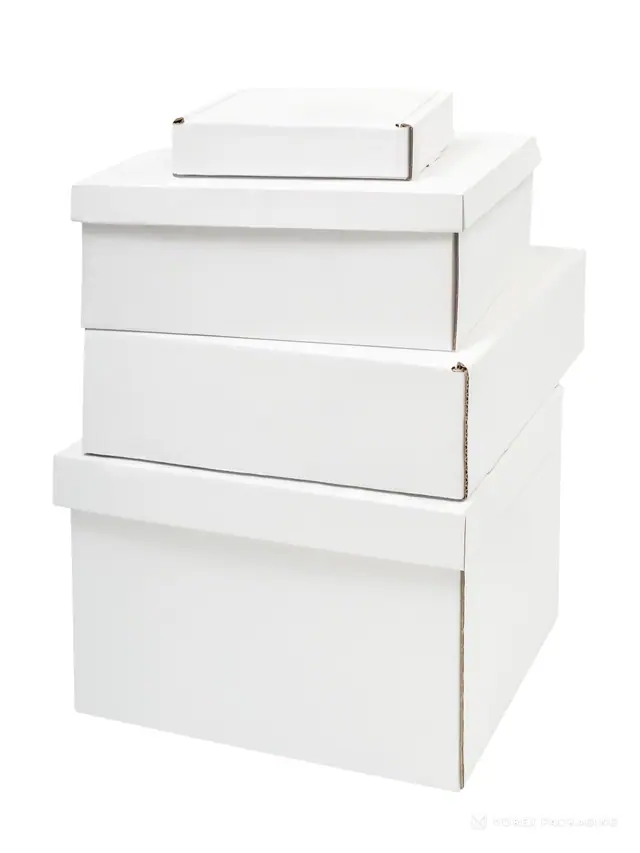
The short answer
A bakery box is the right size when its inside length and width are a little larger than the cake board, tray or row of bakes it holds, and the inside height clears the tallest point of frosting, piping or topping. Measure the product on its board, not the box you used before, and give the box size as length x width x height of the inside. For a fast start, our standard sizes are an 8 x 8 x 5 in cake box, an 8 x 4 x 4 in pastry box, a 9 x 8 x 2 in donut box, a 6.5 x 6.5 x 3 in four-cupcake box, a 6 x 6 x 2 in cookie box and an 8.25 x 2.5 x 2 in macaron box, each with a fixed-price pack page.
This guide walks through how to measure, which box style suits each bake, and how to decide between a standard size and a custom one. All bakery styles are listed on our bakery packaging page, and every listed size with its print options is on our custom printed bakery boxes page.
How to measure for a bakery box
Most sizing mistakes come from measuring the wrong thing. Use this order:
- Measure the base the product sits on. For a cake, that is the cake board or drum, which is usually wider than the cake itself. For pastries, cookies and donuts, lay out the number of pieces you sell together, in the arrangement you use at the counter, and measure the whole footprint.
- Measure the tallest point. Include piping, a cake topper base, meringue peaks, a glaze drip that stands proud or a cupcake swirl. The lid should not touch any of it.
- Add a little clearance on every side. A box that is exactly the size of the board is hard to load and scuffs the sides; a box that is far too big lets the board slide. Leave enough room for fingers or a cake lifter at the edges, and no more.
- Write the size as inside L x W x H. Box makers quote inside dimensions, so the board thickness and the lid overlap are handled for you. If you only have an old box, measure inside it, not outside.
Weigh the product too. A heavy cheesecake or a tall layer cake needs a stiffer board than a box of croissants, which changes the material more than the size (see below).
Sizes by bake: our standard bakery boxes
These are the sizes we keep as standard packs, so the price is fixed on the page and you only send artwork. Every one can also be made to your own size.
| Bake | Standard inside size | Style and board | Pack page |
|---|---|---|---|
| Single-layer cakes, cheesecakes | 8 x 8 x 5 in | Lock-corner lid box, white SBS paperboard | Cake box pack |
| Croissants, danishes, eclairs, small assortments | 8 x 4 x 4 in | Lock-corner lid box, white SBS paperboard | Pastry box pack |
| Donuts (flat, not stacked) | 9 x 8 x 2 in | Roll end tuck front, white E-flute corrugated | Donut box pack |
| Four cupcakes | 6.5 x 6.5 x 3 in | Window box with 4-cavity insert, 18pt SBS | Cupcake box |
| Cookies (stacked or a single layer) | 6 x 6 x 2 in | Tuck end carton with optional window, 18pt SBS | Cookie box |
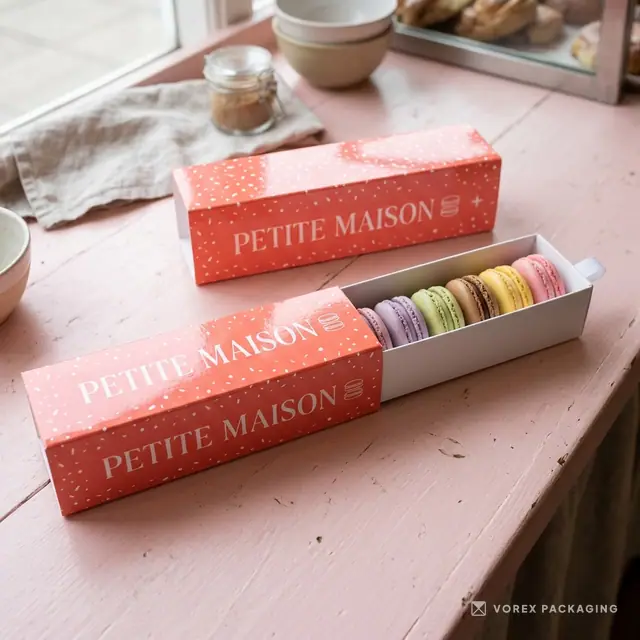
| Macarons in a row | 8.25 x 2.5 x 2 in | Sleeve-style box, white SBS paperboard | Macaron box pack |
| Mixed bakes, window lid | 8 x 8 x 5 in | Lock-corner window lid box, 18pt SBS | Bakery box |
Before you order, check your own product against the table with a ruler. An 8 x 8 in cake box holds a board up to just under that size, so a cake on a larger board needs a custom size rather than a squeeze.
Cakes: board first, then height
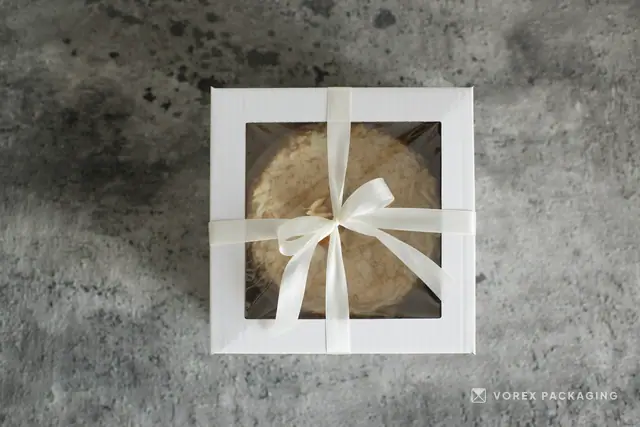
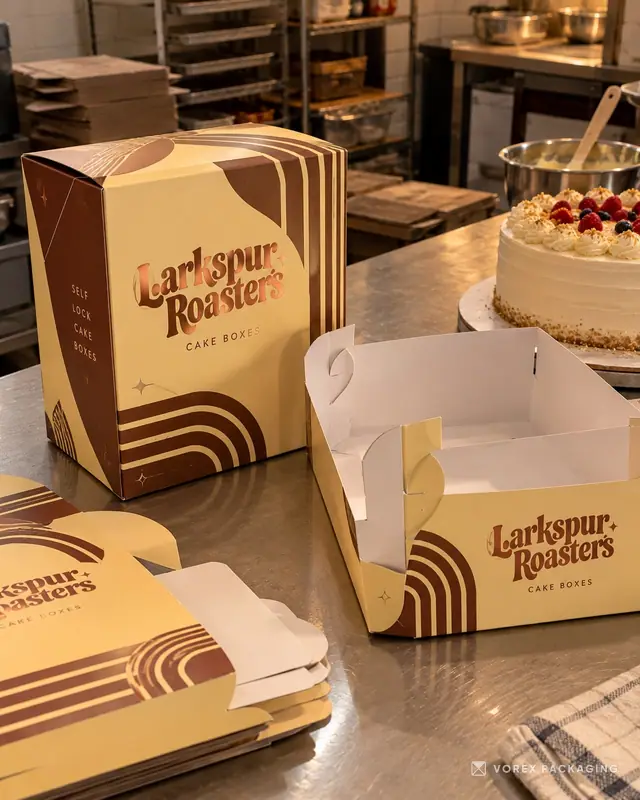
For cake boxes, the board sets the length and width and the decoration sets the height. Tall layer cakes and tiered cakes need a taller box, and heavy or tall cakes are better in corrugated board than in paperboard. Lock-corner boxes set up without glue and suit busy counters; four-corner cake boxes and self-lock cake boxes are the other common builds. A clear window on the lid lets staff and customers check the decoration without opening the box.
Pastries, donuts and pies: count and footprint
Pastries and donuts are sized by how many you sell together and how they sit. Glazed and filled bakes should not touch each other, so leave a gap between pieces or use a divider; our guide to box inserts explains how to measure for one. Donuts go in a shallow box in a single layer, which is why our standard donut box is only 2 in tall. Pastry boxes often need a grease-resistant coating for butter-rich or glazed bakes; ask for it when you order.
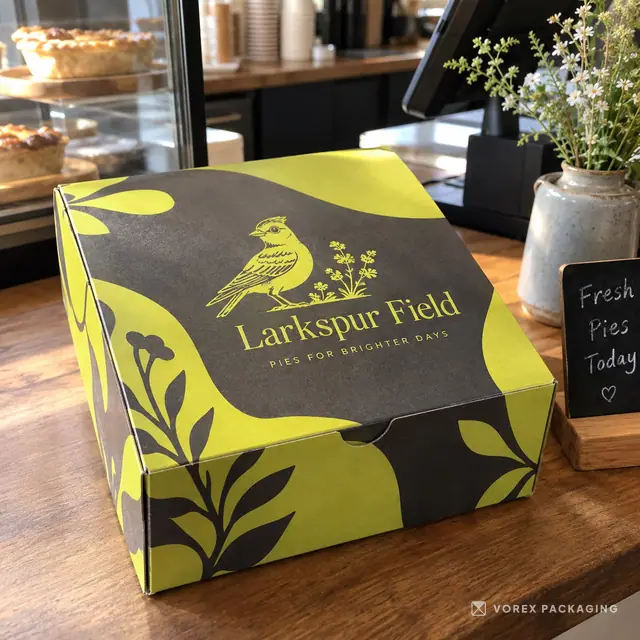
Pie boxes are shallow and square, sized to the pie tin or plate diameter with clearance above the crust or meringue. Our post on packaging pies for Thanksgiving orders covers the pickup side.
Cupcakes, cookies and macarons: inserts decide the size
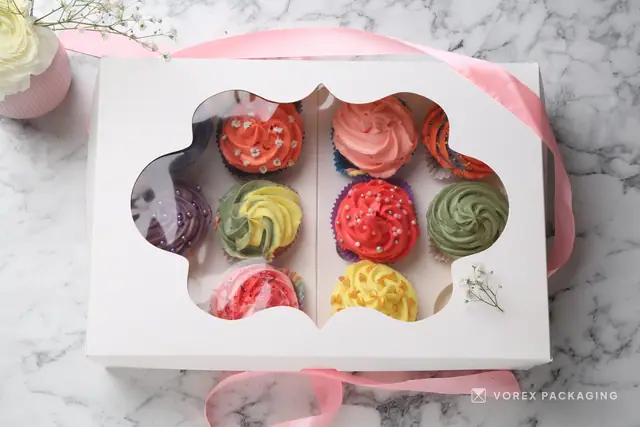
With small bakes the insert does most of the work. Cupcake boxes are sized around the liner base (so the cavity grips it) and the tallest frosting swirl (so the lid clears it); the count, from one to twenty-four, sets the footprint. Cookie boxes are sized to the cookie diameter and how many you stack; decorated cookies usually sit in one layer under a window. Macaron boxes hold the shells on their side in a channel or upright in cavities, so measure the macaron diameter and thickness, then multiply by the count. For holiday cookie gifting, see how to package Christmas cookies.
Which board for which bake
- White SBS paperboard: the bright, smooth board most bakery boxes use. Best for printing logos and colors, light to medium weights and counter sales.
- Kraft board: the brown, natural look many artisan bakeries prefer. Our kraft vs white boxes comparison covers how print looks on each.
- Corrugated (E-flute): stiffer and better for heavy cakes, stacking and delivery. See corrugated vs paperboard for when it is worth it.
Boxes that will go through delivery apps or be stacked in a car need more strength than boxes carried by hand from the counter.
Standard size or custom size?
Pick a standard size when your bake fits it with sensible clearance: the price is fixed on the pack page, you only send your logo, and one design can cover several products. Pick a custom size when your cakes sit on larger boards, your pastries are unusually long or tall, or you sell a set count that leaves a standard box half empty. Custom bakery boxes start from 1 piece. Production is fast once you approve your proof.
Send your inside size, quantity and artwork through the quote form and a specialist replies with pricing, or browse every style on the bakery boxes page.
Common sizing mistakes
- Measuring the cake, not the cake board.
- Forgetting the topper, piping or meringue when setting the height.
- Giving outside dimensions of an old box as the new inside size.
- Putting glazed bakes in a box with no divider, so they stick together.
- Using thin paperboard for a heavy cake that will be delivered.
Box sizes in this guide
Each size has its own page with the box styles and products at that size, a dieline and a quote form with the size filled in.
- 8 x 8 x 5 in boxes
- 8 x 4 x 4 in boxes
- 9 x 8 x 2 in boxes
- 6.5 x 6.5 x 3 in boxes
- 6 x 6 x 2 in boxes
- 8.25 x 2.5 x 2 in boxes