











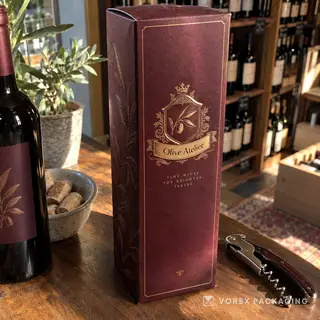


Thanksgiving Pie Boxes: Packaging for Pie Shops and Bakeries
· 36 min · The Vorex Packaging Podcast
In episode seven, the first of our Thanksgiving episodes, Maya and Jordan look at packaging for pie shops and bakeries. We cover a little history (the national holiday from 1863, the fourth Thursday as the uniform date from 1941, no pies at the 1621 harvest feast, and the custard-like pumpkin pie in American Cookery, 1796); sizing a pie box from the baked pie, crimp and topping included, using the Vorex pie box size guide; window or solid lid, kraft or white board and autumn design; a hypothetical bakery's pre-orders and pickup day; allergen labels and the FDA's nine major food allergens (sesame since January 1, 2023); two real stories, Marie Callender's (pies in the 1930s, a wholesale bakery started in 1948 by selling the family car) and Libby's 2009 canned pumpkin shortage; planning backward from the holiday; and whether one box can fit every bake. Not legal or food-safety advice: check the rules where you sell.
This episode will play here as soon as it is live on Spotify. Apple Podcasts and YouTube are coming soon too. Until then, read the show notes and the full transcript below.
In this episode
- Black Friday is November 27 and Cyber Monday November 30.
- At Thanksgiving the box goes to dinner: put your name where the whole table can see it.
- The size on a pie pan is a name, not a box size. Measure the baked pie across the crimp and at its tallest point, then add room on every side and above.
- Vorex's listed 10 x 10 x 2.5 in pie box fits most standard 9-inch pies under about 9.75 in across and 2.25 in tall; meringue, 10-inch and deep-dish pies get a box made to their measurement.
- Test one printed box with every pie on your menu before ordering the run.
- A window lets the crust sell the pie and speeds up pickup; it also adds a film, so word any recycling claim carefully.
- Your pre-order list is your packaging plan: count boxes by size, add extras, label every flavor, measure the shelf, fold early.
- The FDA lists nine major food allergens (milk, eggs, fish, crustacean shellfish, tree nuts, peanuts, wheat, soybeans, sesame). Label at boxing, not at pickup.
- Marie Callender's: a family pie business whose name traveled. Put your name on every box.
- Libby's 2009 shortage: don't run short in November. Order early, order a few extra, ask about rush.
- Not one box for everything, but one family of boxes with one design.
Chapters
- 0:00 Cold open
- 1:07 Welcome to the show
- 3:05 Why Thanksgiving is pie week
- 6:41 Sizing a pie box properly
- 10:35 Window or solid lid, kraft or white
- 14:22 Pre-orders and pickup day
- 18:30 Labels: what goes on a pie box
- 22:11 Real stories: the family car and the pumpkin shortage
- 26:48 Planning backward from November 26
- 30:16 Question: one box for every pie?
- 32:27 Get started
Sources
The story segment uses public sources only. We paraphrase and state only what each source supports.
- Thanksgiving (United States): Thanksgiving (United States) (Wikipedia, read 30 Oct 2026). Fourth Thursday of November, the uniform date country-wide since 1941; modern national celebration dates to Lincoln's 1863 proclamation; no pies at the 1621 harvest feast (no butter, wheat flour or sugar); pumpkin pie at today's dinner and pecan pie in the South.
- Pumpkin pie: Pumpkin pie (Wikipedia, read 30 Oct 2026).
- U.S. Food and Drug Administration: Food Allergies (fda.gov, read 30 Oct 2026). Nine major food allergens; FALCPA passed in 2004; FASTER Act signed April 23, 2021, sesame effective January 1, 2023; allergen named in parentheses after the ingredient or in a 'contains' statement.
- Marie Callender's: Marie Callender's (Wikipedia, read 30 Oct 2026). Pies sold in Long Beach and Orange County in the 1930s; family car sold in 1948 to set up a wholesale bakery with son Don; first official location 1964; retail outlet in Orange named after his mother; 84 locations by the end of the 1970s; 23 locations as of October 2026.
- Libby's: Libby's (Wikipedia, read 30 Oct 2026). November 2009 announcement of a likely canned pumpkin shortage (poor weather on Illinois farms, depleted back stock); Libby's accounts for the vast majority of US canned pumpkin; farms established in multiple states as a hedge; 1970s 'on the label' jingle.
- Vorex Packaging: Custom Thanksgiving Pie Boxes (size guide, options, FAQ) (vorexpackaging.com, read 30 Oct 2026). Measure the baked pie; 10 x 10 x 2.5 in listed option for standard 9-inch pies under about 9.75 x 2.25 in; window lid with clear film; kraft vs white board; flavour stickers; inside printing; single printed box; THANKSGIVING25 terms.
- Vorex Packaging: Custom Thanksgiving Bakery Boxes (vorexpackaging.com, read 30 Oct 2026).
Packaging mentioned
- Thanksgiving packaging (THANKSGIVING25 until Nov 26)
- Thanksgiving pie boxes and size guide
- Thanksgiving bakery boxes
- Pie box sizes for 9-inch and 10-inch pies (guide)
- How to package pies for Thanksgiving
- Single printed pie box
- Standard packs (fixed prices, Add to cart)
- Stickers
- Labels
- Rush orders
Get a quote Try the 3D design preview
Full transcript
0:00 Jordan: Maya, picture the Wednesday before Thanksgiving at a small pie shop.
0:04 Maya: Oh, I can picture it. There's a line out the door, the ovens have been on since before sunrise, and every surface in the back is covered in pies.
0:13 Jordan: Pumpkin, pecan, apple, sweet potato. Maybe a few with a tall meringue on top.
0:18 Maya: And somewhere in that kitchen, someone is holding a pie, looking at a box, and realizing the box is about a quarter of an inch too small.
0:26 Jordan: That's the nightmare, isn't it? The pie is perfect, and the lid squashes the crust.
0:31 Maya: Or the pie slides around in a box that's too big, and the customer opens it at the dinner table and the filling is touching the side.
0:39 Jordan: So today is a whole episode about that box. Pie boxes and bakery packaging for Thanksgiving. How to size them, how to design them, how to run pre-orders and pickup day, what goes on the label, and how to plan it all backward from the holiday.
0:54 Maya: Plus two real stories. A pie business that started by selling the family car, and the year America almost ran short of canned pumpkin. Welcome to The Vorex Packaging Podcast. I'm Maya.
1:06 Jordan: And I'm Jordan.
1:08 Maya: Welcome back, and welcome if this is your first episode. This show is for people who make and sell things. Bakers, candle makers, skincare brands, coffee roasters, online shops, and anyone who puts a product in a box.
1:22 Jordan: Quick recap of where we've been. Episode one was about what your box says before anyone opens it. Episode two was board, print and finish. Episode three was dielines, proofs and holiday timelines. Episode four was holiday packaging for bakeries, cafes and online shops. Episode five was shipping boxes. And episode six was green claims, what you can honestly print on your box.
1:47 Maya: And from today until Thanksgiving, every episode has a Thanksgiving theme. Today, we're starting with the people who carry the heaviest load that week, pie shops and bakeries.
1:58 Jordan: If you listened to episode four, you'll remember we talked about holiday packaging for bakeries in general. Today we're going much deeper on one thing. The pie, and everything around the pie.
2:09 Maya: Our house rules, same as always. When we mention a real company, a real date or a real number, it comes from a public source that we read while preparing this episode, and the links are in the show notes. When we use an example that isn't real, we'll tell you it's a hypothetical.
2:26 Jordan: And one more note before we start. We'll talk a little about food labels today, especially allergens. We're not lawyers and we're not food safety inspectors. We'll tell you what the public guidance says, and we'll link it, but your local health department and your own regulator have the final word.
2:43 Maya: Here's the plan. First, why Thanksgiving is pie week, with a little history. Then sizing a pie box properly. Then design choices, window or solid lid, kraft or white. Then pre-orders and pickup day. Then labels. Then our two stories. Then planning backward from the holiday, a question we hear a lot, and how to get started.
3:04 Jordan: Let's get into it. Let's start with the dates, because everything in this episode hangs on them.
3:13 Maya: In the United States, Thanksgiving is on the fourth Thursday of November. This year, twenty twenty-six, that's Thursday, November twenty-sixth.
3:22 Jordan:
3:23 Maya: It's already behind us.
3:31 Jordan: Which matters if you sell on both sides of the border. American customers are just getting started.
3:40 Maya: Exactly. And right after the American holiday comes Black Friday on November twenty-seventh, and Cyber Monday on November thirtieth. So for a lot of bakeries, that last week of November is the busiest of the whole year.
3:54 Jordan: Okay, a bit of history, because I looked this up and found it genuinely interesting. When did Thanksgiving become a national holiday in the United States?
4:03 Maya: According to the Wikipedia article on Thanksgiving in the United States, the modern national celebration dates to eighteen sixty-three, when Abraham Lincoln proclaimed a national day of Thanksgiving. And the fourth Thursday of November became the uniform date across the country in nineteen forty-one.
4:21 Jordan: So the date we plan around today is less than a century old in its current form.
4:25 Maya: Right. And here's the part I love. The same article says that at the harvest feast in sixteen twenty-one, the one most people picture, there were no pies.
4:35 Jordan: No pies at the first Thanksgiving?
4:37 Maya: No pies, because the colonists had no butter, no wheat flour and no sugar. So pie came later.
4:44 Jordan: Then when does pumpkin pie as we know it show up?
4:46 Maya: The Wikipedia article on pumpkin pie points to a cookbook called American Cookery, published in seventeen ninety-six. It has an early version of the more modern, custard-like pumpkin pie, a sweet custard filling in a pie crust, with spices similar to the ones used today.
5:04 Jordan: Custard. That's a word bakers should hold on to.
5:07 Maya: It really is, and we'll come back to it. Today, the same article says, the filling is usually cooked and puréed pumpkin mixed with eggs, evaporated milk, sugar and spices.
5:25 Jordan: And today?
5:26 Maya: Today, throughout much of the United States, it's traditional to serve pumpkin pie after Thanksgiving dinner. And the Thanksgiving article adds that the dinner has grown to include regional specialties, like pecan pie in the South.
5:41 Jordan: So, pumpkin everywhere, pecan in the South, and in our experience apple and sweet potato on a lot of menus too.
5:48 Maya: And that's why so many bakeries call it pie week. One holiday, one dessert at the center of the table, and a huge share of customers who want to buy that dessert instead of baking it.
5:58 Jordan: Here's what I find interesting from a packaging point of view. Most of the year, a bakery box is something a customer throws away on the way home.
6:07 Maya: But at Thanksgiving, the box goes to dinner.
6:09 Jordan: It does. It sits on a counter in somebody's kitchen while twelve relatives walk past it. It gets photographed. Sometimes the pie gets served right out of it.
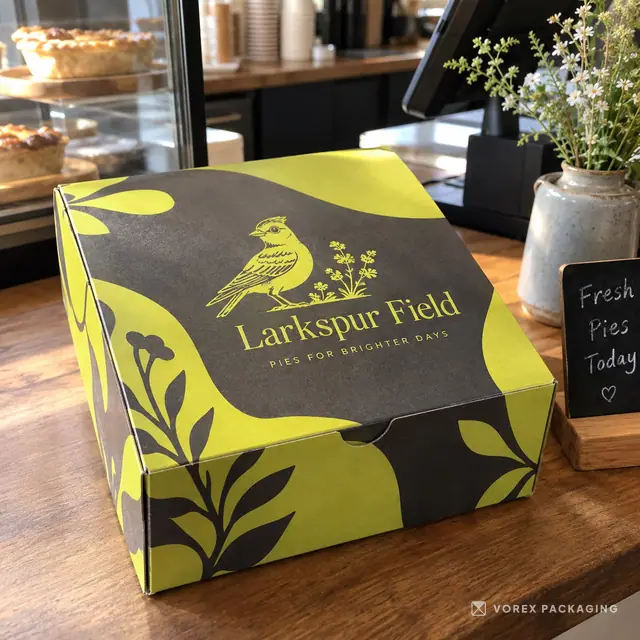
6:18 Maya: Which means the box is doing marketing at the one meal of the year where the most people are in the same room. A plain white box says nothing. A box with your name, a warm autumn design and a flavor label says, this came from somewhere special, and here's where.
6:34 Jordan: And somebody at that table is going to ask, where did you get this pie?
6:38 Maya: And you want the answer printed right there on the lid.
6:45 Jordan: Let's get practical. The box that's a quarter of an inch too small. How do you avoid it?
6:50 Maya: You start by accepting one slightly annoying fact. The size on a pie pan is a name, not a box size.
6:57 Jordan: Explain that.
6:58 Maya: When you say a nine-inch pie, you're usually talking about the pan. But the baked pie isn't nine inches. The crimped edge sits on the rim, and sometimes hangs over it. The crust puffs up in the oven. A lattice top or a crumb topping adds height. So the actual pie can be noticeably wider and taller than the name on the pan.
7:18 Jordan: So you measure the pie, not the pan.
7:20 Maya: Exactly. The Vorex size guide for pie boxes says it simply. Measure the baked pie across its widest point, with the crimp included. Then measure from the bottom of the tin to the tallest point of the pie. Then add a little room on every side and a little room above.
7:36 Jordan: Why room above? Isn't snug better?
7:39 Maya: Snug across, yes. You don't want the pie sliding. But above, you need clearance, because if the lid touches the top of the pie, it marks the surface. And if it's a meringue or whipped topping, the lid will ruin it.
7:51 Jordan: So what does that look like in real numbers?
7:53 Maya: The Vorex Thanksgiving pie box page has a size guide. Their listed option is a box that's ten by ten inches across and two and a half inches tall on the inside. And the guide says most standard nine-inch pies that measure under about nine and three quarter inches across, and under about two and a quarter inches tall, fit that box.
8:14 Jordan: So a classic pumpkin pie in a nine-inch tin.
8:17 Maya: Usually, yes, as long as it measures under those numbers. But measure your own pie. Your crimp, your recipe.
8:23 Jordan: And what if it doesn't fit?
8:25 Maya: Then the box gets made to your measurement. The guide gives a few cases. A nine-inch pie with a meringue or a tall topping keeps the ten by ten base, but gets a taller height made to your measured height. A ten-inch pie, which is often ten inches or more across the crimp, needs one size up from ten by ten, made to your measured width and height. A deep-dish pie is your width plus room, by your height plus headroom. And slices and hand pies go in a small bakery box made to size.
8:55 Jordan: So you might end up with two or three box sizes for one menu.
8:59 Maya: You might, and that's normal. A lot of pie shops end up with one box for their standard pies and one taller box for anything with meringue.
9:07 Jordan: Is there a way to check all this before you order hundreds of boxes?
9:11 Maya: There is, and it's my favorite tip of the whole episode. Before you order the run, test one box with each pie on your menu.
9:18 Jordan: One actual printed box?
9:20 Maya: One actual box. Vorex lists a single printed pie box on the site for exactly this reason. So you can bake every pie on your menu, put each one in the box, close the lid, and see what happens.
9:38 Jordan: I'd also pick it up and carry it around the room.
9:41 Maya: Yes! Carry it like a customer would. One hand under the bottom, maybe tilted a little because they're holding a coffee in the other hand. Does the pie shift? Does the bottom bow? Does the lid stay shut?
9:53 Jordan: And put it on a car seat.
9:54 Maya: Honestly, yes. Thanksgiving pies travel. Across town, to a relative's house, sometimes a long drive. A box that holds up in your shop might not hold up on a passenger seat over a few bumps.
10:06 Jordan: What about the board itself? How thick should it be?
10:09 Maya: The Vorex pack is listed in eighteen point card, which is a paperboard thickness. For a single whole pie carried by hand, a paperboard box is the usual choice. If you're shipping pies, or stacking a lot of them, that's when you'd ask about corrugated, which we covered back in episode five.
10:27 Jordan: So the honest summary is, measure the pie, add room, test one box, and don't guess.
10:32 Maya: Measure, room, test. That's the whole chapter.
10:39 Jordan: Let's talk about the look. First big decision, window or no window?
10:43 Maya: I think for pies, a window is often worth it. The Vorex page describes it as a die-cut window in the lid, backed with a clear film panel. It shows the crust and the filling.
10:54 Jordan: And why does that matter so much for pies specifically?
10:57 Maya: Two reasons. One, the pie is beautiful, and the crust is the best advertisement you have. A glossy pumpkin custard, a pecan top, a lattice on an apple pie. Let people see it.
11:09 Jordan: And two?
11:10 Maya: Two, it's practical. At a busy pickup counter, a window helps staff and customers spot the right flavor without opening the box. Pumpkin and sweet potato look a lot alike from a distance, but through a window, with a label, there's no confusion.
11:25 Jordan: Any reason not to have a window?
11:27 Maya: A few. If the pie has a very delicate top, a solid lid with more headroom might protect it better. If you want a really clean, printed lid with your logo in the middle, a window takes up some of that space. And if you've been listening to episode six, you'll remember that a film window is a second material on a paper box.
11:46 Jordan: Right, the recycling question.
11:48 Maya: Exactly. A window doesn't make a box bad. It just means you shouldn't print a plain recyclable claim on it without thinking about the film. You could add a simple instruction, like, remove the window before recycling the box, if that's true for your box.
12:03 Jordan: Second decision. Kraft or white?
12:05 Maya: The Vorex pie box page puts it nicely. Kraft board gives a rustic farmhouse look that suits autumn baking, while white board makes cranberry reds and pumpkin oranges print brighter.
12:16 Jordan: So it depends on the feeling you want.
12:18 Maya: It depends on the feeling, and on your colors. If your brand is earthy and handmade, a farm stand, a country bakery, kraft is lovely. If your brand is bright and modern, or you want a full autumn pattern with lots of color, white board will make those colors pop.
12:34 Jordan: What about the colors themselves? Thanksgiving has a pretty clear palette.
12:38 Maya: It does. The page suggests burnt orange, deep cranberry, wheat gold and cream. Hand-drawn leaves, a simple pie illustration, or your logo in a wreath of harvest motifs.
12:50 Jordan: I'd add one thing. Don't let the autumn design swallow your name.
12:53 Maya: Such a good point. We said in episode one that a box is a promise, and one clear idea beats ten. At Thanksgiving, the idea is your name. The leaves are the frame. The bakery name is the picture.
13:06 Jordan: Is there anything people forget to design?
13:08 Maya: The inside of the lid. Vorex can print inside the box, and for pies it's a lovely spot. The page suggests a thank-you note, a reheating suggestion, or your social handle, so it's seen the moment the box opens.
13:22 Jordan: A reheating suggestion is clever. Although I'd be careful there.
13:26 Maya: Careful how?
13:27 Jordan: Well, if you're printing instructions, they need to be right for every pie that goes in that box. A pumpkin pie and an apple pie don't get treated the same way.
13:36 Maya: That's true. So if you print care instructions on a box that holds several flavors, keep them general, or put the specific instructions on the flavor label instead. Which brings us neatly to stickers and labels.
13:49 Jordan: One design, many flavors.
13:50 Maya: Exactly. Pair one printed box with flavor labels, and a single design covers pumpkin, pecan, apple and sweet potato, without a separate box run for each flavor. That's the Vorex suggestion, and it's how a lot of pie shops keep things simple.
14:06 Jordan: And it saves money, because you're ordering one bigger run of one design instead of four small runs.
14:13 Maya: In general, yes, a bigger run of one design tends to be the more efficient choice. Your quote will tell you the actual numbers for your order.
14:25 Jordan: Let's talk about the busiest part. Pre-orders and pickup day. I want to do this one as a hypothetical, so we can walk through it step by step.
14:34 Maya: Good idea. So, to be clear, this is a made-up example. Not a real bakery.
14:39 Jordan: A hypothetical bakery. Let's call it Copper Pan Pies. Small shop, two ovens, sells four flavors at Thanksgiving. Pumpkin, pecan, apple and a chocolate cream pie.
14:49 Maya: Great. And they take pre-orders.
14:51 Jordan: They take pre-orders, and on the day before Thanksgiving, a few hundred people come to pick them up. Where does packaging come in?
14:59 Maya: Way earlier than pickup day. It comes in when you open pre-orders. Because the moment you know how many pies you'll sell, you know how many boxes you need.
15:07 Jordan: So the pre-order form is also a packaging forecast.
15:11 Maya: Exactly. If Copper Pan Pies opens pre-orders and sees two hundred pumpkin, eighty pecan, sixty apple and forty chocolate cream, now they know they need about three hundred and eighty pie boxes, plus extras.
15:25 Jordan: How many extras?
15:26 Maya: Enough for mistakes, walk-ins and a dropped box or two. And remember, in this hypothetical, the chocolate cream pie is taller, so it might need the taller box. So that's actually two counts. Standard boxes for the first three flavors, and a taller box for the cream pie.
15:43 Jordan: Okay, pickup day. Walk me through it.
15:45 Maya: Picture the counter. A line of people, all saying their name, all wanting a different combination. Two pumpkin and an apple. One pecan. Three chocolate cream. If the staff have to open every box to check, the line stops.
15:59 Jordan: So the labels do the work.
16:01 Maya: The labels do the work. A flavor sticker on every lid, so anyone can see what's inside. And then a name or order number on each order, so the pies for one customer stay together.
16:12 Jordan: Do you print the flavor stickers in advance?
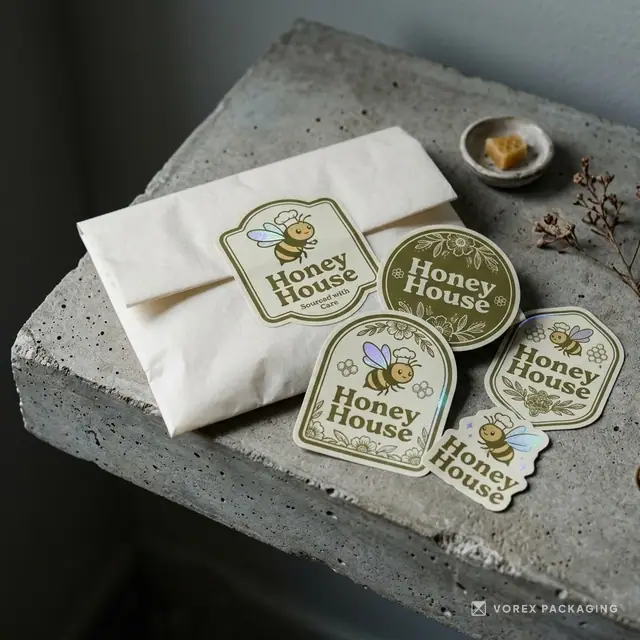
16:15 Maya: Yes. Flavor stickers can be printed in advance, because you know your menu. Vorex makes custom stickers and labels that match your boxes. The order names are usually handwritten or printed on the day, because they change.
16:28 Jordan: I've seen bakeries use a different color sticker for each flavor.
16:32 Maya: That's a great system. Orange for pumpkin, brown for pecan, red for apple. From the back of the shop, you can see at a glance which shelf is which. And it helps the customer at home too, if they've bought two pies.
16:44 Jordan: What about the way the pies are stored before pickup?
16:47 Maya: Here's where box design matters again. Pie boxes are low and square, so they stack well, but only if the board is strong enough and the pies are firm enough. A custard pie like pumpkin, which we talked about, needs to be handled carefully. And your local food safety rules decide how pies like that need to be stored. We're not going to give you times or temperatures, because that's your health department's job, not ours.
17:12 Jordan: Fair. But from a packaging point of view?
17:15 Maya: From a packaging point of view, think about where the pies will wait. If they're waiting in a refrigerator, does your box fit the shelves? Does a stack of boxes fit the space? Measure the shelf before you finalize the box. It sounds silly, but a box that's half an inch too wide for the shelf is a real problem on the busiest day of the year.
17:35 Jordan: And one more practical one. When do you fold the boxes?
17:38 Maya: Before pickup day. Boxes usually arrive flat, which is great, because a stack of flat boxes takes very little room behind the counter. But on the day itself, nobody has time to fold three hundred and eighty boxes.
17:51 Jordan: So you fold them the day before, or in the quiet moments of the week.
17:55 Maya: Yes, and that's another reason to test one box early. You want to know how long it takes to fold one, whether it needs tape, and whether the lid tucks in securely. If it takes a full minute per box, that's over six hours of folding for our hypothetical bakery.
18:11 Jordan: Six hours. That's a whole shift.
18:12 Maya: Exactly. A box that folds in a few seconds is worth a lot that week.
18:17 Jordan: So the lesson from Copper Pan Pies, our hypothetical friends?
18:21 Maya: Your pre-order list is your packaging plan. Count the boxes by size, add extras, label every flavor, measure the shelf, and fold early.
18:34 Jordan: Let's talk about labels more seriously, because a pie isn't a candle. It's food.
18:39 Maya: Right. And this is the chapter where our little legal note matters most. We'll tell you what the official public guidance says, and you should check the rules where you sell.
18:48 Jordan: So what goes on a pie label?
18:50 Maya: At a basic level, think about what a customer needs to know when the pie is on their table and you're not there. What it is. Who made it. And what's in it, especially anything that someone at that table might be allergic to.
19:02 Jordan: Thanksgiving is the meal with the most guests. Some of them are going to have allergies.
19:07 Maya: That's exactly why this matters more at Thanksgiving than at any other time. The person who bought the pie might know what's in it. But the cousin at the end of the table doesn't.
19:17 Jordan: So what does the guidance say about allergens in the United States?
19:21 Maya: The U.S. Food and Drug Administration has a page on food allergies. It lists nine major food allergens. Milk, eggs, fish, crustacean shellfish, tree nuts, peanuts, wheat, soybeans, and sesame.
19:34 Jordan: Sesame is the newest one, right?
19:36 Maya: It is. According to the F D A, the FASTER Act was signed into law on April twenty-third, twenty twenty-one, and that made sesame the ninth major allergen. The requirement became effective on January first, twenty twenty-three.
19:51 Jordan: And the original law?
19:53 Maya: The Food Allergen Labeling and Consumer Protection Act was passed in two thousand four. People call it FALCPA.
19:59 Jordan: Now think about a pie menu for a second. Pumpkin pie has eggs and milk. The crust has wheat. Pecan pie has pecans, which are tree nuts.
20:08 Maya: And butter is milk. And some crusts or toppings use other things. So a typical Thanksgiving pie menu touches several of those nine allergens.
20:17 Jordan: How does the F D A say allergens should show up on a label?
20:21 Maya: The page describes two ways. One, in parentheses after the name of the ingredient, for example, lecithin, and then soy in parentheses. Or two, in a contains statement right after or next to the list of ingredients. Their example is, contains wheat, milk and soy.
20:38 Jordan: A contains line is easy to read on a busy table.
20:41 Maya: It is. Now, which rules apply to your pies depends a lot on how and where you sell them, a retail bakery, a farmers market, a home kitchen under your state's rules. So check your local requirements.
21:00 Jordan: Where does packaging come in, though? This sounds like a recipe problem.
21:04 Maya: Packaging comes in with space. If your label needs a product name, your bakery name, an ingredient list and a contains line, it needs room. And a sticker on the lid of a pie box competes with the window, the logo and the autumn design.
21:19 Jordan: So you design the box with a home for the label.
21:21 Maya: Exactly. Leave a clean, flat space on the lid or the side where a label can go, and design your autumn pattern around it. Don't put a sticker over a busy leaf pattern where nobody can read it.
21:33 Jordan: Side panel or lid?
21:35 Maya: The flavor sticker usually goes on the lid, so it's visible when pies are stacked. The ingredient and allergen label can go on the side or the lid, as long as it's easy to find and easy to read.
21:47 Jordan: And one rule I'd add. Never put an allergen label on the box and the wrong pie inside.
21:53 Maya: Which is why your pickup system matters. Flavor sticker and ingredient label applied at the same moment, by the same person, when the pie goes into the box. Not later, at the counter, in a rush.
22:05 Jordan: Label at boxing, not at pickup.
22:07 Maya: Label at boxing, not at pickup. I'm writing that one down.
22:15 Jordan: Okay. Story time. And today we have two.
22:17 Maya: Our first story is about a name that a lot of American listeners will recognize from the frozen food aisle and from restaurants on the West Coast. Marie Callender's.
22:27 Jordan: I know the name. I didn't know the story.
22:29 Maya: Here's what the Wikipedia article on Marie Callender's says. In the nineteen thirties, Marie Callender and her husband, Cal Warren Callender, began selling pies in the city of Long Beach and in Orange County, in California.
22:43 Jordan: So it started with pies, specifically.
22:45 Maya: Specifically pies. Then, in nineteen forty-eight, they sold their family car and used the money to set up a wholesale bakery with their son, Don.
22:54 Jordan: They sold the car. That's commitment.
22:56 Maya: It really is. And wholesale is important here. In the beginning, they were baking pies for other businesses to sell. The article says the first official location opened in nineteen sixty-four, and that Don opened a retail outlet in Orange, California, and named it after his mother.
23:14 Jordan: Named after his mother. So the pie had a person's name on it.
23:18 Maya: And then it grew. The article says that by the end of the nineteen seventies there were eighty-four locations. Later the chain went through a lot of ownership changes, and as of October twenty twenty-six, the article says the company operates twenty-three locations, in California, Idaho, Nevada and Utah.
23:37 Jordan: What's the packaging lesson here? They didn't exactly start with fancy boxes.
23:41 Maya: I think the lesson is about the name. A pie business that starts out baking for other people, wholesale, is often invisible. The restaurant or the shop gets the credit. When the family put a name on the shop, the name became the brand, and later the name traveled far beyond the bakery.
23:59 Jordan: So for a small pie shop today?
24:00 Maya: Your name should be on every box that leaves the shop. Especially at Thanksgiving, when the box sits on a table in front of a room full of potential customers. If you do wholesale, supplying cafes or restaurants with pies, it's worth thinking about whether your name can be on the box there too, with the partner's agreement.
24:19 Jordan: And a name that's a person or a place is memorable.
24:22 Maya: It can be. Copper Pan Pies is fine. But a name that tells a story is even better. And whatever your name is, make it the clearest thing on the lid.
24:31 Jordan: Second story. The year America almost ran out of canned pumpkin.
24:35 Maya: This one is from the Wikipedia article on Libby's. Libby's is the brand behind a lot of the canned pumpkin in American kitchens. The pumpkin pie article says Libby's canned pumpkin is the most popular brand, and that it uses one pumpkin variety, the Dickinson pumpkin.
24:52 Jordan: One variety. Okay. So what happened?
24:54 Maya: In November two thousand nine, Libby's announced that because of poor weather on its Illinois pumpkin farms and a depleted back stock, a canned pumpkin shortage was likely as Thanksgiving approached.
25:07 Jordan: A pumpkin shortage, right before Thanksgiving. That's about the worst timing possible.
25:12 Maya: It is. And the article says Libby's accounts for the vast majority of canned pumpkin production in the United States. So when Libby's was short, a lot of kitchens were short.
25:22 Jordan: What did they do about it?
25:23 Maya: The article says the shortfall prompted Libby's to establish farms in multiple states, as a hedge against another mass shortage like the one in two thousand nine.
25:33 Jordan: So they spread the risk. Not all the pumpkins in one place.
25:37 Maya: Exactly.
25:38 Jordan: And the lesson for a bakery?
25:40 Maya: I think there are two. The first one is about ingredients and supplies in general. The week of Thanksgiving is the worst possible time to discover you're short of anything. Pumpkin, butter, boxes, labels. So you plan the whole season ahead, and you keep a little extra of the things that would stop you completely.
25:58 Jordan: And the boxes are one of those things.
26:00 Maya: They really are. You can't sell a pie without a box. Well, you can, but you really don't want to. So order your boxes early, order a few more than your pre-orders say, and if you're cutting it close, ask about rush.
26:12 Jordan: And the second lesson?
26:14 Maya: The second one is a fun one. The Libby's article also mentions a television jingle from the nineteen seventies. When it says Libby's, Libby's, Libby's, on the label, label, label, you will like it, like it, like it, on your table, table, table.
26:29 Jordan: On the label, on your table. That's literally this whole episode.
26:32 Maya: It is! The label is how your product gets from the shelf to the table, and the name on it is what people remember. Fifty years later, people still know that jingle.
26:42 Jordan: Okay, I'm going to have that stuck in my head for the rest of the episode.
26:46 Maya: Sorry. Not sorry.
26:52 Jordan: Let's talk timing. Today is October thirtieth, and American Thanksgiving is November twenty-sixth. If someone listening hasn't ordered boxes yet, what should they do?
27:02 Maya: Work backward from the holiday. In episode three, we called this a reverse timeline. You start with the day the boxes need to be in your shop, and you walk back through every step.
27:12 Jordan: And the day they need to be in your shop isn't Thanksgiving.
27:16 Maya: Not even close. It's the day you start boxing pies, and ideally a little before that, so you have time to fold boxes, check them and sort labels. If your pre-orders start going out the door on Monday or Tuesday of Thanksgiving week, the boxes need to be there before that.
27:32 Jordan: Then what comes before that?
27:34 Maya: Production and shipping. Vorex says production is fast once you approve your proof, and then your order ships. Your quote confirms the lead time for your order before you approve anything. We're not going to give you a number of days on this show, because it depends on the order, so ask when you request your quote.
27:51 Jordan: And before production?
27:53 Maya: The proof. Vorex sends a digital proof on your dieline, and nothing prints until you approve it.
28:03 Jordan: So the sample is worth it, even in a rush?
28:05 Maya: For pie boxes, I'd say especially worth it, because of everything we talked about in chapter two. A sample tells you if your pie fits. A proof on a screen doesn't.
28:15 Jordan: And before the proof?
28:17 Maya: Your artwork and your measurements. And this is where people lose time. They wait for the perfect design, they don't have their pie measured, and they don't know their quantities. So the first step, honestly, is today. Measure your pies. Count last year's sales, or this year's pre-orders. Decide on your sizes.
28:35 Jordan: What if someone's listening to this the week before Thanksgiving?
28:38 Maya: Then ask about rush orders when you request your quote. Rush is available on request. And be honest with yourself about what's realistic. Nobody can promise a delivery date on a podcast, so ask, and the quote will tell you what's possible for your order.
28:54 Jordan: And if it's too tight?
28:55 Maya: Then use what you have for this Thanksgiving, maybe a plain box with a printed sticker, and start planning your custom boxes for Christmas and next year. Not every plan has to happen this month.
29:06 Jordan: Speaking of which, does a Thanksgiving box have to be thrown away on November twenty-seventh?
29:11 Maya: That's a great question. A lot of bakeries make their pie box less about Thanksgiving and more about fall, or even the whole holiday season. A harvest design with leaves and wheat works from October right through to the end of November.
29:26 Jordan: And if you skip the word Thanksgiving on the box?
29:28 Maya: Then the same box can carry pies into December. Some bakeries print one evergreen design and use seasonal stickers to change the message. Happy Thanksgiving on a sticker in November, a winter sticker in December.
29:41 Jordan: One box run, two holidays.
29:43 Maya: Exactly.
30:00 Jordan: Quick summary of this chapter, Maya?
30:02 Maya: Measure and count today. Get your quote. Approve your proof, and test the sample. Order a few more than you think. And if the date is tight, ask about rush, rather than hoping.
30:12 Jordan: Order early, ask about rush.
30:14 Maya: Order early, ask about rush.
30:20 Jordan: Time for our question. And as always, honesty first. We still don't have a listener question we can read on air, so we picked one we hear a lot.
30:29 Maya: And if you'd like your question on the show, email hello@vorexpackaging.com and tell us it's okay to read it on air.
30:36 Jordan: The question. I sell pies, but also rolls, cookies and slices at Thanksgiving. Can I just use one box for everything? It would be so much simpler.
30:46 Maya: I love this question, because the instinct is right. Fewer box sizes really is simpler. Fewer things to order, fewer things to store, fewer things to get wrong on the busiest day.
30:57 Jordan: But?
30:58 Maya: But one box for everything usually means a box that fits nothing well. A whole pie needs a low, square box, close fitting across. Dinner rolls need a deeper box. Cookies want a flat box, maybe with an insert. And a single slice in a whole-pie box slides around and gets damaged.
31:16 Jordan: So where's the middle ground?
31:18 Maya: I'd think about it in families. One pie box for your standard pies. Maybe a taller version of the same box for meringue or cream pies. And one bakery box, a deeper box, for rolls, pastries and assortments. Then the same autumn design on all of them.
31:34 Jordan: So the look is consistent even if the sizes aren't.
31:37 Maya: Exactly. Vorex makes Thanksgiving bakery boxes alongside the pie boxes, for dinner rolls, pastries and cookie trays. The bakery box page talks about lock-corner boxes with a window for pastries, deeper boxes with dividers for dinner rolls, and flat boxes with inserts for cookie assortments.
31:56 Jordan: And slices?
31:58 Maya: Slices and hand pies in a small bakery box made to size. Which, by the way, is also lovely as an add-on at the counter. Someone picking up a whole pie might add two slices for the drive home.
32:10 Jordan: Okay, I like that. So the answer is, not one box, but one family.
32:14 Maya: One family, one design, as few sizes as you need and no fewer. And then you use stickers and labels to say what's inside.
32:23 Jordan: As few as you need and no fewer. Very wise.
32:26 Maya: I have my moments.
32:31 Jordan: That's our episode on pie boxes and bakery packaging for Thanksgiving. Maya, how do people take the next step?
32:38 Maya: Start with the Thanksgiving packaging page on the Vorex website. It has pie boxes, bakery boxes, gift boxes and favor boxes. And there's a Thanksgiving offer right now. The code THANKSGIVING25 takes twenty-five percent off Thanksgiving packaging orders, until November twenty-sixth.
32:57 Jordan: Any fine print?
32:59 Maya: Yes. It's for Thanksgiving packaging orders only, it's applied to the quoted price, and it isn't combined with other offers. All of that is on the page.
33:07 Jordan: And where do you request the quote?
33:09 Maya: At vorexpackaging.com/quote. Tell them the style, the inside size of the box, which is where your pie measurements come in, the quantity, and whether you want a window. Put THANKSGIVING25 in the promo code field.
33:24 Jordan: And if you're not sure about the size?
33:25 Maya: Leave it blank and tell them what pies you sell, and how you measured them. A packaging expert can suggest a size. And remember, you'll see a digital proof before anything prints.
33:36 Jordan: What about people who just want a standard pie box right now?
33:40 Maya: There are standard packs on the website with an Add to cart button, including the ten by ten by two and a half inch Thanksgiving pie box, in packs and as a single printed box. You can check out with pay later. No card is needed at checkout, and you're invoiced after you approve your proof.
33:57 Jordan: And the price?
33:58 Maya: The current prices are on the packs page at vorexpackaging.com/packs. Prices can change, so the website and your quote always have the final word.
34:09 Maya: Yes. You approve it and confirm the order, and then the full batch is printed.
34:21 Jordan: You can also try the 3D design preview on the home page. Upload your logo, pick a box shape and color, and turn it around in your browser before you decide anything. And the full catalogue of styles is on the website too.
34:35 Maya: A few Vorex facts in one place. There is no minimum order quantity: order 1 piece or 10,000. Production is fast once you approve your proof, and then your order ships. Rush orders are available on request. [Correction, 2 Nov 2026: shipping is free on every order.] And there's a reprint for production errors reported within sixty days of delivery.
34:58 Jordan: If you're new and your order isn't Thanksgiving packaging, the code FIRST20 takes twenty percent off your first custom order. It's for new customers, one per business, and it isn't combined with other offers or used on the packs.
35:12 Maya: And Vorex makes stickers and labels too, so your flavor stickers can match your boxes.
35:17 Jordan: A word on how Vorex works. Vorex Packaging is a packaging studio. They help with style, sizing and design, and they print and ship to customers across the United States.
35:29 Maya: Everything we mentioned today, the Thanksgiving history, the pumpkin pie history, the F D A's allergen page, the Marie Callender's story, the Libby's story, and the Vorex pie box size guide, is linked in the show notes.
35:43 Jordan: Next episode, we stay with Thanksgiving, and talk about client and employee gifting. What to put in a Thanksgiving gift box, and how to brand it.
35:52 Maya: If this episode helped, follow the show, and send it to a baker who's about to fold three hundred boxes on Thanksgiving Eve.
35:59 Jordan: Measure the pie, label at boxing, and order early.
36:02 Maya: Measure the pie, label at boxing, and order early. Thanks for listening to The Vorex Packaging Podcast. I'm Maya.
36:10 Jordan: And I'm Jordan. Happy Thanksgiving, and see you next time.
Voices produced with AI text-to-speech.