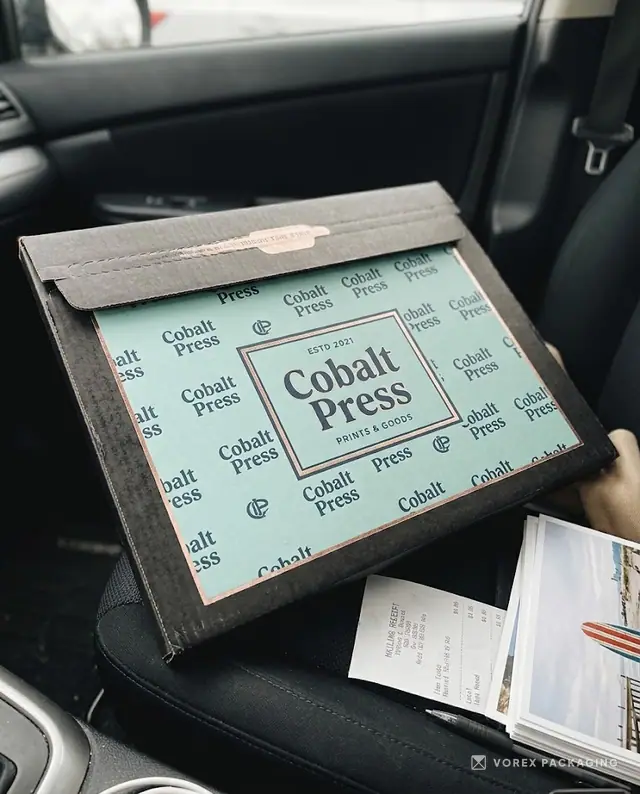
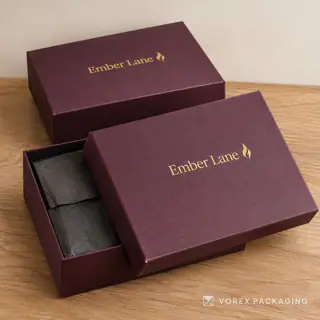









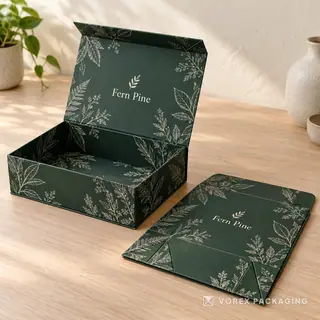

















How Much Do Custom Rigid Boxes Cost? 50 vs 100 vs 200 Pieces Explained
Updated · Vorex Packaging
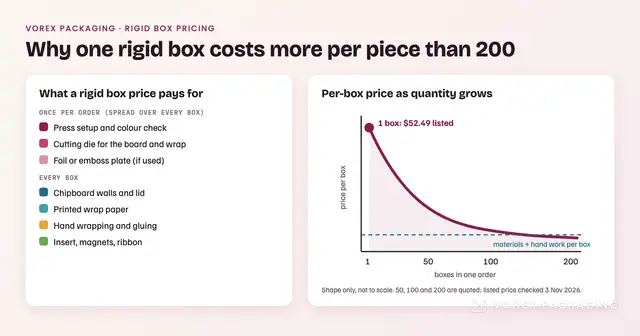
On our site one printed 9 x 7 x 3 in custom rigid box is listed at $31.49 (sale, regular $52.49); every other listed rigid size and style shows its own price on its product page. Orders of 50, 100 or 200 rigid boxes are quoted, because the one-time setup is shared by every box: the more you order, the less each box costs, while board, wrap and hand assembly stay per box.
The short answer
On vorexpackaging.com one printed custom rigid box (9 x 7 x 3 in, lift-off lid) is listed at $31.49 (sale, regular $52.49); every other rigid size and style we sell as a single piece is in the table below at the price its product page shows. We do not publish prices for 50, 100 or 200 rigid boxes; those are quoted, because the right price depends on size, wrap, finish and insert. What we can show you honestly is how the price per box behaves as the quantity grows, what moves it, and how to compare quotes so 50, 100 and 200 are priced on the same box.
What does one rigid box cost on our site today?
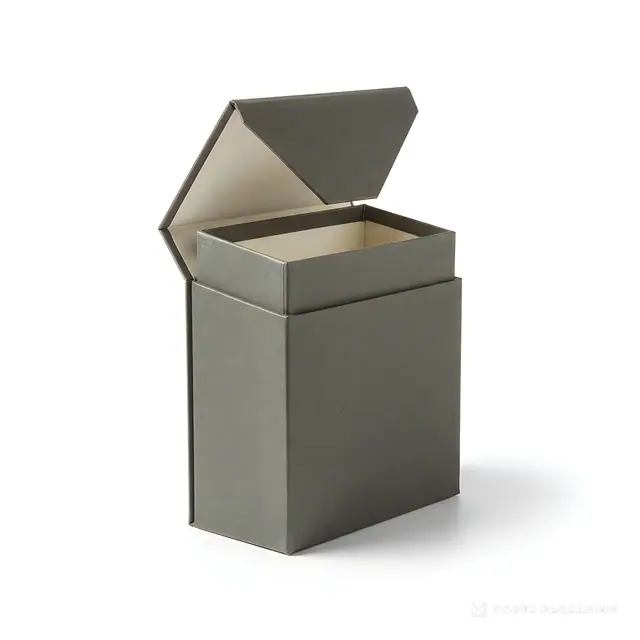
These are the single-piece rigid boxes with a listed price on our product pages on 3 Nov 2026. Each price is for one printed box, full colour outside, made of rigid chipboard wrapped in printed paper.
| Rigid box (listed size) | Style | Listed price, 1 piece |
|---|---|---|
| Rigid box, 9 x 7 x 3 in | Lift-off lid | $31.49 (sale, regular $52.49) |
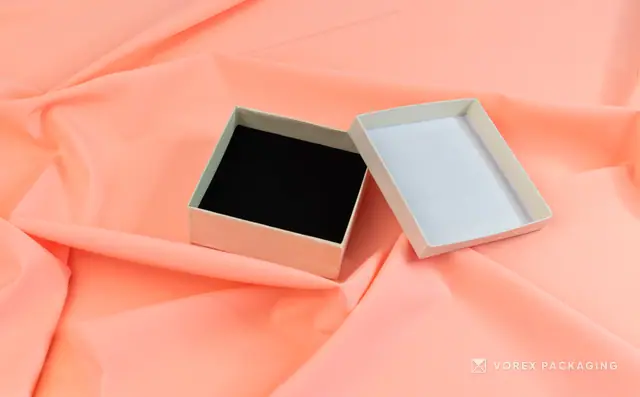
| Two-piece rigid box, 8 x 6 x 3 in | Lid and base | $31.49 (sale, regular $52.49) |
| Magnetic closure rigid box, 10 x 8 x 3 in | Hinged magnetic flap | $12.99 (sale, regular $52.49) |
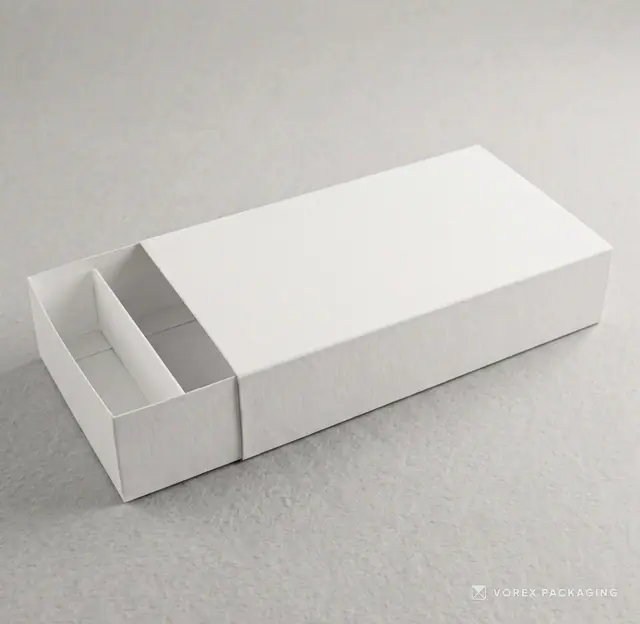
| Rigid drawer box, 6 x 4 x 2 in | Tray and sleeve | $12.99 (sale, regular $52.49) |
| Collapsible rigid box, 10 x 8 x 4 in | Folds flat | $31.49 (sale, regular $52.49) |
| Luxury rigid box, 12 x 9 x 3 in | Lift-off lid | $31.49 (sale, regular $52.49) |
For contrast, our listed folding-carton jewelry box (3.5 x 3.5 x 1.5 in, 18pt SBS paperboard) is $1.39 (sale, regular $5.59) for one printed piece. The gap is not a markup trick; it comes from how the two boxes are made.
Why does a rigid box cost more than a folding carton?
A folding carton is printed and die-cut as a flat sheet, shipped flat and folded by you. A rigid box (also called a setup box) is a different build. As the Wikipedia entry on boxes puts it, setup boxes "are made of stiff paperboard and are permanently glued together with paper skins that can be printed or colored", and "unlike folding cartons, these are assembled at the point of manufacture and transported as already constructed". The same entry notes that they "are more expensive than folding boxes".
In practice that means every rigid box needs:
- thick chipboard cut for the walls, base and lid;
- a printed wrap sheet, cut to its own shape, glued around the board and folded into the corners;
- wrapping and gluing by hand or on a wrapping machine, box by box;
- anything extra fitted one at a time: magnets in a flap, a ribbon pull, a foam or card insert.
The full side-by-side is on rigid box vs folding carton.
Why does the price per box drop from 1 to 50 to 100 to 200?
Every order carries two kinds of cost. Some work happens once per order whatever the quantity: setting up the press and checking colour, making the cutting die for the board and wrap, and making a foil or emboss plate if you use one. Other costs repeat with every box: board, wrap paper, glue, hand work and the insert.
So the price per box behaves roughly like this:
price per box ≈ (one-time setup ÷ number of boxes) + materials and work per box
With one box, that box carries the whole setup. With 50 boxes, each carries a fiftieth of it; with 200, a two-hundredth. The per-box part does not shrink much, because each rigid box is still wrapped and glued on its own. That is why the per-box price falls steeply from 1 to 50, then flattens: the step from 100 to 200 usually saves less per box than the step from 1 to 50. The header image shows the shape of that curve; it is an illustration, not our price list.
The U.S. Small Business Administration uses the same split of fixed and variable costs in its break-even formula: "Break-even point (units) = fixed costs ÷ (sales price per unit – variable cost per unit)". Your packaging is a variable cost per unit in that formula, so a lower per-box price at a higher quantity lowers the number of sales you need to break even.
What changes the price of 50, 100 or 200 rigid boxes?
- Size. Bigger boxes use more chipboard and a larger wrap sheet. Measure your product and add room for the insert; the box size calculator helps.
- Style. A lift-off lid has two simple parts. A magnetic box adds a hinged cover and magnets; a drawer box adds a sleeve; a collapsible box adds folding construction.
- Wrap paper. Printed coated paper is the standard; specialty and textured papers cost more.
- Print coverage. Full colour outside is the listed spec. Printing inside the lid or base adds a second printed sheet.
- Finishes. Foil stamping, embossing, spot UV and soft-touch lamination each add a step, and foil or emboss adds a plate that is part of the one-time setup.
- Insert. A card, foam or molded pulp insert is cut and fitted per box (see custom box inserts).
- Quantity. The setup share per box, as above.
How do you compare quotes for 50, 100 and 200 pieces?
- Ask for all three quantities in one request, on the identical spec, so the only thing that changes is the quantity.
- Write the spec down: inside dimensions, style, chipboard, wrap paper, print sides, finishes, insert.
- Compare the total and the per-box price. 200 boxes at a lower per-box price can still be more cash than you want tied up in stock.
- Check what is included: the digital proof, the dieline, shipping and any rush charge. With us every order includes free digital design and dieline and a digital proof before production, and shipping is free on every order.
- Test one first. Our single printed box lets you check fit, colour and the unboxing before you commit to a run.
Which quantity makes sense for a small brand?
- 1 box: a fit and colour test, a pitch sample for a retailer or a one-off gift.
- Around 50: a launch, a PR or influencer mailing, or a limited gift set.
- 100 to 200: a product that already sells steadily, where the lower per-box price is worth the stock.
Plan for storage too. Rigid boxes arrive assembled and do not fold flat (collapsible styles are the exception). Two hundred 9 x 7 x 3 in boxes take 200 x 189 = 37,800 cubic inches, about 22 cubic feet, before any outer cartons. If that space is hard to find, a collapsible rigid box or a smaller first run may cost less overall than a bigger order at a lower unit price.
When is a rigid box not the best buy?
If the box is mainly for shipping, or the product is light and low priced, a printed paperboard box or a mailer box usually gives a better result per dollar. Rigid boxes earn their price on products that are kept, gifted or shown: jewelry, watches, skincare sets, corporate gifts. For the bigger picture, read how much custom packaging costs, or try the rough ranges in the packaging cost calculator. When you know your size and style, send it with 50, 100 and 200 as quantities and get a quote; there is no minimum order quantity.
Box sizes in this guide
Each size has its own page with the box styles and products at that size, a dieline and a quote form with the size filled in.
- 9 x 7 x 3 in boxes
- 8 x 6 x 3 in boxes
- 10 x 8 x 3 in boxes
- 6 x 4 x 2 in boxes
- 10 x 8 x 4 in boxes
- 12 x 9 x 3 in boxes
- 3.5 x 3.5 x 1.5 in boxes
Sources
- Vorex Packaging product pages, listed single-piece prices for rigid boxes and the folding-carton jewelry box, checked 3 Nov 2026.
- Wikipedia, "Box", section on setup boxes, read 3 Nov 2026.
- U.S. Small Business Administration, break-even point calculator, read 3 Nov 2026.