













Food-Safe Packaging Basics for Home Bakers and Cottage Food Sellers
Updated · Vorex Packaging
For home bakers, food-safe packaging means the surface touching the food is made for food contact (or the bake sits on a liner), greasy bakes get grease-resistant paper, every package is labeled with item, ingredients and allergens, and perishables stay cold. Cottage food rules come from your state, so read them before ordering printed packaging.
The short answer
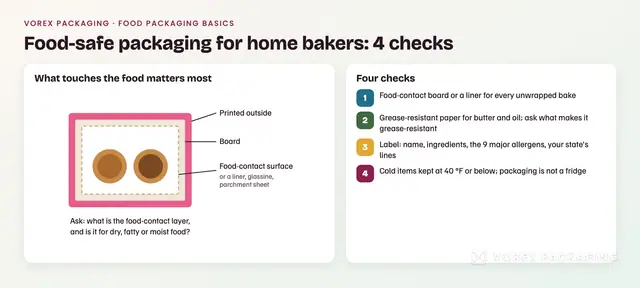
For a home baker, food-safe packaging comes down to four checks: the surface that touches the food is made for food contact (or the bake sits on a food-contact liner), greasy or buttery bakes get grease-resistant paper, every package carries a clear label with the item, ingredients and allergens, and anything perishable stays cold, because a box does not keep food safe on its own. Cottage food rules (what you may sell, where, and what the label must say) come from your state, so read your state's rules before you order printed bakery packaging.
This is general information with the federal sources quoted, not legal advice. It does not claim any certification for Vorex packaging; for your order, ask your specialist what the food-contact layer is made of.
What does "food contact" mean?
U.S. food law has a definition. Under 21 U.S.C. 348(h)(6), "the term 'food contact substance' means any substance intended for use as a component of materials used in manufacturing, packing, packaging, transporting, or holding food if such use is not intended to have any technical effect in such food."
For paper and board, the FDA's rules sort foods by type. 21 CFR 176.170 is titled "Components of paper and paperboard in contact with aqueous and fatty foods", and it says the substances it lists "may be safely used as components of the uncoated or coated food-contact surface of paper and paperboard intended for use in producing, manufacturing, packaging, processing, preparing, treating, packing, transporting, or holding aqueous and fatty foods, subject to the provisions of this section." A separate section, 21 CFR 176.180, covers "Components of paper and paperboard in contact with dry food".
The practical lesson: a dry cookie, a buttery croissant and a cream-filled pastry are different foods to the rules, so tell your packaging supplier which one you are boxing.
What should actually touch the food?
- The inside surface of the box or bag, if the bake goes in unwrapped. Ask your supplier what that surface is and which foods (dry, fatty, moist) it is meant for.
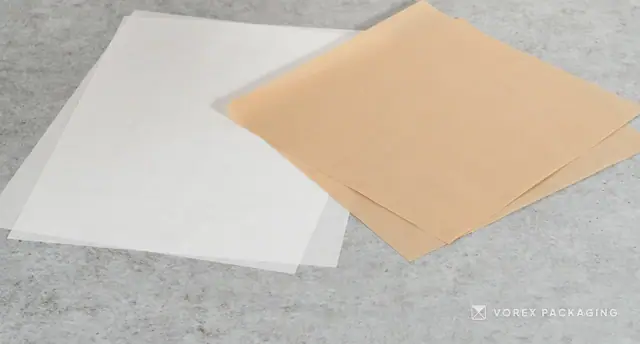
- A liner when in doubt: a sheet of parchment paper, greaseproof paper or wax paper between the bake and the box keeps oil off the board and the board off the food.
- Not the print. Keep printed artwork on the outside. Put stickers and labels on the box or bag, never on the food.
- Not decorative fillers. Tissue paper, shred and ribbon are decoration. Unless the supplier says a filler is made for food contact, keep it away from unwrapped food.
What about grease-proof paper and PFAS?
Some grease-resistant paper and board was treated with PFAS chemicals. The FDA reports: "In February 2024, the FDA announced that substances containing PFAS used as grease-proofing agents on paper and paperboard for food contact use are no longer being sold by manufacturers into the U.S. market." Some states and cities also have their own packaging rules (for example on foam or PFAS), so check local rules; our takeout packaging checklist lists what to look for.
When you buy grease-resistant paper or board from anyone, ask how it resists grease (a coating, a liner, or a dense paper such as glassine) and which foods it is meant for.
What must the label say?
At a minimum a buyer should be able to read what the food is, what is in it and who made it. Allergens matter most. The FDA states: "The major food allergens are milk, eggs, fish, Crustacean shellfish, tree nuts, peanuts, wheat, soybeans, and sesame." Bakes very often contain milk, eggs, wheat, soybeans, tree nuts or sesame, so list them clearly.
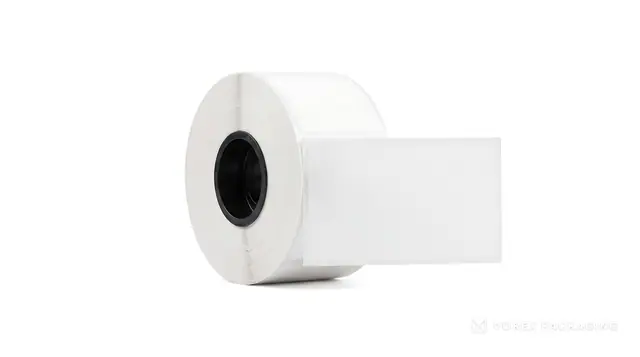
Cottage food sellers usually have extra label lines set by their state. Read your state's cottage food rules and copy the required wording exactly. A printed roll label or sticker is the simplest way to put the same information on every box: our roll labels are $6.30 and 3 x 3 in stickers $1.63 for one printed piece, so you can test the layout before a run.
How do you keep perishable bakes safe in the box?
Packaging does not chill food. For anything with cream, custard, cream cheese or fresh fruit, the cold chain is what keeps it safe. The FDA's safe food handling page advises keeping the refrigerator "consistently 40° F or below", and: "Refrigerate or freeze meat, poultry, eggs, seafood, and other perishables within 2 hours of cooking or purchasing. Refrigerate within 1 hour if the temperature outside is above 90° F."
- Put a "Keep refrigerated" line on the label of perishable items.
- Cold boxes collect condensation; a liner or a moisture-resistant board stops the box from going soft.
- For deliveries, plan the time out of the fridge, not just the box.
What do cottage food rules usually cover?
Each state writes its own rules. Before you buy packaging, find your state's cottage food page (usually the department of agriculture or health) and check:
- which foods you may sell from a home kitchen (many perishable items are treated differently from shelf-stable bakes);
- where you may sell (in person, farmers markets, online, shipped);
- exactly what the label must say;
- whether there are sales limits or registration steps.
Design the label after you read the rules, not before, so the printed packaging does not need replacing.
Which packaging suits a home bakery?
| Bake | Packaging | Food-contact note |
|---|---|---|
| Cookies, brownies | Cookie box 6 x 6 x 2 in, $0.79 (sale, regular $1.39) for one printed piece | Line with parchment for buttery cookies |
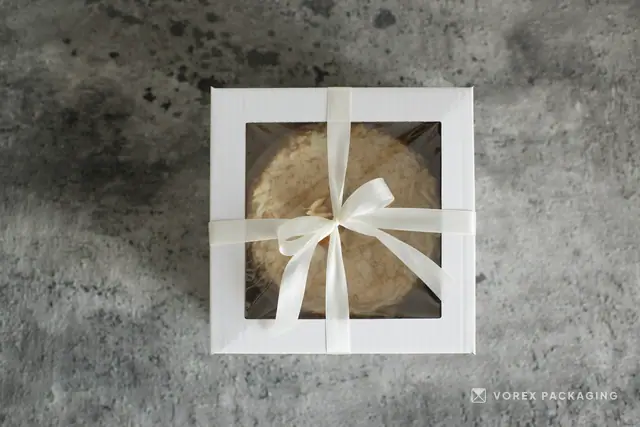
| Cakes | Bakery box 8 x 8 x 5 in, $0.79 (sale, regular $1.39) | Cake on a board, not on the box floor |
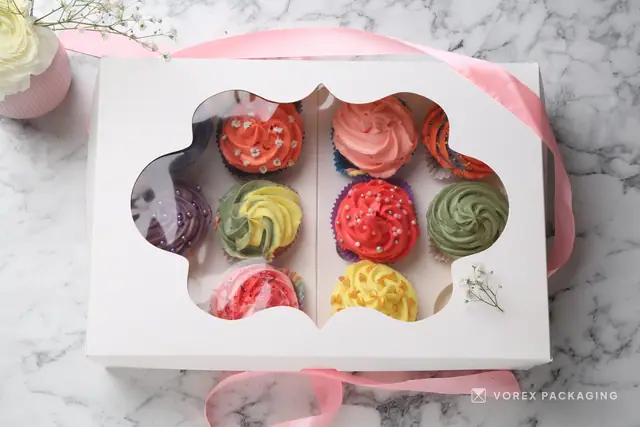
| Cupcakes | Cupcake box with insert, $0.79 (sale, regular $1.39) | Frosting should not touch the window film |
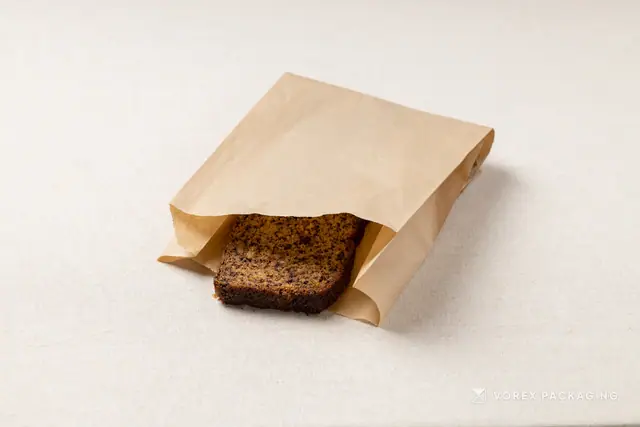
| Bread, pastries | Bakery bag 8 x 4.5 x 10 in, $1.59 | Ask which foods the bag is meant for |
Prices are our listed single-piece prices, checked 3 Nov 2026. Sizes for every bake are in bakery box sizes, and seasonal planning is in the holiday bakery packaging checklist.
Checklist before you sell
- State cottage food rules read; label wording copied from them.
- Food-contact surface or liner for every unwrapped bake.
- Grease-resistant paper for buttery and oily items; asked how it resists grease.
- Label on every package: item, ingredients, the nine major allergens where present, required state lines.
- "Keep refrigerated" on perishables; cold chain planned.
- Print on the outside only; decorations kept off unwrapped food.
There is no minimum order quantity, and every order includes free digital design and dieline and a digital proof. Tell us what you bake and get a quote.
Box sizes in this guide
Each size has its own page with the box styles and products at that size, a dieline and a quote form with the size filled in.
Sources
All read on 3 Nov 2026:
- U.S. Code, 21 U.S.C. 348(h)(6) (Legal Information Institute, Cornell Law School).
- eCFR, 21 CFR 176.170 and 21 CFR 176.180.
- FDA, Authorized Uses of PFAS in Food Contact Applications, Food Allergies and Safe Food Handling.