













Free Reverse Tuck End Box Dieline Template
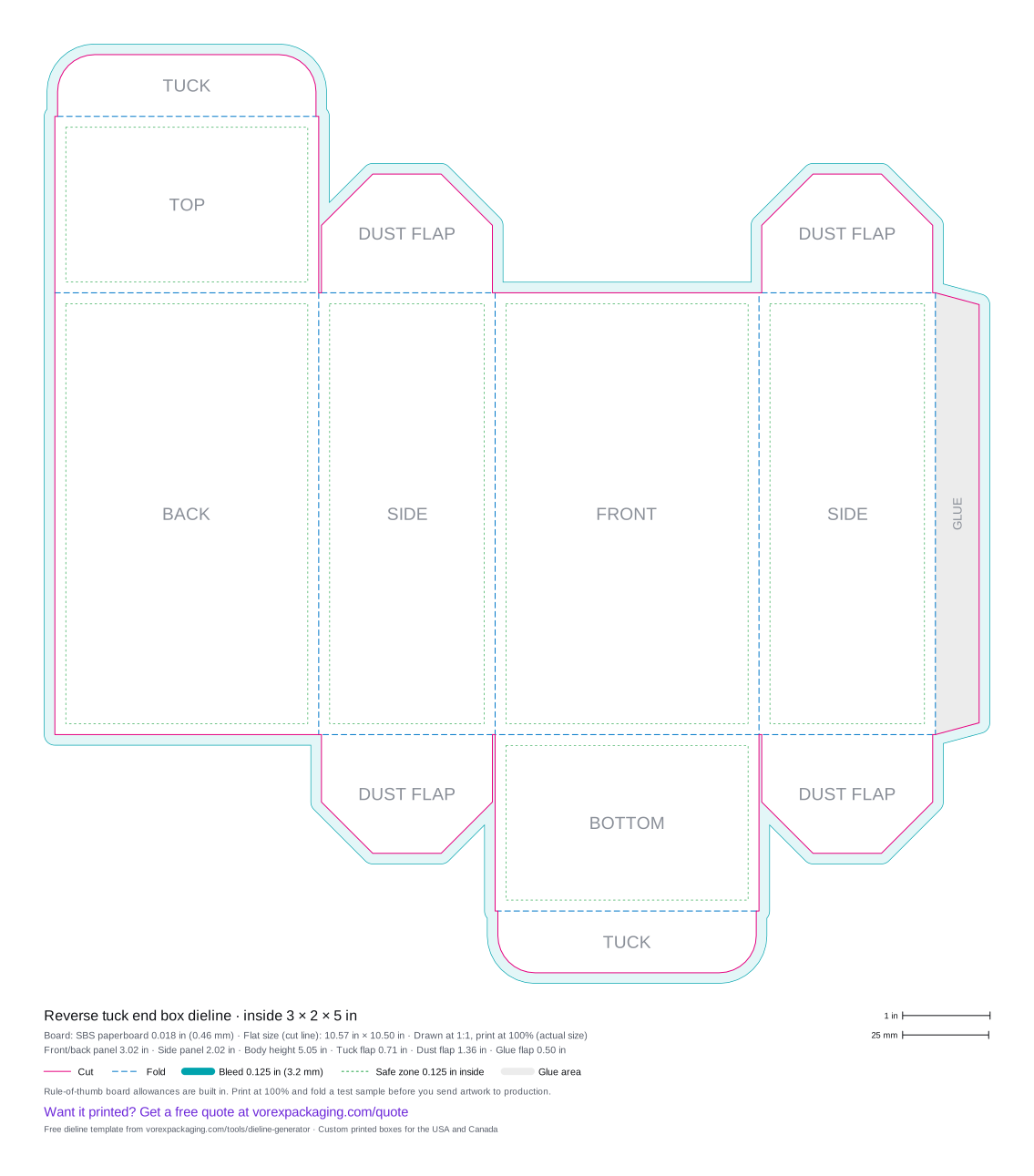
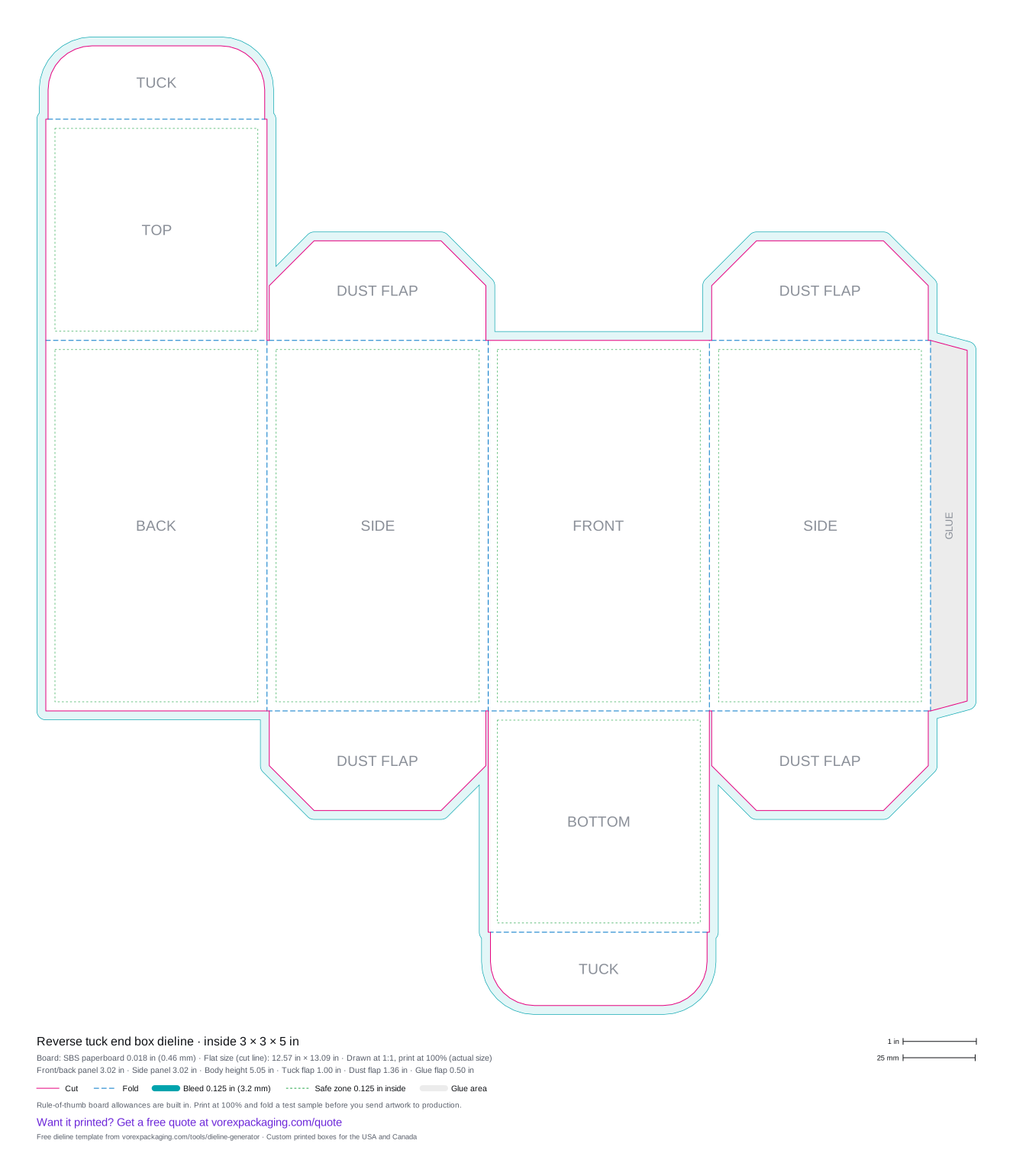
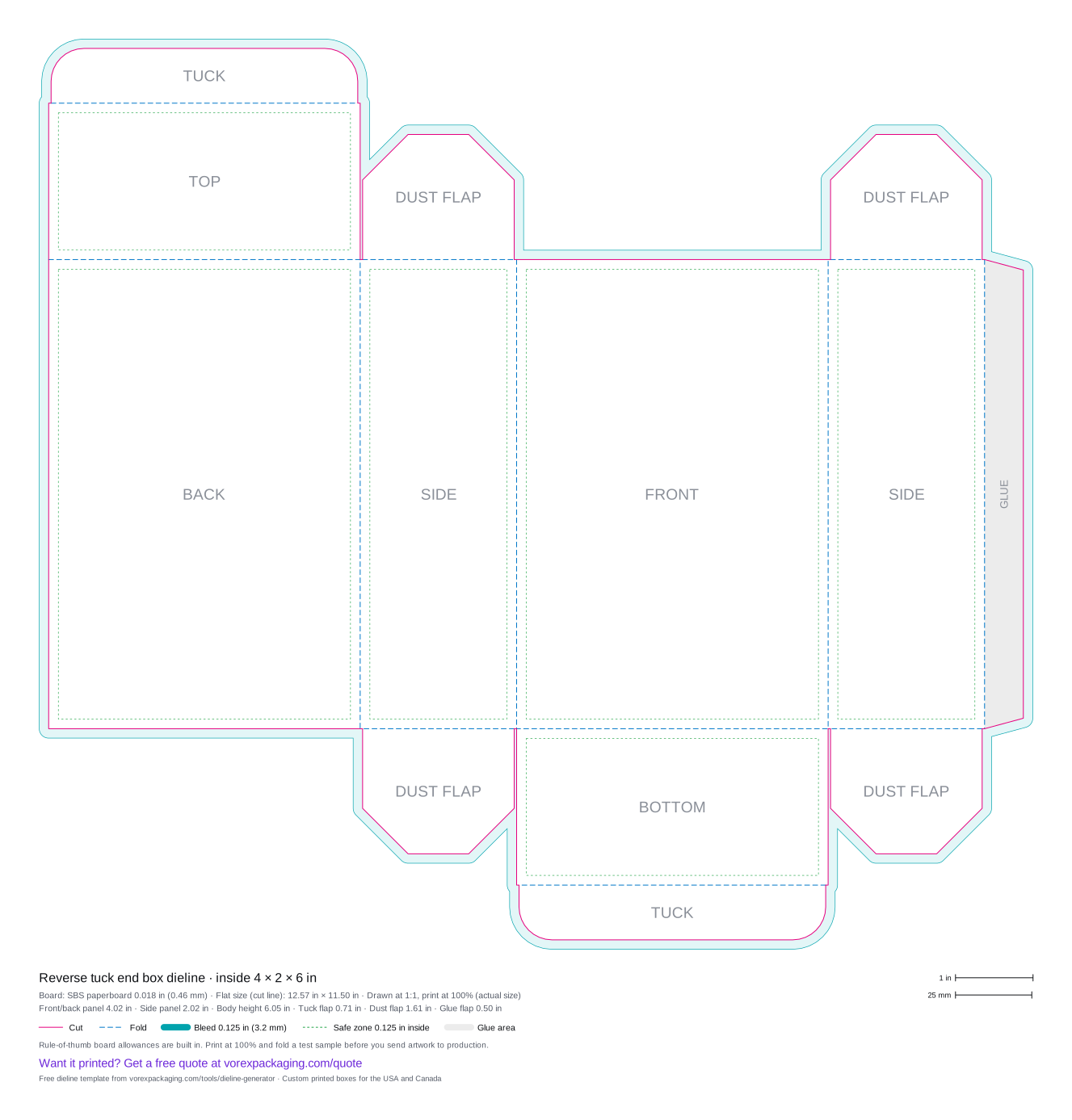
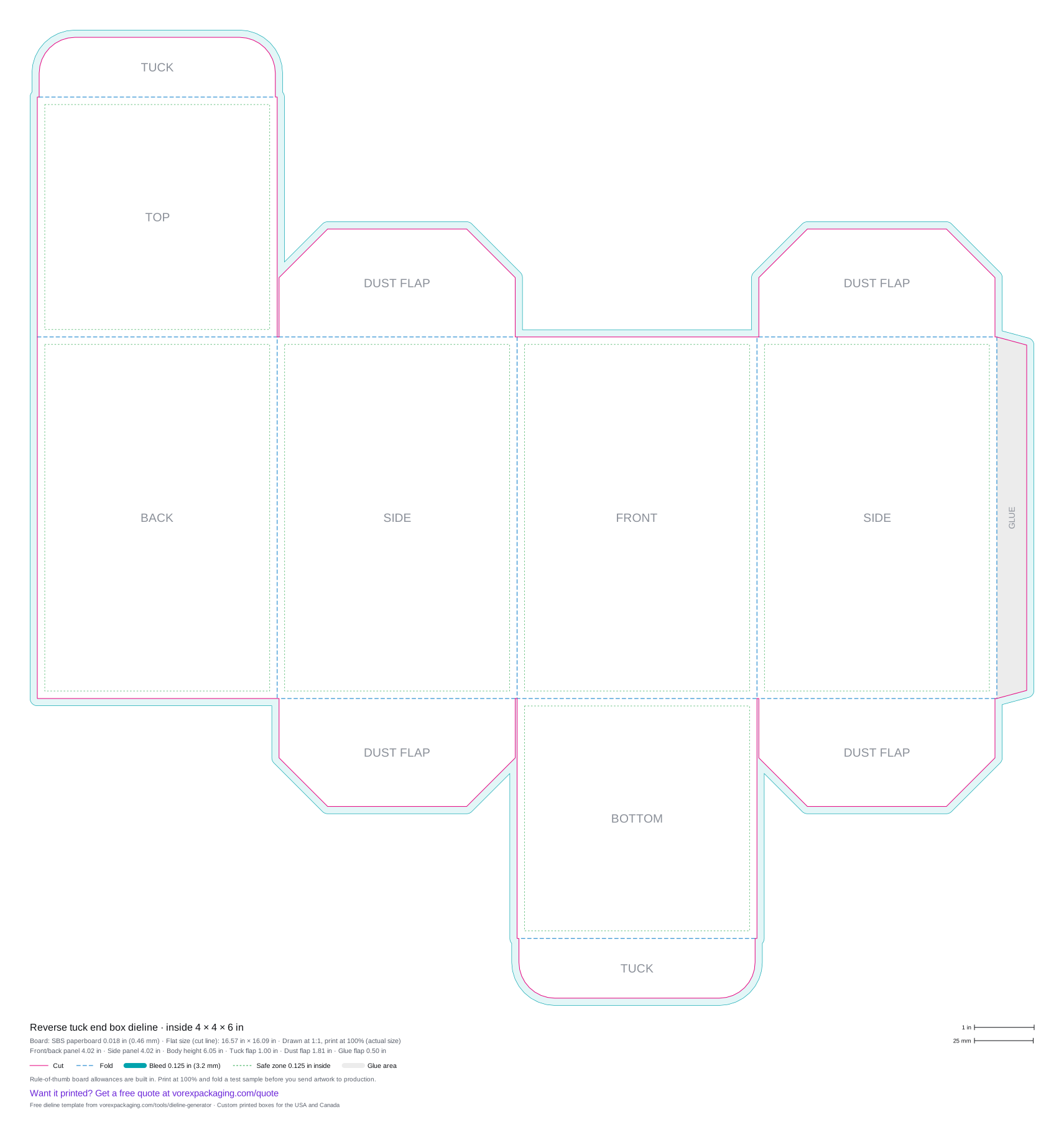
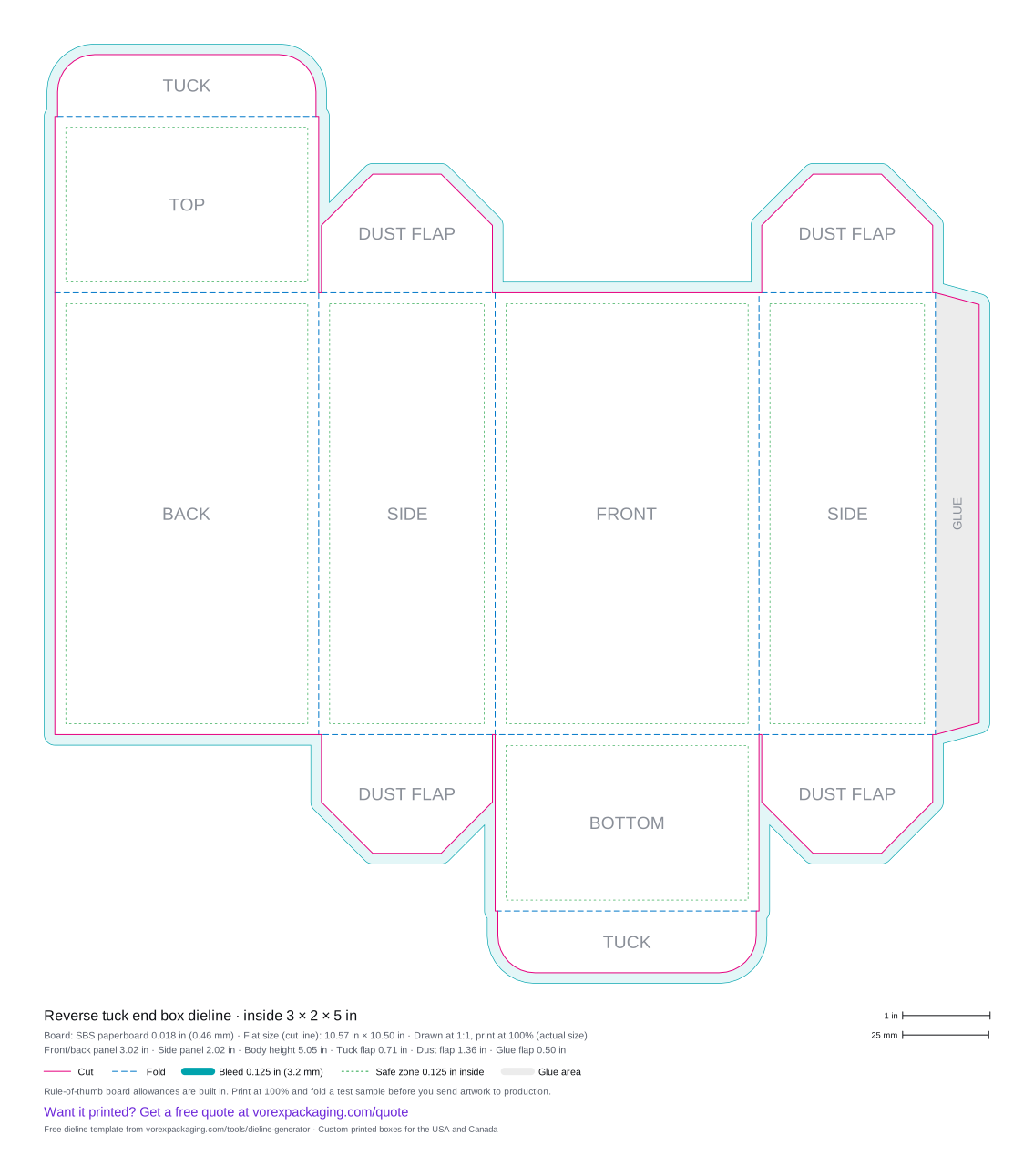
A reverse tuck end (RTE) box is a folding carton whose top tuck closes from the back panel and whose bottom tuck closes from the front panel, so the two tucks open in opposite directions. This free generator draws the flat RTE dieline for your inside length, width and height: four body panels and a glue flap, a tuck closure at each end, and dust flaps on the side panels, with cut, fold, bleed and safe zone lines. Download it as SVG or a 100%-scale PDF.
- Cut line
- Fold / crease
- Bleed 0.125 in
- Safe zone 0.125 in
- Glue area
Common reverse tuck end box sizes
Inside sizes in inches on SBS paperboard 0.018 in (0.46 mm). Each file is drawn at actual size with cut, fold, bleed and safe zone layers.
| Inside size (L × W × H) | Flat size | Download |
|---|---|---|
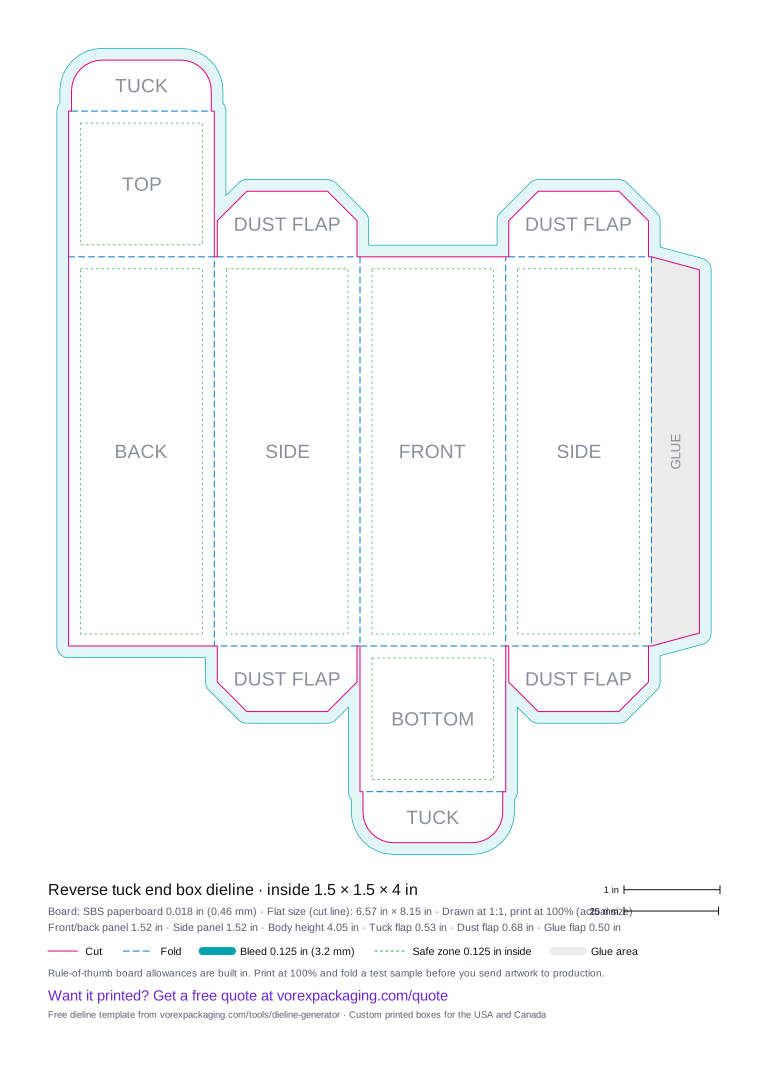
| 1.5 × 1.5 × 4 in | 6.57 × 8.15 in | SVG · PDF · Quote this size |
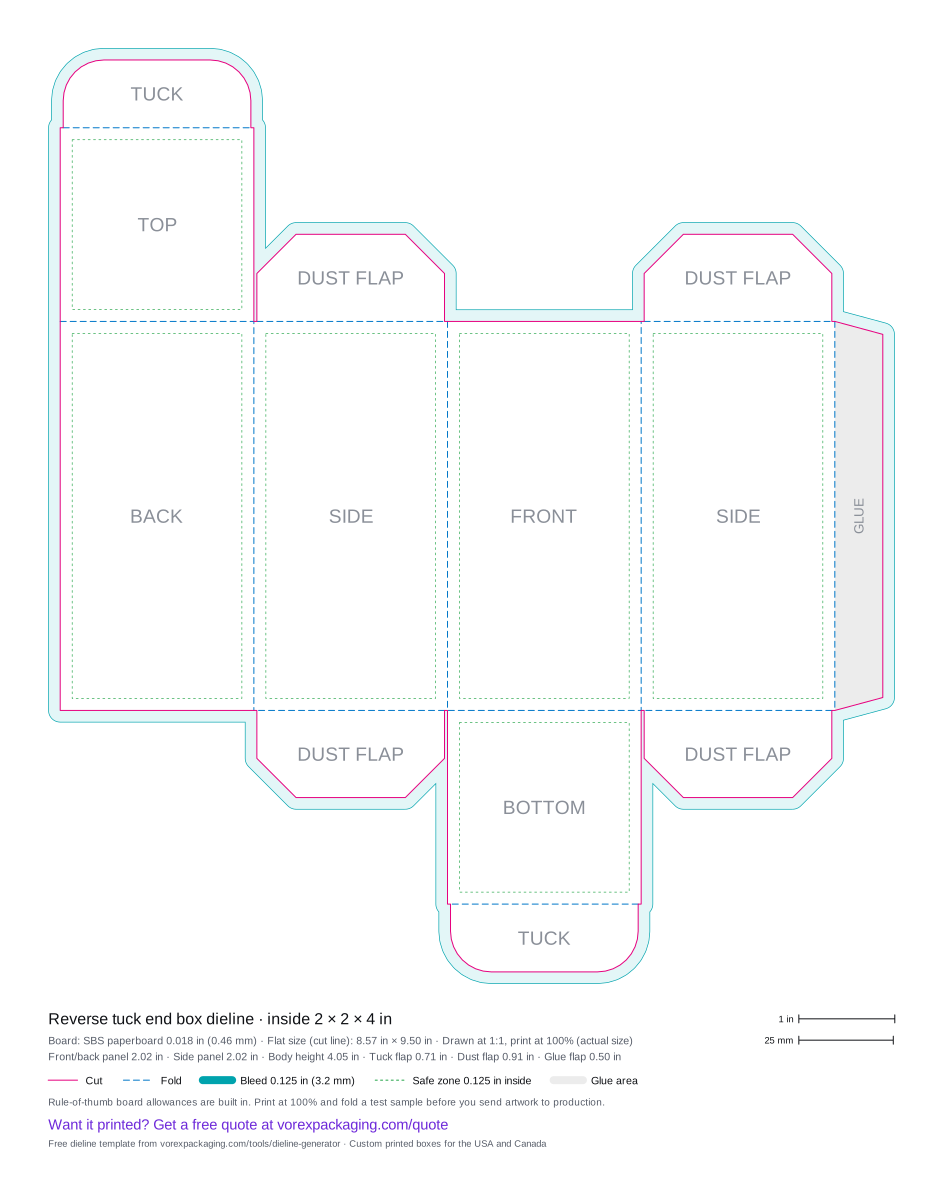
| 2 × 2 × 4 in | 8.57 × 9.50 in | SVG · PDF · Quote this size |
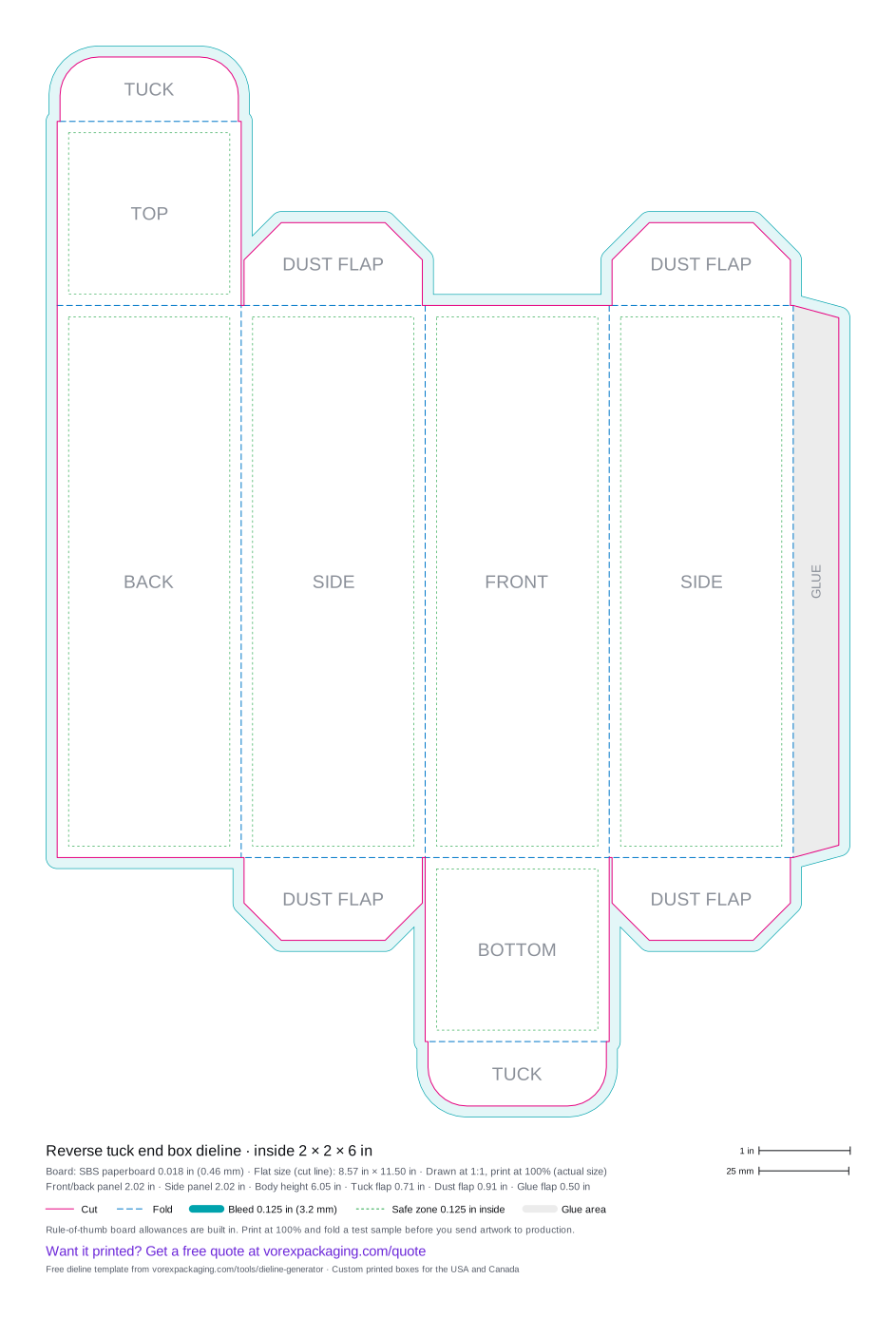
| 2 × 2 × 6 in | 8.57 × 11.50 in | SVG · PDF · Quote this size |
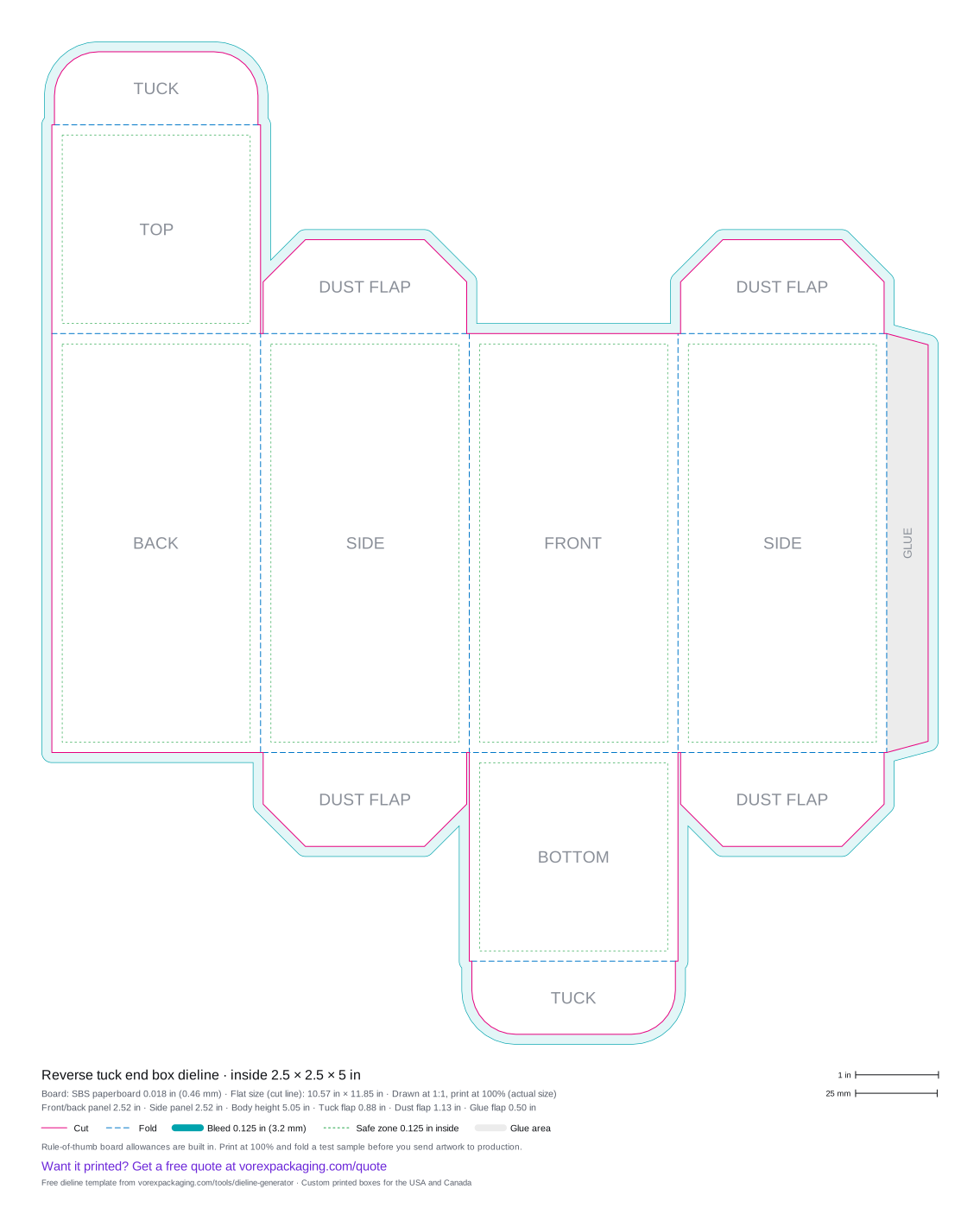
| 2.5 × 2.5 × 5 in | 10.57 × 11.85 in | SVG · PDF · Quote this size |
| 3 × 2 × 5 in | 10.57 × 10.50 in | SVG · PDF · Quote this size |
| 3 × 3 × 5 in | 12.57 × 13.09 in | SVG · PDF · Quote this size |
| 4 × 2 × 6 in | 12.57 × 11.50 in | SVG · PDF · Quote this size |
| 4 × 4 × 6 in | 16.57 × 16.09 in | SVG · PDF · Quote this size |
Reverse tuck end box
Reverse tuck end cartons are the most common folding carton for cosmetics, supplements, candles and other retail products. Because the top and bottom tucks hinge from opposite panels, the front panel stays free of a fold line along its top edge, which keeps the main artwork clean.
What the template includes
- Cut lines (solid) and fold lines (dashed) on separate layers
- A 0.125 in (3.2 mm) bleed outside the cut and a 0.125 in safe zone inside each main panel
- Panel labels and a legend with every panel size, the flat size and the board
- 1 in and 25 mm scale bars, so you can check a print at 100%
From template to printed box
- Pick the box style. Choose the style and enter the inside length, width and height in inches or millimetres.
- Set the board. Choose SBS paperboard, E-flute corrugated or a custom thickness, and adjust the glue and tuck flaps if you need to.
- Download the template. Download the dieline as SVG or PDF. Both are drawn at actual size.
- Check the scale. Print the PDF at 100% (actual size) and measure the 1 in bar in the legend, then cut and fold a test sample.
- Place your artwork. Open the file in Illustrator, Affinity, Inkscape or Canva, keep the dieline on its own layer, extend backgrounds to the bleed line and keep text inside the safe zone.
- Send it to print. Ask your printer to confirm the final die line for their board, then send the artwork for a proof.