














Thanksgiving Takeout and Meal Kits: Packaging for Restaurants
· 37 min · The Vorex Packaging Podcast
In episode eight, the second of our Thanksgiving episodes, Maya and Jordan look at packaging for restaurants that sell Thanksgiving dinner to go. US Thanksgiving is Thursday, November 26, 2026, and Black Friday is November 27. We cover a little takeout history; why hot takeout and heat-at-home meal kits need different containers; a container list by dish (food cartons, paper clamshells, trays, the folded takeout pail, pie boxes, cup carriers, and a wide-gusset bag or delivery box); steam, grease and liquids; foam rules in New York State (from January 1, 2022), Washington (from June 2024) and Oregon (from January 1, 2025, with Oregon's rule on foodware containers with intentionally added PFAS); one label per container; two real stories, the oyster pail (patents from 1890 and 1908, adopted for Chinese takeout after World War II, shown at the Smithsonian in 2011) and Swanson's 1953 TV dinner, a Thanksgiving meal in an aluminum tray; what Blue Apron and the meal kit industry show about packaging; EPA recycling numbers for containers and packaging; counting containers and labels for a hypothetical restaurant; and why to brand boxes for the whole year and keep the seasonal part on stickers, sleeves and cards. Not legal or food-safety advice: check the rules where you sell.
Player not loading? Spotify's player isn't available in every country. Open the episode on Spotify, or read the full transcript below.
In this episode
- US Thanksgiving is Thursday, November 26, 2026; Black Friday is November 27.
- Hot takeout leaves warm and needs heat, grease and steam control; a heat-at-home meal kit leaves cold and needs fridge-stackable containers and reheating labels.
- Group the menu into three or four container sizes and test each one with real food in a test meal before pre-orders open.
- Vorex's listed options: food box 8 x 6 x 3 in (18pt paperboard), paper clamshell 6 x 6 x 3 in, takeout pail 4 x 3 x 4 in, kraft bag 8 x 10 x 5 in; other sizes made to measurement, no minimum order.
- Vent crispy foods, close moist ones, ask for grease-resistant food-contact board, and keep gravy and sauces in lidded containers low in the bag.
- New York State banned EPS foam food service containers from January 1, 2022; Washington from June 2024; Oregon from January 1, 2025, when it also banned the sale of foodware containers with intentionally added PFAS. Check your state and city.
- One label per container: the dish, keep refrigerated for kits, one tested reheating line; allergens help the host (the FDA lists nine major allergens).
- The oyster pail became the Chinese takeout box because it was right for the food: insulated, vented, self-closing, with a handle.
- Swanson's first TV dinner (1953) was a Thanksgiving meal in a compartment tray: design for the reheat.
- Corrugated boxes had a 96.5% recycling rate in 2018 (EPA), but food-soiled paper is often not accepted: keep recycling claims honest.
- Count containers and labels per order, add extras, measure the fridge and shelf, fold early, order early and ask about rush.
- Brand the boxes for the whole year; keep Thanksgiving on stickers, sleeves and the card in the bag.
Chapters
- 0:00 Cold open
- 1:16 Welcome to the show
- 2:59 Why Thanksgiving to go matters
- 6:23 Takeout or meal kit: what changes
- 8:52 Containers, dish by dish
- 13:26 Steam, grease, liquids, and the foam rules
- 18:28 Labels: what goes on every container
- 21:09 Real stories: the oyster pail and the TV dinner
- 26:03 What meal kit companies taught everyone
- 29:43 Counting, ordering and timing
- 32:46 Question: print Thanksgiving on the box?
- 34:36 Get started
Sources
The story segment uses public sources only. We paraphrase and state only what each source supports.
- Take-out: Take-out (Wikipedia, read 6 Nov 2026). Colonial-era street vendors (pepper pot soup, oysters, roasted corn, fruit, sweets); African American women selling street food in the 18th and 19th centuries in cities like Savannah and New Orleans; takeout containers (paperboard, corrugated fiberboard, plastic, foam); foam largely replaced with paper wrappers among large chains; pandemic shift to take-out only.
- DoorDash: DoorDash (Wikipedia, read 6 Nov 2026). Started January 2013 in Palo Alto, California, as PaloAltoDelivery.com; IPO December 2020.
- Oyster pail: Oyster pail (Wikipedia, read 6 Nov 2026). 1890 paper pail patent (F. W. Wilcox and W. D. Moshier); 1908 oyster pail patent (J. G. Reber); originally for oysters, also honey; adopted for Chinese takeout after World War II, especially in the West; folded waxed or plastic-coated paperboard, solid wire handle, self-closing locking tab, steam escapes; 2011 Smithsonian exhibit Sweet & Sour.
- Swanson: TV dinner (Wikipedia, read 6 Nov 2026). C. A. Swanson & Sons, first commercially successful TV dinner in 1953: turkey, cornbread stuffing, frozen peas and sweet potatoes in a compartment aluminum tray modeled on airline trays, heated without extra dishes; 98 cents; first run of 5,000; Gerry Thomas's 1996 surplus-turkey account disputed by the Los Angeles Times, Swanson family members and former employees; Betty Cronin credited with technical contributions.
- Blue Apron: Blue Apron (Wikipedia, read 6 Nov 2026). Founded August 2012 in Long Island City, New York, by Matt Salzberg, Ilia Papas and Matt Wadiak; founders packed and shipped the first 30 orders; NYSE IPO June 29, 2017; Wonder Group agreed to acquire it for $103 million in 2023; meal kits criticized for packaging waste from individually packaged ingredients.
- Meal kits: Meal kit (Wikipedia, read 6 Nov 2026). Blue Apron, HelloFresh (already in Europe) and Plated entered the American market in 2012; criticism of freezer gel packs that are hard to recycle.
- U.S. EPA: Containers and Packaging: Product-Specific Data (epa.gov, read 6 Nov 2026). 2018: 82.2 million tons of containers and packaging generated, 53.9 percent recycled; paper and paperboard containers and packaging 41.9 million tons, 80.9 percent recycled; corrugated boxes 96.5 percent recycled.
- New York State DEC: Expanded Polystyrene Foam Ban (dec.ny.gov, read 6 Nov 2026). From January 1, 2022, no covered food service provider or store may sell, offer for sale or distribute disposable food service containers that contain expanded polystyrene foam (bowls, clamshells, cups, plates, trays).
- Washington Department of Ecology: Expanded polystyrene ban (ecology.wa.gov, read 6 Nov 2026). As of June 2024 the ban covers EPS containers, plates, bowls, clam shells, trays and cups.
- Oregon DEQ: Polystyrene foam and PFAS foodware (SB 543) (oregon.gov, read 6 Nov 2026). From January 1, 2025, food vendors may not use polystyrene foam containers for prepared food; sale of foodware containers with intentionally added PFAS prohibited.
- Foam food containers: Foam food container (Wikipedia, read 6 Nov 2026). City bans mentioned for San Francisco, Seattle and Portland, Oregon; foam is a good thermal insulator that keeps food at its filled temperature.
- U.S. Food and Drug Administration: Food Allergies (fda.gov, read 30 Oct 2026). Nine major food allergens: milk, eggs, fish, crustacean shellfish, tree nuts, peanuts, wheat, soybeans, sesame.
- Vorex Packaging: Thanksgiving Takeout and Meal-Kit Packaging: A Restaurant Checklist (vorexpackaging.com, read 6 Nov 2026). Takeout leaves hot, meal kits leave cold; group the menu into three or four sizes and test with real food; food box 8 x 6 x 3 in (18pt SBS), paper clamshell 6 x 6 x 3 in, kraft bag 8 x 10 x 5 in; liquids in lidded deli containers branded with a label; logo on the bag and lid, not the date; food sleeves.
Packaging mentioned
- Thanksgiving packaging
- Thanksgiving takeout and meal-kit packaging (restaurant checklist)
- Food and restaurant packaging
- Custom food boxes
- Chinese takeout boxes
- Burger boxes and clamshells
- Kraft paper bags
- Food sleeves
- Paper food trays
- Thanksgiving pie boxes
- Labels
- Stickers
- Rush orders
Get a quote Try the 3D design preview
Full transcript
0:00 Jordan: Maya, here's a scene. It's the Wednesday before Thanksgiving, about five in the afternoon, at a neighborhood restaurant.
0:07 Maya: Let me guess. The dining room is quiet, but the kitchen is the busiest it's been all year.
0:12 Jordan: Exactly. Because the dining room isn't where the money is that week. It's the pickup shelf. Forty, fifty, sixty Thanksgiving dinners, all going home in bags.
0:22 Maya: Turkey, stuffing, mashed potatoes, green beans, cranberry sauce, gravy, rolls, and a pie on top.
0:28 Jordan: And somewhere on that shelf, there's a bag where the gravy has tipped over, and it's soaking slowly into the stuffing.
0:35 Maya: Oh no. That's the one that gets a one-star review on Friday morning.
0:39 Jordan: It is. And the food was great. The packaging let it down.
0:42 Maya: So today is a whole episode about that bag, and everything inside it. Thanksgiving takeout and meal kits for restaurants. Which containers for which dishes, how to handle steam, grease and liquids, what goes on the label, which foam and coating rules to check, and how many boxes to order.
1:01 Jordan: Plus two real stories. The little folded paper pail that became the Chinese takeout box, and the frozen Thanksgiving dinner that started an entire food category.
1:11 Maya: Welcome to The Vorex Packaging Podcast. I'm Maya.
1:14 Jordan: And I'm Jordan.
1:16 Maya: Welcome back, and welcome if this is your first episode. This show is for people who make and sell things. Bakers, restaurant owners, caterers, candle makers, skincare brands, coffee roasters, online shops, and anyone who puts a product in a box.
1:32 Jordan: Quick recap. Our first six episodes covered the basics: what your box says, board and finishes, dielines and proofs, holiday packaging, shipping boxes, and honest green claims. Episode seven started our Thanksgiving series with pie shops and bakeries.
1:48 Maya: And until Thanksgiving, every episode stays on a Thanksgiving theme. Today it's restaurants. Specifically, restaurants that sell Thanksgiving dinner to go, either hot and ready to eat, or cold, as a heat-at-home meal kit.
2:02 Jordan: Our house rules, same as always. When we mention a real company, a real date or a real number, it comes from a public source we read while preparing this episode, and the links are in the show notes. When we use an example that isn't real, we'll tell you it's a hypothetical.
2:18 Maya: And one more note. Today touches food safety and local rules about containers. We're not lawyers and we're not health inspectors. We'll tell you what the public sources say, and link them, but your local health department and your state have the final word.
2:34 Jordan: Here's the plan. First, why Thanksgiving to go matters for restaurants. Then the difference between takeout and a meal kit. Then containers, dish by dish. Then steam, grease and liquids, plus the foam and coating rules. Then labels. Then our two stories. Then what meal kit companies taught everyone about packaging. Then counting and ordering, a listener-style question, and how to get started.
2:57 Maya: Let's get into it.
3:02 Jordan: Let's start with the calendar, because everything hangs on it.
3:06 Maya: Thanksgiving in the United States is on the fourth Thursday of November. This year, twenty twenty-six, that's Thursday, November twenty-sixth.
3:14 Jordan: And then Black Friday on the twenty-seventh.
3:17 Maya: Right. So for a lot of restaurants, the last full week of November is two very different weeks in one. Monday to Wednesday is production and pickup. Thursday, many restaurants are closed, or doing one dinner service. And Friday, people want leftovers turned into something new, or they want a break from cooking entirely.
3:36 Jordan: Why does Thanksgiving to go work so well for restaurants? I have a theory.
3:41 Maya: Go on.
3:42 Jordan: Thanksgiving is the one meal of the year where people feel the most pressure to cook from scratch, and the least time to do it. A host might have twelve people coming, one oven, and a turkey that takes most of the day.
3:54 Maya: So buying the sides, or the whole dinner, takes a lot off their plate. Literally.
3:59 Jordan: Literally. And the restaurant gets a big batch of orders it can plan in advance, because almost everyone pre-orders.
4:05 Maya: I looked into the history of takeout for this episode, because I wanted to know how long people have been carrying restaurant food home in America.
4:13 Jordan: And?
4:14 Maya: Much longer than I thought. The Wikipedia article on take-out says that in the colonial period, street vendors sold things like pepper pot soup, oysters, roasted corn, fruit and sweets. And it says many African American women made their living selling street food in the eighteenth and nineteenth centuries, in cities like Savannah and New Orleans.
4:35 Jordan: So food to go is very old. What's newer is the packaging.
4:39 Maya: Exactly. The same article lists the containers takeout uses today: paperboard, corrugated fiberboard, plastic, and foam food containers. And it notes that foam containers faced pressure from environmental groups, and among large restaurant chains they were largely replaced with paper wrappers.
4:58 Jordan: We'll come back to foam, because for some restaurants it's not a choice anymore. It's the law.
5:04 Maya: We will. And the article also notes something everyone listening remembers. During the pandemic, many restaurants closed their dining rooms and shifted to takeout only.
5:14 Jordan: Which is when a lot of restaurants built their first real takeout program.
5:18 Maya: And their first real takeout packaging. Often in a hurry, with whatever containers were in stock.
5:25 Jordan: And delivery apps grew up in that same stretch. The Wikipedia article on DoorDash says it was started in January twenty thirteen in Palo Alto, California, under the name Palo Alto Delivery dot com, and it went public in December twenty twenty.
5:40 Maya: So a restaurant's food now travels further, and through more hands, than it used to. A driver, a car, a doorstep.
5:47 Jordan: Which raises the bar for the box.
5:49 Maya: Here's how I like to think about it. When someone eats in your restaurant, you control everything. The plate, the lighting, the music, the server, the temperature of the food.
5:59 Jordan: And when they take it home?
6:00 Maya: The packaging is all that's left. The box is your plate. The bag is your front door. The label is your server. At Thanksgiving, it's all sitting on somebody's kitchen counter while the whole family walks past it.
6:12 Jordan: That's a lot of people seeing your name.
6:15 Maya: It's the most people in one room all year. So the packaging has two jobs. Get the food home in good shape, and tell the table where it came from.
6:27 Jordan: Let's separate the two formats, because I think people mix them up.
6:31 Maya: They look similar on a menu, but they need different packaging. The Vorex guide to Thanksgiving takeout packaging puts it in one line each.
6:39 Jordan: Go ahead.
6:40 Maya: Ready-to-eat takeout leaves hot. The containers have to hold heat and grease for the drive home, vent steam so crispy things stay crisp, and close firmly enough to travel stacked in a bag.
6:51 Jordan: And the meal kit?
6:53 Maya: A meal kit, or a heat-at-home dinner, leaves cold, and the customer reheats it, often a day later. So the containers have to stack in a fridge, survive condensation, and carry clear reheating instructions.
7:06 Jordan: That's a big difference. One is about the next twenty minutes. The other is about the next day or two.
7:11 Maya: Exactly. And it changes the materials. A hot container fights steam and grease. A cold container fights moisture from condensation, and it has to stand up to being stacked and moved around inside a crowded home fridge on the busiest cooking day of the year.
7:27 Jordan: Many restaurants do both, though.
7:29 Maya: Many do. And the simple way to handle that, which the guide suggests too, is one outer look. Your logo on the bag and the boxes. Then different inner containers for hot items and cold items.
7:41 Jordan: So the customer sees one brand, and the kitchen uses the right container for each dish.
7:46 Maya: Right. Nobody at the table cares that the stuffing tray and the pie box are different materials. They care that it all looks like it came from one place.
7:56 Jordan: Let me ask the business question. If a restaurant is choosing just one, which should it pick?
8:01 Maya: I don't think there's one right answer, and we don't have numbers on which sells better. But here's how I'd think about it as a hypothetical.
8:08 Jordan: Okay.
8:09 Maya: Hot takeout works when your pickup window is short and your customers live close by. It's the closest thing to eating your food in the restaurant.
8:18 Jordan: And the meal kit?
8:19 Maya: The meal kit spreads your work out. You can cook earlier in the week, chill everything, and let customers pick up on Tuesday or Wednesday. The customer reheats on Thursday. Your kitchen isn't trying to finish fifty turkeys at the same hour.
8:33 Jordan: And the customer gets to feel like they cooked.
8:36 Maya: A little bit, yes. They warm it in their own oven, the house smells like Thanksgiving, and they plate it themselves. Some hosts really like that.
8:44 Jordan: But the packaging has to make that easy.
8:46 Maya: It has to make it almost foolproof. Which is where the labels come in, and we'll get there.
8:56 Jordan: Let's build a box list. Where do you start?
8:58 Maya: With the menu, not the catalog. Write down every dish, and how much of it goes in one order. Then group the dishes into three or four container sizes.
9:07 Jordan: Why three or four? Why not a perfect container for every dish?
9:11 Maya: Because every extra size is another stack on the shelf, another thing to reorder, another thing for a busy line cook to grab the wrong one of. The Vorex takeout guide says it directly: group the menu into three or four container sizes and test each one with real food before pre-orders open.
9:30 Jordan: Okay, let's go through a typical Thanksgiving menu. Turkey first.
9:34 Maya: Sliced turkey or ham, as a main for one or two people, goes in a folding food carton or a paper clamshell that's grease-resistant on the inside. The listed Vorex food box is eight by six by three inches, a tuck end carton in eighteen point paperboard.
9:50 Jordan: Eight by six by three. So a fairly shallow box.
9:53 Maya: Shallow on purpose, and we'll come back to why shallow matters. For a family-size order of turkey, you'd go bigger, made to your measurement.
10:02 Jordan: What about individual plates? Some restaurants do a single Thanksgiving plate, turkey and three sides.
10:08 Maya: That's where the paper clamshell shines. It's one piece, with a hinged lid and a locking tab. The listed one is six by six by three inches. Turkey sliders, a slice of turkey with stuffing, a sandwich made from leftovers on Friday.
10:22 Jordan: The Black Friday leftover sandwich. Every restaurant should sell that.
10:26 Maya: It's honestly a great idea. Same packaging, different menu.
10:30 Jordan: Rolls and cornbread?
10:32 Maya: Paper food trays or a small carton. Rolls don't need much protection, but they do need to stay together and not get squashed under heavier containers.
10:41 Jordan: Mashed potatoes, stuffing, green bean casserole?
10:43 Maya: Those are the heavy, warm, slightly wet sides. A sturdy carton with a grease-resistant inside, or a lidded container, depending on how saucy they are. Stuffing is fine in a carton. Creamy mashed potatoes, you'd want a lid that seals.
10:58 Jordan: Where does the classic Chinese takeout pail fit? The folded one with the wire handle.
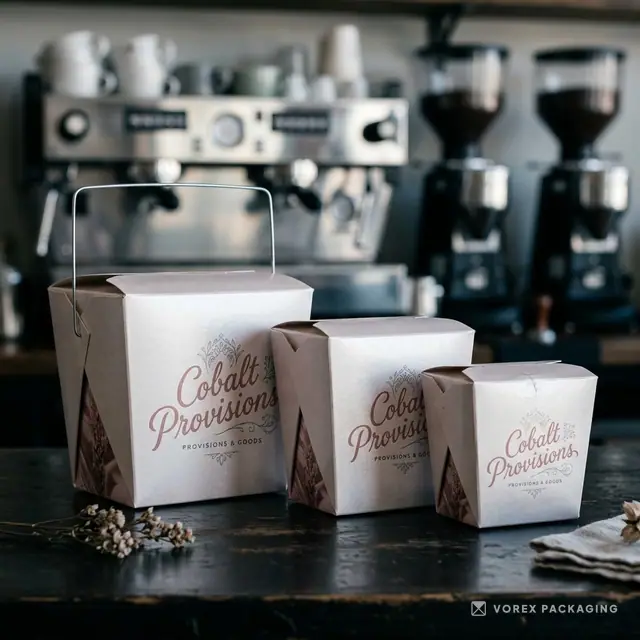
11:04 Maya: It's surprisingly useful at Thanksgiving. Vorex lists it in a four by three by four inch size, in white or kraft board, with wire or paper handles. It's great for rice dishes, roasted vegetables, mac and cheese, anything spoonable but not runny.
11:20 Jordan: And it's fun. It doesn't look like every other Thanksgiving container.
11:23 Maya: It doesn't. And there's a whole story behind that pail, which we'll get to in the story segment.
11:29 Jordan: Dessert?
11:30 Maya: A pie box, with a window lid if you want one. We did a whole episode on pie boxes last week, episode seven. The short version: measure the baked pie, not the pan, and test one box with every pie.
11:43 Jordan: And drinks? Some restaurants sell hot cider or coffee with the dinner.
11:46 Maya: Then you need cup carriers, two or four cups. Otherwise someone is balancing four hot drinks on top of a bag with a pie in it.
11:54 Jordan: I've been that person. It does not end well.
11:56 Maya: And then the whole order goes in one outer carrier. A wide-gusset kraft bag, or for bigger orders, a corrugated delivery box. The listed Vorex kraft bag is eight by ten by five inches.
12:09 Jordan: Why does the gusset matter?
12:10 Maya: The gusset is the side panel that folds in. A wide one gives the bag a flat, wide base, so the containers sit level instead of tipping into each other. That's the gravy scene from the cold open. A narrow bag lets the containers lean.
12:25 Jordan: So the bag isn't just something to carry. It's a tray.
12:28 Maya: It's a tray with handles. For a full dinner for eight, a corrugated box with a lid is often better than a bag, because it stays square, it stacks in a car trunk, and it doesn't fold in on itself.
12:40 Jordan: Is there a way to check all of this before the big week?
12:43 Maya: Yes, and it's the same tip as last week. Do a test meal. Cook one full order, pack it exactly the way you'll pack it on Wednesday, put it in a car, drive it around for twenty minutes, and then open it on a kitchen counter.
12:56 Jordan: Like a customer would.
12:58 Maya: Like a customer would. Did anything tip? Did the fries, or the crispy onions on the green beans, go soggy? Did the pie stay level? Is everything still warm enough? Then fix what failed before you order the full run.
13:11 Jordan: And you can order one printed box to test, right?
13:14 Maya: You can. Vorex has no minimum order. You can order one piece or ten thousand. So you can order one printed food box and one clamshell for the test meal, and see them with your real food.
13:30 Jordan: Let's talk about the three enemies of takeout. Steam, grease and liquids.
13:34 Maya: Steam first. Hot food releases steam, and if the steam can't escape, it condenses on the lid and drips back onto the food.
13:42 Jordan: Which is how a crispy roast potato becomes a sad, soft potato.
13:46 Maya: Exactly. So for anything crispy, you want a container that vents. The folded paper pail actually does this well, and the Wikipedia article on it says its folded design lets steam escape. Some cartons have small vent holes, or you leave a corner open on a lid that's not airtight.
14:03 Jordan: And for things that should stay moist? Turkey, stuffing?
14:06 Maya: Those can take a closed container. Moist food in a closed box stays moist. Crispy food in a closed box goes soft. So you match the container to the texture you want at the table.
14:18 Jordan: Grease next.
14:19 Maya: Grease soaks into plain paperboard and comes through as a dark stain on the outside. On a printed box, right through your logo.
14:27 Jordan: Not the look you want.
14:28 Maya: No. So for oily or buttery dishes, ask for grease-resistant, food-contact board. That's a question to ask when you request the quote, so the right board is chosen for that container.
14:39 Jordan: And there's a rule change around grease resistance, isn't there?
14:43 Maya: There is, at least in some states. Some states now regulate a group of chemicals called PFAS, sometimes called forever chemicals, in food packaging. Oregon's Department of Environmental Quality says that from January first, twenty twenty-five, the state banned the sale of foodware containers with intentionally added PFAS.
15:03 Jordan: So that's Oregon specifically.
15:05 Maya: That's the one we read about directly for this episode. Other states have their own rules, and they keep changing, so check your state before you buy. And when you order, ask your packaging supplier what the grease barrier is, and say which state you're in.
15:19 Jordan: Third enemy. Liquids.
15:21 Maya: Gravy, cranberry sauce, soups. Paper cartons are not the right home for them. The Vorex guide says it plainly: use lidded deli containers inside the bag, and brand them with a label or a sticker instead of printing the cup.
15:35 Jordan: And pack them where?
15:37 Maya: Low in the bag, upright, wedged between heavier containers so they can't tip. Never on top of the pie. And if you can, tape or sticker the lid, which also shows the customer nothing has been opened.
15:49 Jordan: That's a nice double use. A sticker that seals the lid and shows your logo.
15:54 Maya: It's one of the cheapest upgrades in takeout. A round sticker with your name, across the seam of the lid or the fold of the bag.
16:01 Jordan: Now, foam. You said for some restaurants it's the law.
16:04 Maya: Right. Expanded polystyrene foam, the white foam clamshells and cups a lot of people call Styrofoam, is banned for food service in a growing number of places. Three examples we read directly from the state agencies.
16:19 Jordan: Go ahead.
16:20 Maya: New York State. The Department of Environmental Conservation says that from January first, twenty twenty-two, no covered food service provider or store is allowed to sell, offer for sale or distribute disposable food service containers that contain expanded polystyrene foam. That includes bowls, clamshells, cups, plates and trays, and it covers restaurants, cafeterias, grocery stores and more.
16:45 Jordan: Washington?
16:47 Maya: Washington's Department of Ecology says that as of June twenty twenty-four, the ban covers expanded polystyrene containers, plates, bowls, clamshells, trays and cups.
16:58 Jordan: And Oregon?
16:59 Maya: Oregon's Department of Environmental Quality says that from January first, twenty twenty-five, food vendors may not use polystyrene foam containers for prepared food. That's the same law as the PFAS rule we mentioned.
17:13 Jordan: And cities have their own rules too.
17:15 Maya: They do. The Wikipedia article on foam food containers mentions city bans in San Francisco, Seattle and Portland, Oregon. So the practical advice is, if you still have foam containers from last year, check your state and city rules before you use them.
17:31 Jordan: Why did restaurants use foam in the first place?
17:34 Maya: Because it's a very good insulator. The same article says foam keeps food at the temperature it had when it went into the container, hot or cold. That's the job your replacement has to do too, which is why a snug carton inside a closed bag, packed tight, matters more when foam is off the table.
17:52 Jordan: And you said earlier that shallow matters.
17:54 Maya: Shallow matters for cold meal kits in particular. Food in a shallow container cools and reheats more evenly than food in one deep tub. A three-inch deep carton is a better home for a family-size side than a tall pail.
18:08 Jordan: Is that a food safety rule?
18:10 Maya: It's a common kitchen habit rather than a rule we're quoting. For actual times, temperatures and container rules, ask your local health department. They set the rules for your kitchen, and they're the ones who inspect it. We'd rather send you to them than read numbers on a podcast.
18:26 Jordan: Fair enough. Labels. You said they make or break a meal kit.
18:34 Maya: They really do. Picture the customer on Thursday morning. They open the fridge and see eight containers that all look the same. Which one is the stuffing? Which is the sweet potato? Which goes in the oven first?
18:47 Jordan: Chaos.
18:48 Maya: So, one label per container. On it: what the dish is, keep refrigerated for anything in a meal kit, and one short reheating line.
18:57 Jordan: Just one line?
18:58 Maya: One short line, and then the full instructions on a card in the bag. Something like, oven at a temperature you've tested, covered, for a time you've tested, until hot all the way through. Write the numbers you've actually tested in your own kitchen.
19:12 Jordan: Because ovens vary.
19:14 Maya: Ovens vary, and containers matter. A paper carton can't go in an oven, so you need to tell people to move the food into an oven dish, or use oven-safe trays for anything you expect them to bake. That's a packaging decision, not just a label decision.
19:29 Jordan: Good point. If the instructions say bake in the container, the container has to survive the oven.
19:35 Maya: And allergens. We covered this in detail in episode seven. The FDA lists nine major food allergens: milk, eggs, fish, crustacean shellfish, tree nuts, peanuts, wheat, soybeans and sesame.
19:48 Jordan: And Thanksgiving food is full of them.
19:50 Maya: It's packed with them. Butter and milk in the mashed potatoes, wheat in the stuffing and rolls, eggs in the pie, nuts on the green beans or in the pecan pie. For prepackaged food there are specific labeling rules, and for restaurant food your local rules apply, so check what's required for how you sell. Even where it isn't required, an allergen line helps the host, who's feeding twelve people and has to ask every guest.
20:16 Jordan: The host will thank you.
20:18 Maya: The host will absolutely thank you.
20:20 Jordan: Anything else on the label?
20:21 Maya: The customer's name or order number, on the bag. On pickup day that's what stops two Johnson orders from going home with the wrong Johnson.
20:30 Jordan: Can you print all of this on the boxes?
20:32 Maya: You could, but I wouldn't. Print your brand on the boxes and the bag. Put the changing information, the dish name, the reheating line, the order number, on labels and stickers.
20:42 Jordan: Why?
20:43 Maya: Because a box printed with Thanksgiving twenty twenty-six is waste on Friday. A box printed with your logo works for Christmas catering, for New Year's Eve, for every takeout order in January. The Vorex guide says the same thing: logo on the bag and lid, not the date.
21:00 Jordan: And the seasonal part lives on the stickers.
21:03 Maya: Right. A Thanksgiving sticker, a harvest-colored label, and next month a winter one. Same boxes.
21:13 Jordan: Story time. Two real stories, both about packaging that became famous because it was right for the food.
21:19 Maya: I'll take the first one. The Chinese takeout box. The folded white pail with the wire handle.
21:25 Jordan: Possibly the most recognizable food container in America.
21:29 Maya: It might be. And here's the surprise. It wasn't designed for Chinese food at all. According to the Wikipedia article, it's called an oyster pail, and it was originally designed to hold oysters.
21:41 Jordan: Oysters.
21:42 Maya: Oysters. The article says that in eighteen ninety, F. W. Wilcox and W. D. Moshier patented a paper pail. And in nineteen oh eight, J. G. Reber patented an oyster pail.
21:54 Jordan: So more than a century ago.
21:56 Maya: Well over a century. And remember what we said earlier, that oysters used to be cheap street food in America. The article says that in the early twentieth century, the same pails also held honey. Then, as oysters became more expensive in the mid twentieth century, the manufacturers needed a new market.
22:15 Jordan: And they found one.
22:16 Maya: They did. After World War Two, Chinese food in the United States became popular as food that was tasty, unusual, fairly inexpensive, and traveled well. And the article says the pails were adopted for it, especially in the West, because they insulate, and they handle rice and sauced dishes.
22:35 Jordan: What makes the design so good?
22:37 Maya: The article describes it as folded paperboard, waxed or plastic coated, with a handle made of solid wire, and a locking paperboard tab that is self-closing. And its folded, origami-like design lets steam escape.
22:51 Jordan: So it's insulated, it vents steam, it closes itself, and it has a handle.
22:56 Maya: Everything we just talked about in the last chapter, in one folded sheet. And in twenty eleven, according to the article, the Smithsonian National Museum of American History displayed the containers in an exhibit called Sweet and Sour, about the history of Chinese food in the United States.
23:13 Jordan: A takeout box in the Smithsonian.
23:15 Maya: A takeout box in the Smithsonian.
23:18 Jordan: What's the lesson for a restaurant today?
23:20 Maya: Two lessons. First, a container that's genuinely right for the food lasts. Nobody had to be convinced to use the oyster pail. It just worked.
23:29 Jordan: And second?
23:30 Maya: Second, the shape itself became the brand. You see that pail on a TV show and you know what's inside without reading a word. That's what you want for your restaurant at a smaller scale. A bag, a box, a sticker, that people recognize across a room.
23:45 Jordan: My turn. The second story is a Thanksgiving story. The TV dinner.
23:50 Maya: I love this one.
23:51 Jordan: According to the Wikipedia article on the TV dinner, C. A. Swanson and Sons developed the first commercially successful TV dinner in nineteen fifty-three. And the original meal was a Thanksgiving meal. Turkey, cornbread stuffing, frozen peas and sweet potatoes.
24:08 Maya: The very first one was Thanksgiving dinner.
24:10 Jordan: It was. And here's the packaging part. It came in a compartmentalized aluminum tray, modeled on the trays used for airline food. The meal could be taken out of the outer packaging as one unit and heated in the oven without any extra dishes.
24:26 Maya: So the tray was the plate, the cooking dish and the package, all at once.
24:30 Jordan: Exactly. The article says the original sold for ninety-eight cents, with a first production run of five thousand dinners.
24:37 Maya: And there's a famous story about how it started, right? Leftover turkeys?
24:41 Jordan: There is, and this is where we have to be careful. A Swanson executive, Gerry Thomas, told a story in nineteen ninety-six that he came up with the idea after the company had a big surplus of frozen turkeys because of poor Thanksgiving sales.
24:56 Maya: Great story.
24:57 Jordan: Great story. But the article says it's disputed. The Los Angeles Times, members of the Swanson family and former employees credited the Swanson brothers instead. And the article also says a bacteriologist at the company, Betty Cronin, has been credited with important contributions to the technical side, how to freeze and reheat the meal.
25:18 Maya: So the honest version is, nobody agrees on exactly whose idea it was, but everyone agrees it was a Thanksgiving dinner in a tray.
25:26 Jordan: That's the honest version.
25:28 Maya: And the lesson for a Thanksgiving meal kit is huge.
25:31 Jordan: Go ahead.
25:32 Maya: The TV dinner was designed around how the customer would heat and eat it. One tray, separate compartments so the peas didn't run into the sweet potatoes, straight into the oven. The package was the instructions.
25:45 Jordan: So design for the reheat.
25:47 Maya: Design for the reheat. If your meal kit is meant to go in the oven, think about oven-safe trays. If it's meant to be moved into the customer's own dishes, make that obvious, and make the containers easy to open and scrape out. Either way, decide it on purpose.
26:07 Jordan: Let's talk about the meal kit companies, because they've been running a big packaging experiment for over a decade.
26:13 Maya: The Wikipedia article on meal kits says three companies entered the American market roughly at the same time in twenty twelve: Blue Apron, HelloFresh, which was already operating in Europe, and Plated.
26:26 Jordan: And Blue Apron is the one most people know here.
26:29 Maya: According to its Wikipedia article, Blue Apron was founded in August twenty twelve in Long Island City, New York, by Matt Salzberg, Ilia Papas and Matt Wadiak. And the founders packed and shipped the first thirty orders themselves, from a commercial kitchen.
26:45 Jordan: Thirty orders packed by the founders. That's every small restaurant's Thanksgiving, honestly.
26:50 Maya: It really is. And then it grew fast. The article says it went public on June twenty-ninth, twenty seventeen, on the New York Stock Exchange. And in twenty twenty-three, Wonder Group agreed to acquire it for one hundred and three million dollars.
27:05 Jordan: Which tells you the meal kit business is hard, even at scale.
27:09 Maya: It's a tough business. But the packaging lessons are useful for any restaurant doing a meal kit.
27:14 Jordan: What's lesson one?
27:16 Maya: Cold is a packaging problem. Meal kit companies ship food that has to stay cold, so they use insulation and ice packs. And the meal kit article says the industry has been criticized for how hard it is to recycle the freezer gel packs that keep the meat and dairy cold.
27:33 Jordan: A restaurant doing pickup doesn't need that, though.
27:36 Maya: Mostly not, and that's an advantage. If your customers pick up and drive home, a cold bag and a fridge do the job. Don't copy shipping packaging you don't need. If you deliver further, talk to your local health department about how long food can travel and how cold it has to stay.
27:53 Jordan: Lesson two?
27:54 Maya: Labels, again. The Blue Apron article notes that meal kit companies have been criticized for excess packaging waste, from all the individually packaged ingredients. So the meal kit companies had to make every little bag and tub obvious, so the customer could follow a recipe card. A restaurant meal kit is simpler, a few finished dishes, but the same principle holds. Every container labeled, one instruction card in the bag.
28:21 Jordan: And keep the number of containers down.
28:23 Maya: Keep it down. Ask whether two sides can share one container with a divider, whether the rolls really need their own box, whether you need a separate cup for something that could go in a corner of a tray.
28:35 Jordan: And lesson three?
28:36 Maya: Choose materials people can actually recycle, and say so honestly. The EPA has public numbers on this. In twenty eighteen, the latest year on its containers and packaging page, the United States generated eighty-two point two million tons of containers and packaging, and fifty-three point nine percent of it was recycled.
28:57 Jordan: About half.
28:58 Maya: About half overall. But paper and paperboard containers and packaging had a recycling rate of eighty point nine percent, and corrugated boxes, ninety-six point five percent, among the most recycled products.
29:11 Jordan: So a corrugated delivery box has a very good chance of being recycled.
29:16 Maya: A clean one, yes. And here's the honest catch, which we talked about in episode six. Food-soiled paper is a different story in a lot of local recycling programs. A greasy carton might not be accepted. So don't print a big recycle me claim on a food container without knowing what your local program takes.
29:34 Jordan: Honest claims only.
29:36 Maya: Honest claims only. The outer bag and the delivery box are where a recyclable claim is most likely to be true.
29:47 Jordan: Let's get to numbers. How does a restaurant figure out how many boxes to order?
29:51 Maya: Let's do it with a hypothetical restaurant. This is not a real business. Let's call it Harvest Table Kitchen. A neighborhood restaurant offering a Thanksgiving dinner for four, as a heat-at-home meal kit.
30:04 Jordan: Okay. Harvest Table Kitchen. Hypothetical.
30:06 Maya: Hypothetical. First, they cap the menu. Say they decide they can produce eighty dinners for four. That's the number, because that's what their kitchen and their fridge space can handle.
30:17 Jordan: Then?
30:18 Maya: Then they count containers per order. Say one dinner is one main carton for the turkey, three side cartons, one lidded container each for gravy and cranberry sauce, one tray of rolls, one pie box and one bag.
30:31 Jordan: So per dinner, one main carton, three side cartons, two lidded deli containers, one tray, one pie box, one bag.
30:39 Maya: Right. Times eighty dinners. Eighty main cartons, two hundred and forty side cartons, one hundred and sixty deli containers, eighty trays, eighty pie boxes and eighty bags.
30:50 Jordan: And then extra.
30:51 Maya: Then extra, for spills, re-packing, a container that gets crushed, a staff member who folds one wrong. How much extra is a judgment call. And then labels: one per container, plus one per bag for the name or order number.
31:06 Jordan: That's a lot of labels.
31:07 Maya: That's the part people underestimate. In our hypothetical, every dinner has eight containers plus the bag, so nine labels per order, and seven hundred and twenty labels for eighty dinners, before extras.
31:19 Jordan: Wow. Okay, so order the labels with the boxes.
31:22 Maya: Order them with the boxes, and print them early. Labeling on Wednesday afternoon is a bad plan.
31:28 Jordan: Anything else to plan?
31:30 Maya: Space. Eighty dinners is a lot of cold containers. Measure your walk-in, measure the pickup shelf, and choose container sizes that stack well. That's another reason to stick to three or four sizes. Same footprint, easy stacking.
31:44 Jordan: And flat boxes take less space before they're folded.
31:47 Maya: Much less. Cartons and pie boxes arrive flat, which is great for storage. But someone has to fold them. Fold the week before, not the night before.
31:57 Jordan: Timing. When should Harvest Table Kitchen order?
32:00 Maya: Plan backward from the holiday. Thanksgiving is Thursday, November twenty-sixth. Before that you need time for pickup, time to pack, time to label, time to fold, time for your test meal, time for the boxes to arrive, time for printing, and time to approve your proof.
32:16 Jordan: And how long does each step take?
32:18 Maya: It depends on your order, and on the season, so we won't put a number on it. What we'll say is, order early. Every Vorex order starts with a digital proof you approve. Production is fast after you approve it, and if your date is tight, rush orders are available on request. Just ask.
32:36 Jordan: And no promise that boxes arrive before a particular day.
32:39 Maya: Right. Nobody should promise that on a podcast. Order early, and talk to your supplier about your date.
32:50 Jordan: Our question for this episode is one we hear in different forms all the time. Here's a typical version. We're doing Thanksgiving dinners for the first time. Should we print special Thanksgiving boxes, or use our regular ones?
33:03 Maya: Great question. And the honest answer is, it depends on how many you'll use, but most restaurants should brand the boxes for the whole year and make the seasonal part removable.
33:14 Jordan: Removable how?
33:15 Maya: Three ways. Stickers and labels, which we've talked about. A printed sleeve. And a card in the bag.
33:21 Jordan: Tell me about the sleeve.
33:23 Maya: A food sleeve is a printed paper band that slides around a plain carton or tray. Vorex makes printed food sleeves. It's a low-cost way to make a stock container look like yours, and you can print a seasonal sleeve for Thanksgiving and a different one for Christmas, on the same cartons.
33:40 Jordan: That's smart. The carton stays the same.
33:42 Maya: The carton stays the same, the sleeve changes. And the card in the bag can do a lot of work. A thank-you note, how to reheat, and the next thing you're selling.
33:52 Jordan: Like the Christmas catering menu.
33:54 Maya: Exactly. The Thanksgiving customer is the best possible Christmas catering customer. They already trust you with the most important meal of the year. Give them the next menu while the food is still warm.
34:06 Jordan: Is there ever a case for printing Thanksgiving right on the box?
34:09 Maya: Sure. If you sell a lot of one Thanksgiving item, a pie or a dinner box, and you're confident you'll use them all, a fully seasonal design can look fantastic on the table. Just order closer to what you'll actually use. And maybe keep the year off the box, so leftovers can come back next November.
34:28 Jordan: Keep the year off. I like that.
34:30 Maya: Harvest colors work all autumn. A box that says Thanksgiving twenty twenty-six works for one week.
34:40 Jordan: That's our episode on Thanksgiving takeout and meal-kit packaging. Maya, how do people take the next step?
34:46 Maya: Start with the Thanksgiving packaging page on the Vorex website, and the Thanksgiving takeout guide on the Vorex blog, which has the full dish by dish list we used today.
34:57 Jordan: And to get pricing?
34:58 Maya: Request a quote at vorexpackaging.com/quote. Send your menu, the containers you think you need, rough quantities, and your pickup date. If you're not sure about sizes, say what goes in each container, and a packaging specialist can suggest sizes.
35:14 Jordan: What's included?
35:15 Maya: Every order comes with free digital design and a free dieline. There's no minimum order, so you can order one piece or ten thousand. Shipping is free on every order. You see a digital proof before anything prints, and you pay by invoice after you approve your proof.
35:31 Jordan: And for people who want to test first?
35:33 Maya: Several standard items, like the food box, the clamshell, the kraft bag and the takeout pail, are listed on the website as single printed pieces with an Add to cart button. Order one, pack your test meal, and see it with your real food. The current prices are on each product page, and they can change, so the website and your quote have the final word.
35:54 Jordan: And the labels and stickers?
35:56 Maya: Vorex makes those too, plus food sleeves and cup carriers, so the whole order can match. And you can upload your logo and see it on a box in 3D on the website before you decide anything.
36:07 Jordan: A word on how Vorex works. Vorex Packaging is a packaging studio. They help with style, sizing and design, and they print and ship to customers across the United States.
36:19 Maya: Everything we mentioned today, the takeout history, the oyster pail, the TV dinner, DoorDash, Blue Apron, the meal kit article, the EPA's packaging numbers, and the New York, Washington and Oregon rules, is linked in the show notes.
36:34 Jordan: Next episode, we stay with Thanksgiving and talk about fall design. Colors, finishes, and kraft versus full color.
36:41 Maya: If this episode helped, follow the show, and send it to a restaurant owner who's about to pack eighty Thanksgiving dinners.
36:48 Jordan: Group the menu, keep the gravy low, and label every container.
36:52 Maya: Group the menu, keep the gravy low, and label every container. Thanks for listening to The Vorex Packaging Podcast. I'm Maya.
37:00 Jordan: And I'm Jordan. Happy Thanksgiving, and see you next time.
Voices produced with AI text-to-speech.