





















Shipping Boxes Explained: ECT, Board Grades and Black Friday Mailers
· 32 min · The Vorex Packaging Podcast
In episode five, Maya and Jordan open up the shipping box. What corrugated board is made of: two liners, a fluted medium, and the flute sizes A, B, C, E and F (with the flutes-per-foot and thickness table from Wikipedia), plus single, double and triple wall. The two strength ratings: the Edge Crush Test (ECT, pounds per inch of edge, linked to stacking strength) and the Mullen burst test (rough handling), from Crown Packaging's guide, and the round box maker's certificate required by NMFC Item 222. How to pick a minimum rating from packed weight and the sum of the outside dimensions, with worked hypothetical examples and the Vorex ECT calculator, and why you add a margin. Black Friday and Cyber Monday 2026 dates, USPS holiday send-by dates, mailer boxes, subscription boxes and poly mailers, and the USPS dimensional weight divisor change from 166 to 139. The real story of the first corrugated shipping board (Albert Jones, 1871; Oliver Long, 1874) and Robert Gair's slipped ruler that led to the pre-cut folding carton. Then real Vorex mailer pack prices as listed on 20 Oct 2026, and a question: do I need double wall boxes?
Player not loading? Spotify's player isn't available in every country. Open the episode on Spotify, or read the full transcript below.
In this episode
- Corrugated board = two flat liners plus a wavy medium (the flutes). Single wall has one fluted layer, double wall two (e.g. BC flute), triple wall three.
- US flute sizes (Wikipedia, per foot): A about 33, 3/16 in; B about 47, 1/8 in; C about 39, 5/32 in; E about 90, 1/16 in; F about 125, 1/32 in. The letters are not in size order.
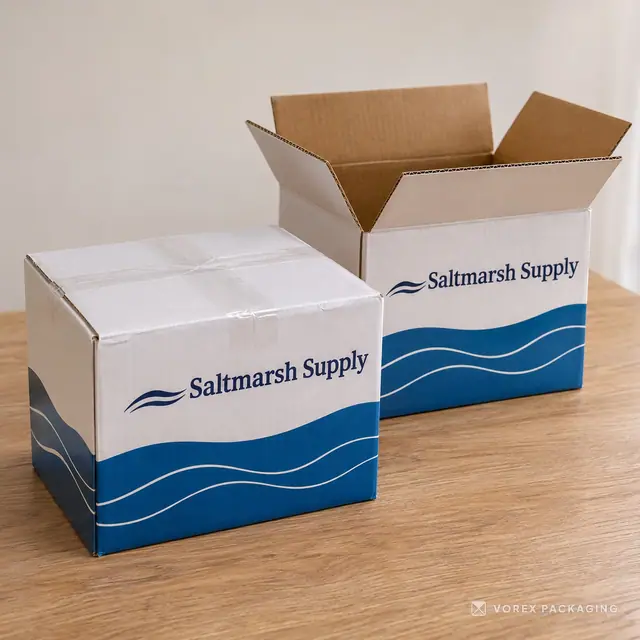
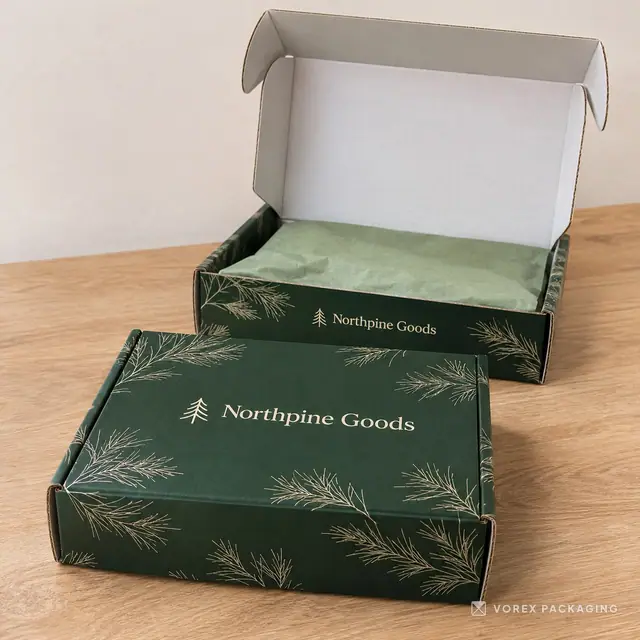
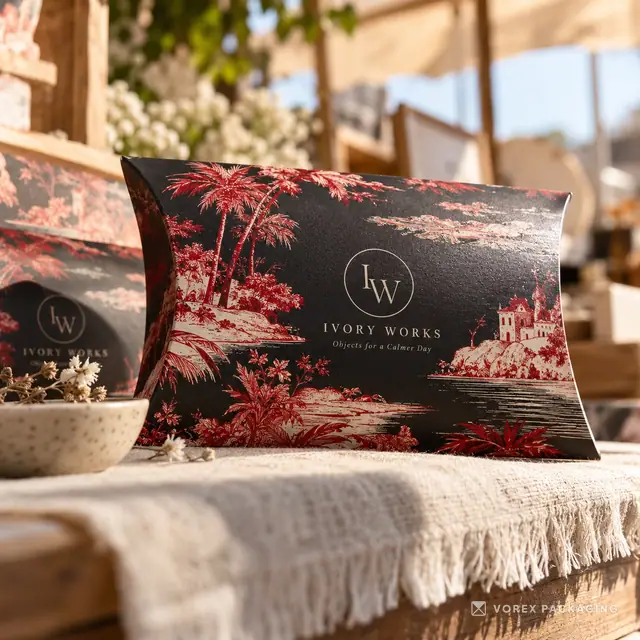
- Vorex mailer box packs are E-flute corrugated (packs page, 20 Oct 2026): thin, smooth and good for print.
- ECT (Edge Crush Test) presses a board sample on its edge; reported in pounds per inch of edge (e.g. 32 ECT) and directly related to stacking strength (Crown Packaging).
- Mullen (burst) test pushes through the face of the board; reported in pounds (e.g. 200#) and related to rough-handling durability. A box is rated by one test or the other; they are alternatives, not conversions.
- Crown Packaging: Mullen-rated board requires a minimum paper basis weight; ECT does not, so an ECT box of equal strength uses less material and weighs less.
- NMFC Item 222: boxes made to the rule carry a box maker's certificate on an outside surface, a circle 3 in across (plus or minus 1/4 in), reducible to no less than 2 in on small boxes. Parcel carriers publish their own packing guidance.
- Pick a minimum: packed weight plus outside length + width + depth added together. Single wall chart rows include 20 lb / 40 in = 125# or 23 ECT; 65 lb / 75 in = 200# or 32 ECT; 95 lb / 95 in = 275# or 44 ECT. Double wall starts at 100 lb (48 ECT), triple wall at 240 lb (67 ECT).
- The chart is a minimum, not a design: add a margin for stacking, humidity, long storage or fragile goods. Calculator: vorexpackaging.com/tools/ect-calculator/.
- 2026: Black Friday Nov 27, Small Business Saturday Nov 28, Cyber Monday Nov 30. USPS send-by dates for Dec 25 delivery in the contiguous US: Ground Advantage and First-Class Mail Dec 17, Priority Mail Dec 18, Priority Mail Express Dec 19; actual delivery may vary.
- USPS dimensional weight divisor 139 (was 166) from July 12, 2026, for packages over one cubic foot; Ordoro's example: 18x14x10 in goes from 16 lb to 19 lb. A 10x8x3 in mailer (240 cubic inches) is far below one cubic foot.
- Story: corrugated paper patented in England in 1856 for hat liners; Albert Jones patented single-faced corrugated shipping material on Dec 20, 1871; G. Smyth's machine and Oliver Long's two-liner board in 1874; Robert Gair's slipped ruler led to the pre-cut folding carton (1879 in his Wikipedia article, 1890 in the corrugated fiberboard article).
- Vorex pack prices listed 20 Oct 2026: kraft mailers 10x8x3 full color 1000 for $899, 1-color 500 for $449, inside and outside 250 for $219; white mailers 10x8x3 500 for $449 or 1000 for $899, 9x6x3 500 for $449; poly mailers 10x12 250 for $259, 500 for $369, 1000 for $679; single mailer box $18.99, single poly mailer $6.99; 3 in stickers 500 for $59, 1000 for $69.
- Broken products? Fix the inside first (fit and inserts), then check the board against the chart, then decide on double wall; test-ship one order to yourself.
Chapters
- 0:00 Cold open
- 1:12 Welcome to the show
- 2:53 What a corrugated box is made of
- 6:57 Edge crush and burst: the two ratings
- 11:54 How to pick the right box: the ECT calculator
- 16:36 Black Friday mailers: box size is money
- 21:09 Real story: the slipped ruler
- 24:22 What it costs: real pack prices
- 27:10 Question: do I need double wall?
- 29:23 Get started
Sources
The story segment uses public sources only. We paraphrase and state only what each source supports.
- Corrugated fiberboard (history and flutes): Corrugated fiberboard (Wikipedia, read 20 Oct 2026). Corrugated paper patented in England in 1856 for hat liners; Albert Jones's patent of 20 December 1871 for single-faced corrugated board as a shipping material; G. Smyth's first machine in 1874; Oliver Long's liner sheets on both sides in 1874; Robert Gair's pre-cut paperboard box after a ruler shifted and cut bags (dated 1890 there); US flute table A 33 +/-3 per ft 3/16 in, B 47 1/8 in, C 39 5/32 in, E 90 1/16 in, F 125 1/32 in; containerboard typically over 0.25 mm thick.
- Robert Gair: Robert Gair (Wikipedia, read 20 Oct 2026). Born in Edinburgh, Scotland, 1839; emigrated at 14; a metal ruler used to crease bags shifted and cut a bag, showing that cutting and creasing paperboard in one operation could make prefabricated cartons; folding carton dated 1879; several buildings in the Brooklyn area now called Dumbo still bear his name.
- Crown Packaging: Mullen Test vs. Edge Crush Test Boxes (whitepaper) (crownpack.com, read 20 Oct 2026). Mullen measures the force to rupture the face of the board, related to rough handling, reported in pounds (200#); ECT compresses a board sample on edge between rigid plates, reported in lb/in (e.g. 32 ECT), directly related to stacking strength; strength equivalency charts for single, double and triple wall; Mullen requires a minimum board basis weight, ECT does not, so an ECT box of equivalent strength weighs less.
- National Motor Freight Traffic Association (via Fibre Box Association): NMFC Item 222: specifications for fiberboard boxes, certificate of box manufacturer (fibrebox.org, read 20 Oct 2026). Boxes made to Item 222 must bear a legible box maker's certificate on an outside surface guaranteeing conformity; circle 3 in diameter plus or minus 1/4 in; burst (Table A) and edge crush (Table B) versions; may be reduced to not less than 2 in on boxes under 10 in long or 9 in wide; city and state of the manufacturing or corporate location.
- United States Postal Service: 2026 Holiday Shipping Deadlines (usps.com, read 20 Oct 2026). Recommended send-by dates for Dec 25 delivery in the contiguous US: Ground Advantage and First-Class Mail Thu Dec 17, Priority Mail Fri Dec 18, Priority Mail Express Sat Dec 19; actual delivery may vary.
- United States Postal Service (pricing): USPS shipping changes 2026 (Ordoro blog, 16 Jul 2026, read 20 Oct 2026). Dimensional weight divisor 166 to 139 from July 12, 2026 (Priority Mail, Priority Mail Express, Ground Advantage); each dimension rounds up to the next inch; one cubic foot (1,728 cubic inches) threshold; 18x14x10 in example from 16 lb to 19 lb.
- Vorex Packaging: ECT calculator and chart (vorexpackaging.com, read 20 Oct 2026). Inputs packed weight and L, W, D; outputs the minimum ECT or burst rating from the published table; the chart is a minimum, not a design; add a margin for stacking, humidity, long storage or fragile goods; ECT and Mullen are alternatives, not conversions.
- Vorex Packaging: Standard packs (vorexpackaging.com, read 20 Oct 2026).
- Vorex Packaging: Shipping policy, rush orders and quality guarantee (vorexpackaging.com, read 20 Oct 2026). free shipping on every order (owner, 1 Nov 2026); rush on request; reprint for production errors or transit damage reported within 60 days of delivery (/quality-guarantee/).
Packaging mentioned
- ECT calculator and chart
- Standard packs (fixed prices)
- Shipping boxes
- Mailer boxes
- Poly mailers
- Stickers
- Glossary: edge crush test (ECT)
- Glossary: burst strength
- Glossary: flute
- Black Friday and corporate holiday gifts
- Rush orders
- Shipping policy
- Quality guarantee (reprint)
Get a quote Try the 3D design preview
Full transcript
0:00 Jordan: Picture a pallet of boxes in a delivery truck in late November. Six boxes high. Every one of them looks fine from the outside.
0:09 Maya: Except the one at the bottom.
0:10 Jordan: Except the one at the bottom. That box is carrying the weight of five other boxes, plus everything inside them, for hours, through every bump in the road. And when it arrives, one corner has caved in.
0:24 Maya: That's a hypothetical. But if you ship products, you've probably opened a box like that, or worse, your customer has.
0:31 Jordan: Or picture the opposite. A small shop that's so worried about damage, it ships a two pound candle in a heavy double wall carton the size of a microwave.
0:41 Maya: And then pays for the size of that carton, every single time.
0:45 Jordan: So today is all about shipping boxes. What a corrugated box is actually made of, what those numbers like thirty-two E C T really mean, how to pick the right box without guessing, and how to get ready for Black Friday and Cyber Monday.
1:01 Maya: Plus a real story about a ruler that slipped, and how that accident helped create the box as we know it. Welcome to The Vorex Packaging Podcast. I'm Maya.
1:10 Jordan: And I'm Jordan.
1:13 Maya: Welcome back, and welcome if this is your first episode. This show is for people who make and sell things. Candle makers, skincare brands, coffee roasters, bakers, online shops, and anyone who puts a product in a box and sends it somewhere.
1:28 Jordan: Quick recap. Episode one was about what your box says before anyone opens it. Episode two was board, print and finish. Episode three was dielines and proofs. And episode four was holiday packaging for bakeries, cafes and online shops.
1:45 Maya: Today is the episode a lot of people skip, because it sounds technical. Shipping boxes. Corrugated board, flutes, and the two strength ratings you see stamped on the bottom of a box.
1:57 Jordan: I promise it's less scary than it sounds. By the end, you'll be able to read that little round stamp, and you'll know which questions to ask before you order.
2:06 Maya: Our house rules haven't changed. When we mention a real brand, a real date or a real number, it comes from a public source that we read while preparing this episode, and the links are in the show notes. When we use an example that isn't real, we'll tell you it's a hypothetical.
2:23 Jordan: And when we talk prices, they're the prices listed on the Vorex website today, the twentieth of October. Prices can change, so the website and your quote always have the final word.
2:34 Maya: Here's the plan. First, what corrugated board is made of. Then the two ratings, edge crush and burst. Then how to pick a box, with a calculator. Then Black Friday mailers and the cost of box size. Then our story, the prices, a question, and how to get started.
2:51 Jordan: Let's open the box.
2:57 Maya: Let's start with the material itself. People call it cardboard, but the word the industry uses is corrugated board, or corrugated fiberboard.
3:06 Jordan: And what's actually in it?
3:08 Maya: Look at the edge of any shipping box. You'll see two flat sheets of paper on the outside, and between them, a wavy sheet that looks like a row of little arches. The flat sheets are called liners. The wavy sheet in the middle is called the medium, and each of those little arches is a flute.
3:24 Jordan: So it's a paper sandwich.
3:26 Maya: A paper sandwich with a very clever filling. Those arches are what make the board stiff. A flat sheet of paper bends easily. Glue a wavy sheet between two flat ones, and suddenly it can stand on its edge and carry weight.
3:39 Jordan: Same idea as a bridge, really. Arches carry load.
3:43 Maya: Exactly. And the paper is usually kraft paper. Wikipedia's article on corrugated fiberboard describes the containerboard as typically over a quarter of a millimeter thick.
3:55 Jordan: Now, I've heard people say B flute or E flute. What does the letter mean?
4:00 Maya: The letter is the size of the flute. How tall the arches are, and how many fit into a foot. The common ones in the United States are A, B, C, E and F.
4:09 Jordan: Give me the numbers.
4:11 Maya: These come from the flute table in Wikipedia's corrugated fiberboard article. A flute is the tallest, about three sixteenths of an inch, with about thirty-three flutes per foot. The C size is about five thirty-seconds of an inch, with about thirty-nine per foot. B flute is about an eighth of an inch, with about forty-seven per foot.
4:31 Jordan: And the thin ones?
4:32 Maya: E flute is about a sixteenth of an inch, with about ninety flutes per foot. And F flute is about a thirty-second of an inch, with about one hundred twenty-five per foot.
4:42 Jordan: So the letters aren't in size order at all.
4:45 Maya: Not even close. So don't try to guess the size from the letter. Just remember the pattern. A and C are the thicker, cushier flutes. B is in the middle. E and F are thin.
4:55 Jordan: Why would you choose thin over thick?
4:58 Maya: It's a trade, as a general rule of thumb. Taller flutes give you more cushioning and more stacking strength for the same paper. Smaller flutes give you a flatter, smoother surface, which prints better, and a thinner wall, which folds into crisp shapes.
5:12 Jordan: Which is why mailer boxes are often E flute.
5:15 Maya: Right. A printed mailer box, the kind that opens like a little treasure chest, is very often E flute. On the Vorex packs page today, the kraft and white mailer box packs are listed as E flute corrugated. Thin enough to print beautifully and fold neatly, strong enough for a lot of everyday e-commerce products.
5:35 Jordan: And the brown box your new kettle arrives in?
5:38 Maya: That's more likely to be B or C flute, or a mix. A plain shipping carton cares more about strength and cushioning than about a perfect print surface.
5:46 Jordan: Okay, flutes. What about single wall and double wall?
5:50 Maya: Single wall means one medium between two liners. So, liner, flutes, liner. That's most of the boxes you see.
5:58 Jordan: And double wall?
5:59 Maya: Double wall is two layers of flutes, with three liners. Liner, flutes, liner, flutes, liner. You'll often see it written as B C flute, meaning one layer of B and one layer of C stuck together. And triple wall is three layers of flutes and four liners. That's for very heavy goods and freight.
6:17 Jordan: So if I want to know what I'm holding, I just look at the cut edge.
6:21 Maya: Look at the edge and count the wavy layers. One row of arches is single wall. Two rows is double wall. And if the arches are tiny, it's probably E or F. If they're chunky, it's probably B, C or A.
6:35 Jordan: That's a nice party trick.
6:37 Maya: It's a great supplier meeting trick. You'll sound like you've been doing this for years.
6:41 Jordan: One more term before we move on. Board grade. What does that mean?
6:46 Maya: Board grade is the overall recipe. Which flute, single or double wall, and how strong the board is rated. And that last part is where the numbers on the bottom of the box come in.
7:01 Jordan: Let's talk about those numbers. Thirty-two E C T. Two hundred pound test. What are they?
7:07 Maya: They're the two ways the corrugated industry rates the strength of board. For this part I read a guide from Crown Packaging called Mullen Test versus Edge Crush Test Boxes, and the definitions are pretty clear.
7:20 Jordan: Start with E C T.
7:21 Maya: E C T stands for Edge Crush Test. You take a small piece of board, stand it on its edge between two flat metal plates, with the flutes running up and down, and you press until it fails.
7:32 Jordan: So you're crushing it from the top, the way the boxes above it would.
7:37 Maya: That's the idea. The result is measured in pounds per inch of edge. So thirty-two E C T means the board held about thirty-two pounds for every inch of its edge before it crushed. Crown's guide calls it a true performance test that's directly related to a box's stacking strength.
7:54 Jordan: Which brings us back to the box at the bottom of the pallet.
7:57 Maya: Exactly. If your boxes get stacked, in a warehouse, on a pallet, in a truck, edge crush is the number that matters most.
8:05 Jordan: And the other one? The pound test?
8:07 Maya: That's the Mullen test, also called the burst test. Instead of crushing the edge, it pushes on the flat face of the board until it bursts through. Crown's guide describes it as related to rough handling durability. It's reported in pounds, like two hundred pound test, written as two hundred with a little pound sign.
8:25 Jordan: So burst is about something poking through, and edge crush is about stacking.
8:30 Maya: That's a good way to remember it. Burst is about punctures and rough handling, like a sharp corner inside the box, or a box being thrown around. Edge crush is about weight pressing down from above.
8:42 Jordan: Which one is better?
8:43 Maya: Neither one is better in general. They measure different things, and a box is usually rated by one or the other. But here's an interesting detail from the Crown guide. The Mullen rating comes with a minimum weight for the papers used to make the board. The edge crush rating doesn't have that requirement.
9:01 Jordan: Why does that matter?
9:03 Maya: Because it means a manufacturer can reach an edge crush rating with lighter paper, if the board is well made. Crown's guide says that when you compare two boxes of the same size and equivalent strength, the E C T rated box will weigh less because it uses less material.
9:20 Jordan: And a lighter box is cheaper to ship.
9:22 Maya: And uses less paper. That's a big reason why E C T is so common for modern e-commerce boxes.
9:28 Jordan: Okay. Where do I actually see these numbers?
9:31 Maya: On the box maker's certificate. It's that round stamp you've probably seen on the bottom flap of a shipping box, a circle with text around the edge.
9:40 Jordan: I always assumed that was decoration.
9:43 Maya: Most people do. It actually comes from the rules of the freight world. In the United States there's a rulebook called the National Motor Freight Classification, published by the National Motor Freight Traffic Association, and one of its rules, Item two twenty-two, sets out specifications for fiberboard boxes. The Fibre Box Association publishes a copy of those items, and that's what I read.
10:07 Jordan: And what does the rule say about the stamp?
10:10 Maya: It says that boxes made to meet that rule must carry a legible certificate of the box manufacturer on an outside surface, guaranteeing that the boxes conform. The certificate is a circle about three inches across, give or take a quarter inch. On small boxes, it can be shrunk, but not below two inches across.
10:30 Jordan: And what's printed in the circle?
10:32 Maya: There are two versions. One for boxes rated by the burst test, and one for boxes rated by edge crush. Either way, it tells you which test the board meets and the limits that go with it, like the maximum weight the box is meant to carry and a size limit. And the rule allows the box maker's city to be either where it was made or the company's corporate location.
10:54 Jordan: So that stamp is basically the box's spec sheet.
10:57 Maya: It's the box's spec sheet, printed right on the box. One caveat. That rule is written for freight, the trucking side. Parcel carriers like U S P S, U P S and FedEx publish their own packing guidance. So the stamp is a very useful reference, but always check your own carrier's rules too.
11:15 Jordan: Can you convert one to the other? Like, is thirty-two E C T the same as two hundred pound test?
11:21 Maya: This is where people get confused. There are published tables that line them up side by side, and in those tables, thirty-two E C T sits on the same row as two hundred pound burst. But they're alternatives, not a conversion. A box qualifies by one test or the other. Our own calculator page says the same thing. They're two different ways to meet the same weight and size limit.
11:45 Jordan: So two boxes on the same row are both acceptable for that load, but they're not tested the same way.
11:51 Maya: Right. And that's the table we'll use next.
11:58 Jordan: Okay. I'm a small business, I'm not a packaging engineer. How do I actually pick a rating?
12:04 Maya: You need two numbers. The packed weight, meaning the product plus the box plus everything inside it. And the outside size of the box, length plus width plus depth, added together.
12:15 Jordan: Added together. Not multiplied.
12:18 Maya: Added. For the strength tables, you add the three outside dimensions. A twelve by ten by six inch box is twelve plus ten plus six, so twenty-eight inches.
12:28 Jordan: Got it. And then?
12:29 Maya: Then you look up the row in the table. The Crown guide has the standard chart for single, double and triple wall boxes. Each row gives a maximum weight, a maximum combined size, the burst rating and the edge crush rating. You find the first row where your box fits under both limits.
12:47 Jordan: Walk me through a few rows.
12:49 Maya: For single wall, the first row is up to twenty pounds and forty inches combined. That's one hundred twenty-five pound burst, or twenty-three E C T.
12:58 Jordan: And the famous thirty-two?
13:00 Maya: Thirty-two E C T sits on the row for up to sixty-five pounds and seventy-five inches combined. That's the same row as two hundred pound burst.
13:09 Jordan: So that's where the classic two hundred pound test box comes from.
13:13 Maya: Exactly. And the single wall rows keep going. Forty-four E C T is the row for up to ninety-five pounds and ninety-five inches. For double wall, the chart starts at one hundred pounds, with forty-eight E C T. And triple wall starts at two hundred forty pounds, with sixty-seven E C T.
13:32 Jordan: That's a lot of rows to remember.
13:34 Maya: Which is why there's a calculator. Vorex has an E C T calculator at vorexpackaging.com/tools/ect-calculator. You type in the packed weight in pounds and the length, width and depth in inches, and it gives you the minimum edge crush or burst rating from that published table.
13:53 Jordan: And it shows the table, so you can check it yourself.
13:57 Maya: It shows the whole table and the sources. And the page is honest about what it is. It says the chart is a minimum, not a design, and that you should add a margin for stacking, humidity, long storage or fragile goods.
14:10 Jordan: Let's try one. Give me a hypothetical.
14:13 Maya: Hypothetical candle shop. A gift set of three candles. Packed in a twelve by ten by six inch box with inserts, it weighs about eight pounds.
14:22 Jordan: Eight pounds, and twelve plus ten plus six is twenty-eight inches.
14:27 Maya: So that's under twenty pounds and under forty inches. The first single wall row. The minimum is twenty-three E C T or one hundred twenty-five pound burst.
14:36 Jordan: So I'd order twenty-three E C T?
14:39 Maya: That's the minimum. But think about the margin. Candles are glass, they're heavy for their size, and in December those boxes might sit in a warehouse and then ride in a packed truck. So a lot of shops in that situation would ask their supplier about something stronger than the bare minimum.
14:55 Jordan: Which is the point of the margin.
14:58 Maya: Right. The table tells you the floor. Your product tells you how far above the floor to go.
15:03 Jordan: Another one. Something heavier.
15:05 Maya: Hypothetical kitchen shop, shipping a cast iron set. Packed weight about forty pounds, in an eighteen by fourteen by twelve inch box.
15:14 Jordan: Eighteen plus fourteen plus twelve. Forty-four inches.
15:18 Maya: Forty pounds is over the thirty-five pound row, so you go to the next one. Up to fifty pounds and sixty inches. That row is twenty-nine E C T, or one hundred seventy-five pound burst.
15:30 Jordan: And cast iron has corners.
15:32 Maya: And cast iron has corners, and it's dense, so it presses hard on the box from the inside. That's exactly the kind of product where people often look at burst strength too, or add good inserts so the corners don't touch the walls.
15:46 Jordan: When should someone think about double wall?
15:49 Maya: The chart starts double wall at a hundred pounds. But weight isn't the only reason. If your boxes are stacked on pallets, stored for a long time, kept somewhere damp, or carry something fragile and valuable, those are all reasons to talk to your supplier about stronger board. The calculator page lists the same reasons.
16:09 Jordan: And the opposite mistake? Overbuilding?
16:11 Maya: That's real too. A higher rating adds weight and cost. The best box is strong enough for its load and its trip, without being overbuilt. So don't just pick the biggest number on the chart.
16:22 Jordan: So the short version.
16:23 Maya: Weigh it packed. Add up the outside dimensions. Use the calculator for the minimum. Add a margin for your real life. Then tell your supplier all of that, including how the box ships and whether it gets stacked.
16:40 Jordan: Let's bring this into the season. Black Friday is coming.
16:44 Maya: In 2026, US Thanksgiving is Thursday, November twenty-sixth. That makes Black Friday November twenty-seventh, Small Business Saturday November twenty-eighth, and Cyber Monday November thirtieth.
16:57 Jordan: And for anyone shipping gifts for Christmas?
17:00 Maya: The U S P S holiday page, which I read today, lists recommended send-by dates for delivery by December twenty-fifth in the contiguous United States. Ground Advantage and First-Class Mail, Thursday, December seventeenth. Priority Mail, Friday, December eighteenth. Priority Mail Express, Saturday, December nineteenth. And U S P S notes that actual delivery can vary.
17:26 Jordan: So your boxes need to be in your hands well before Black Friday.
17:30 Maya: Well before. Work backwards. Your quote and design, your proof rounds, about seven days of production after you approve the proof at Vorex, then shipping to you. And then a buffer, because November is busy for everyone. [Correction, 8 Nov 2026: Vorex does not promise a set number of days; production is fast once you approve your proof, and your quote confirms the delivery estimate.]
17:44 Jordan: Let's talk about what online shops actually ship in. Mailer boxes first.
17:49 Maya: The mailer box is the e-commerce favorite. One piece of board, it folds into a box with a lid attached, and it opens from the front. It looks great printed, it closes without much tape, and it's strong enough for a lot of products.
18:03 Jordan: And it's usually E flute, like we said.
18:06 Maya: Usually E flute. Which is perfect for things like skincare, candles, apparel, small electronics, subscription boxes. If you're shipping something very heavy or very fragile in a mailer, ask about a stronger flute or better inserts.
18:20 Jordan: Subscription boxes are huge right now. Anything special there?
18:25 Maya: A subscription box is usually a printed mailer, but the products inside change every month. So I'd size the box for your typical month, not your biggest month, and use inserts or crinkle paper to fill the gaps. And keep the outside design evergreen, so one print run lasts several months.
18:43 Jordan: And for Black Friday?
18:44 Maya: If you offer gift subscriptions over the holidays, it's a good moment to think about the unboxing. A printed inside, a sticker, a note. We talked about that last episode.
18:55 Jordan: And when is a box overkill?
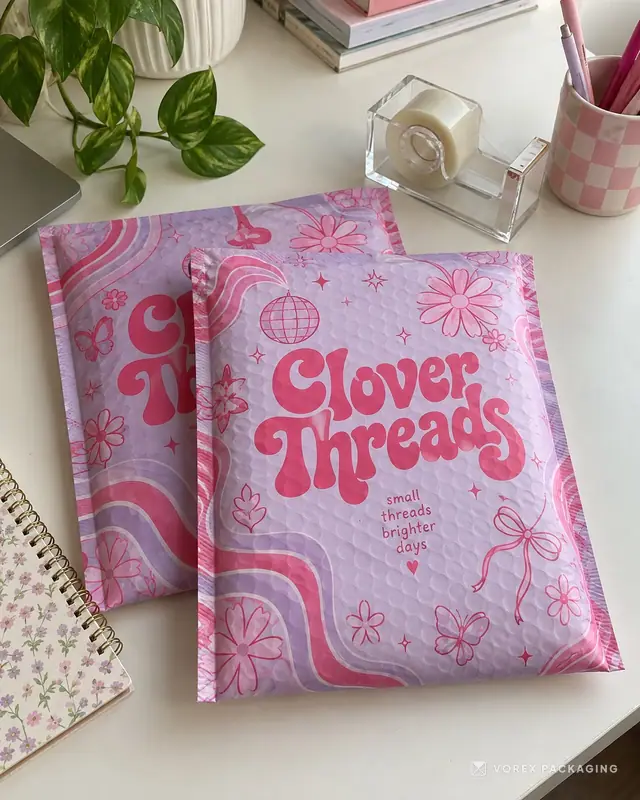
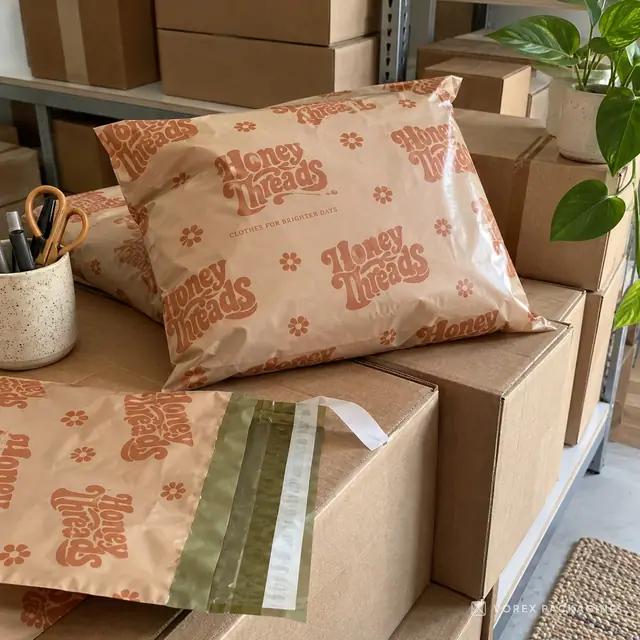
18:57 Maya: If it can't break, a box might be overkill. Clothing, soft goods, a lot of accessories. A printed poly mailer is light, it's flat, and it's waterproof. You pay to ship less air.
19:09 Jordan: Speaking of shipping air.
19:10 Maya: Speaking of shipping air. Let's talk about the size of your box.
19:14 Jordan: We covered this in episode four, but it's worth repeating for anyone who missed it.
19:19 Maya: It is. Carriers don't just charge for weight. For bigger packages, they charge for space, using something called dimensional weight. You multiply length by width by height, and divide by a number called the divisor.
19:32 Jordan: And U S P S changed that number this year.
19:34 Maya: According to Ordoro's write-up from July sixteenth, the U S P S divisor changed from one hundred sixty-six to one hundred thirty-nine, effective July twelfth, 2026. It covers services including Priority Mail, Priority Mail Express and Ground Advantage, and it applies to packages over one cubic foot, which is one thousand seven hundred twenty-eight cubic inches. Each side rounds up to the next whole inch.
20:01 Jordan: Give me the example.
20:03 Maya: Ordoro's example is an eighteen by fourteen by ten inch package. With the old divisor, that came to sixteen pounds of dimensional weight. With the new divisor, nineteen pounds. Three extra billable pounds, with no change to the box or what's in it.
20:19 Jordan: And our ten by eight by three mailer?
20:21 Maya: Ten by eight by three is two hundred forty cubic inches. That's far under one cubic foot. So for that box, the dimensional weight rule we just described doesn't kick in at U S P S.
20:33 Jordan: Which is another argument for right-sizing.
20:35 Maya: Exactly. Look at your three or four most common orders, and make sure you have a box that fits each one snugly. Every inch you take off a big box can save money on every order. And U P S and FedEx have their own rules, so check your own carrier rates.
20:50 Jordan: And this connects to everything we said about E C T.
20:54 Maya: It does. Right size and right strength go together. A smaller box that fits snugly means the product moves less, which means less damage. And a box that's strong enough, but not overbuilt, means less weight and less cost. That's the sweet spot.
21:12 Jordan: Story time. And today it's a story about the box itself.
21:17 Maya: I love this one. All of it comes from two Wikipedia articles I read today, the one on corrugated fiberboard and the one on a man named Robert Gair. Links in the show notes.
21:28 Jordan: Where does it start?
21:29 Maya: It starts with hats. According to Wikipedia, corrugated paper was patented in England in 1856, and it was used as a liner inside tall hats.
21:40 Jordan: Hats. Not shipping.
21:42 Maya: Not shipping. Then on December twentieth, 1871, a man named Albert Jones, in New York City, received a patent for using single-faced corrugated board as a shipping material. Single-faced means one flat liner with the wavy medium on one side.
22:00 Jordan: So, half of today's board.
22:02 Maya: Half of it. And in 1874, two things happened. A man named G. Smyth built the first machine to make corrugated board in large quantities. And Oliver Long improved Jones's design by putting liner sheets on both sides.
22:18 Jordan: So 1874 is when the paper sandwich was born.
22:23 Maya: That's when the sandwich got its second slice of bread. The liner, flutes, liner board we talked about at the top of the show.
22:31 Jordan: And the ruler?
22:32 Maya: That's Robert Gair. According to his Wikipedia article, he was born in Edinburgh, Scotland, in 1839, and came to the United States at fourteen. He ran a paper bag business in Brooklyn.
22:45 Jordan: Paper bags.
22:47 Maya: Paper bags. And one day in his factory, a metal ruler that was used to crease the bags shifted position, and instead of creasing a bag, it cut it.
22:56 Jordan: A mistake.
22:57 Maya: A mistake. But Gair realized that if you cut and crease paperboard in one operation, you could make box blanks in advance. Flat, pre-cut pieces that fold up into cartons. His Wikipedia article dates that invention of the folding carton to 1879. The corrugated fiberboard article tells the same story under 1890. So the sources differ on the year, and we'll leave it at that.
23:24 Jordan: Honest answer.
23:26 Maya: Honest answer. What both agree on is the idea. Cut and crease in one step, ship flat, fold later. The corrugated article says that idea was later applied to corrugated board too. And Gair's article says he went on to build a paper business that occupied several buildings in the part of Brooklyn now called Dumbo, and many of them still carry his name.
23:47 Jordan: So what's the lesson for a small business today?
23:50 Maya: Two lessons, I think. First, the thing that made the modern box possible wasn't just a stronger paper. It was cutting and creasing in one step. That's exactly what a dieline is. When you approve a dieline for a mailer box, you're using Gair's idea.
24:05 Jordan: And the second?
24:07 Maya: Shipping flat. Your boxes arrive as flat sheets and you fold them as you need them. That's why a thousand mailer boxes can fit in a corner of your stockroom. It all goes back to a ruler that slipped.
24:19 Jordan: I'll never look at a flat box the same way. We promised real prices. Maya, what do the Vorex standard packs cost for online shops right now?
24:32 Maya: These are the launch prices listed on the Vorex packs page today, the twentieth of October. They're fixed packs in popular sizes, printed with your artwork, and you approve a digital proof before anything prints.
24:45 Jordan: Start with mailer boxes.
24:47 Maya: Kraft mailer boxes, ten by eight by three inches, E flute, printed full color outside, are eight hundred ninety-nine dollars for one thousand. That's about ninety cents each.
24:58 Jordan: And smaller runs?
24:59 Maya: The same kraft mailer with a one color logo outside is four hundred forty-nine dollars for five hundred. And the kraft mailer printed full color inside and outside is two hundred nineteen dollars for two hundred fifty. About eighty-eight cents each.
25:15 Jordan: And white?
25:16 Maya: White mailer boxes, ten by eight by three, full color outside, are four hundred forty-nine dollars for five hundred, or eight hundred ninety-nine for one thousand. And a smaller white mailer, nine by six by three inches, full color, is four hundred forty-nine dollars for five hundred.
25:35 Jordan: Poly mailers?
25:36 Maya: Printed poly mailers, ten by twelve inches, full color on one side, are two hundred fifty-nine dollars for two hundred fifty, three hundred sixty-nine for five hundred, or six hundred seventy-nine for one thousand.
25:50 Jordan: And if I just want to hold one first?
25:52 Maya: There are single piece listings. A single printed mailer box, kraft or white, is eighteen dollars and ninety-nine cents. A single printed poly mailer is six dollars and ninety-nine cents.
26:04 Jordan: And stickers, for the people who sticker the rest.
26:07 Maya: Three inch square stickers, glossy, full color, are fifty-nine dollars for five hundred, or sixty-nine dollars for one thousand.
26:15 Jordan: Shipping on the packs?
26:17 Maya: [Correction, 2 Nov 2026: shipping is free on every order.And promo codes apply to custom quotes, not to the packs, because the packs already have launch pricing.
26:32 Jordan: And if the pack size isn't right?
26:34 Maya: Then a custom quote. Any size, any style, with no minimum order quantity. That's also how you get a specific board. If you need a particular flute, double wall, or a certain strength rating, put it in your quote request, with your product weight, and the specialist will tell you what the quote is for. [Correction, 2 Nov 2026: shipping is free on every order.]
26:57 Jordan: So a shop could test a printed mailer for under twenty dollars before committing.
27:02 Maya: Eighteen ninety-nine for one box, at today's listed price. Prices can change, so always check the packs page and your quote.
27:14 Jordan: Time for our question. And as always, honesty first. We still don't have a listener question we can read on air, so we picked one we think a lot of you are asking.
27:24 Maya: And if you'd like your question on the show, email hello@vorexpackaging.com and tell us it's okay to read it on air.
27:32 Jordan: The question. I sell handmade ceramic mugs online. A few arrived broken last month. Should I switch everything to double wall boxes before Black Friday?
27:43 Maya: Good question, and I understand the instinct. Something broke, so make the box stronger. But let's slow down for a second.
27:50 Jordan: Where would you start?
27:52 Maya: With why they broke. A mug that breaks in a box usually breaks because it moved, or because something hit the box hard right where the mug was touching the wall. Double wall helps with stacking and some impacts, but if the mug can still slide around inside, a thicker wall won't save it.
28:09 Jordan: So the inside matters as much as the outside.
28:12 Maya: Often more. First, I'd look at the fit and the inserts. The mug should be held in place, with some space between it and every wall, filled with something that cushions. A fitted insert, or good padding, does a lot of the work.
28:25 Jordan: And then the box?
28:27 Maya: Then check the box against the numbers. Weigh a packed order. Add up the outside dimensions. Put them in the calculator to see the minimum, and then add your margin, because ceramics are fragile. If you're shipping two or four mugs in one box, the weight goes up quickly, and that's where a stronger board starts to make sense.
28:45 Jordan: And the cost side?
28:47 Maya: Double wall adds weight and thickness. A thicker wall can push your outside size up, and with the new dimensional weight divisor, size costs money on bigger boxes. So I'd only go to double wall if the numbers or your damage pattern point there.
29:02 Jordan: So the answer is, maybe, but fix the inside first.
29:05 Maya: Fix the inside first, then check the board against the chart, then decide. And test it. Pack one order the way you'd pack it in December, and send it to yourself, or to a friend across the country.
29:17 Jordan: The test shipment again.
29:19 Maya: Every episode. It's the cheapest packaging test there is.
29:26 Jordan: That's our episode on shipping boxes, E C T and Black Friday mailers. Maya, how do people take the next step?
29:35 Maya: First, try the calculator at vorexpackaging.com/tools/ect-calculator. Weight, length, width, depth, and you get your minimum rating and the table behind it.
29:47 Jordan: For fixed prices in popular sizes, the standard packs are at vorexpackaging.com/packs.
29:54 Maya: And for anything else, request a quote at vorexpackaging.com/quote. Tell them the style, the inside size, the quantity, the packed weight, how it ships, and the date you need the boxes in your hands.
30:07 Jordan: Packed weight is new on that list.
30:09 Maya: After today, I think you know why.
30:11 Jordan: You can also try the 3D design preview on the home page. Upload your logo, pick a box shape and color, and turn it around in your browser before you decide anything. And the full catalogue of styles is on the website too.
30:26 Maya: A few Vorex facts in one place. There is no minimum order quantity: order 1 piece or 10,000. Production is about seven days after you approve your proof, then your order ships. [Correction, 2 Nov 2026: shipping is free on every order.] And there's a reprint for production errors reported within sixty days of delivery. [Correction, 8 Nov 2026: Vorex does not promise a set number of days; production is fast once you approve your proof, and your quote confirms the delivery estimate.]
30:47 Jordan: If you're new, the code FIRST20 takes twenty percent off your first custom order. It's for new customers, one per business, and it isn't combined with other offers or used on the packs.
30:58 Maya: And if your date is tight, ask about rush orders when you request your quote.
31:03 Jordan: A word on how Vorex works. Vorex Packaging is a packaging studio. They help with style, sizing and design, and they print and ship to customers across the United States.
31:16 Maya: Everything we mentioned today, the flute table, the Crown guide, the freight rule on box certificates, the U S P S dates, the dimensional weight change, our story, the calculator and the packs, is linked in the show notes.
31:29 Jordan: If this episode helped, follow the show, and send it to someone who's about to ship a lot of boxes this November.
31:36 Maya: Weigh it packed, add it up, and check the stamp.
31:39 Jordan: Weigh it packed, add it up, and check the stamp. Thanks for listening to The Vorex Packaging Podcast. I'm Jordan.
31:46 Maya: And I'm Maya. See you next time.
Voices produced with AI text-to-speech.