













From Dieline to Doorstep: Approve Your Proof Right and Plan Your Holiday Packaging
· 35 min · The Vorex Packaging Podcast
In episode three, Maya and Jordan walk through the part between a packaging idea and a box in your hands: what a dieline is (cut, fold and glue lines, inside dimensions, style by style), how to set up artwork that survives the cut (bleed, safe zone, panel direction, vector files, 300 DPI, CMYK or Pantone, outlined fonts), and how to read a proof before you approve it, point by point. Then two real stories from public sources: the FDA's 2020 warning to Whole Foods Market over undeclared allergens and an FDA analysis that traced many allergen recalls to the wrong label or package, and the Starbucks holiday cup, from the first 1997 design to the plain red cup of 2015. Plus a working-backwards holiday timeline from Halloween (the episode's October 15 proof date has passed; ask about rush orders) through US Thanksgiving, Black Friday, Hanukkah, Christmas and New Year's Eve, and a question about printing the holiday or the year on your boxes.
Player not loading? Spotify's player isn't available in every country. Open the episode on Spotify, or read the full transcript below.
In this episode
- A dieline is your box unfolded flat: cut lines, fold (crease) lines and a glue area. Every style and every size has its own.
- Give box sizes as inside dimensions in the order length x width x height; the outside is larger because of the board thickness.
- The Vorex dieline generator draws eight common styles with bleed and safe zone lines (1/8 in each). Print the PDF at 100%, check the 1 in bar, fold a test box, and ask the printer to confirm the final dieline for their board.
- Background out, words in: extend backgrounds past the cut line (bleed), keep text and logos inside the safe zone and off folds and the glue flap.
- Print-ready files: vector PDF, AI or EPS where possible, photos at 300 DPI at print size, CMYK or Pantone (not RGB), outlined fonts, body text at least 9 pt.
- Proof checklist: spelling, logo and image placement, colors and branding, style and dimensions, dieline and folds, barcode placement, materials and finishes, quantity and delivery address.
- Read every word out loud and type the printed web address into a browser. Check each variant's proof as if it were the first.
- A proof confirms layout, not exact color. Give Pantone or CMYK values, and ask about a physical sample when color is critical.
- You are responsible for the approved proof: errors on it are not production errors. After approval, production starts quickly and changes are generally not possible.
- FDA (Dec 2020): undeclared allergens were the leading cause of Class I food recalls for at least three years; an FDA analysis found the wrong label or package behind 82 of 281 allergen recalls with known causes (2009-2012). Make variants easy to tell apart.
- Starbucks: holiday cups since 1997, mostly red since 1999, and a plain red cup in 2015 became a national conversation. Holiday packaging gets noticed, so decide it on purpose.
- Delivery = quote and design + proof rounds + Fast production after approval + shipping + a holiday buffer + your own packing time. Tell the specialist your in-hand date.
- 2026 dates: Halloween Sat Oct 31 (the Oct 15 proof date has passed: ask about rush orders); US Thanksgiving Thu Nov 26; Black Friday Nov 27; Cyber Monday Nov 30; Hanukkah begins at sundown Dec 4; Christmas Fri Dec 25; New Year's Eve Thu Dec 31.
- Not sure of seasonal quantities? Go festive but general, run a small seasonal batch (no minimum order), or keep the box evergreen and add the season with a sleeve, belly band or sticker.
Chapters
- 0:00 Cold open
- 1:06 Welcome to the show
- 2:25 What a dieline actually is
- 6:52 Artwork that survives the cut
- 11:40 Reading a proof before you approve
- 17:52 Real stories: labels and a holiday cup
- 23:43 Holiday timeline: Halloween to New Year
- 29:31 Question: print the holiday on the box?
- 32:33 Get started
Sources
The story segment uses public sources only. We paraphrase and state only what each source supports.
- US Food and Drug Administration: FDA Warns Whole Foods Market After Repeated Food Recalls for Undeclared Allergens (FDA (Human Foods Program constituent update), 22 Dec 2020, read 13 Oct 2026). More than 30 Whole Foods Market food products recalled in the previous year because major food allergens were not listed on the finished product labels; undeclared food allergens the number one cause of Class I food recalls for at least the last three years; first FDA warning letter to a retailer for that pattern.
- US Food and Drug Administration (research): Quick fixes could quell rising tide of undeclared allergen food recalls (FoodNavigator (Elizabeth Crawford), 30 Oct 2014, read 13 Oct 2026). FDA analysis (Steven Gendel and colleagues): wrong label or package behind 82 of 281 undeclared-allergen recalls with known root causes, September 2009 to 2012; similar-looking labels and rushed staff grabbing the wrong package; Robert Brackett (Illinois Institute of Technology) on taking a few extra seconds to confirm the label matches the food and storing labels separately.
- Starbucks: Starbucks Red Cup (Wikipedia (cites Starbucks Stories, 2007 and 2022), read 13 Oct 2026). First holiday cups in 1997, a jazz-themed gift-wrap design by Sandy Nelson in several colors; predominantly red for the first time in 1999; plain red cups in 2015 drew criticism and calls for a boycott although the designs had never included Christian imagery.
- Vorex Packaging: Artwork and proof policy (vorexpackaging.com, read 13 Oct 2026). What the proof shows, the eight-point checklist, responsibility for the approved proof, color limits of proofs, physical samples for suitable orders, file requirements (vector, 300 DPI, CMYK/Pantone, outlined fonts, 9 pt minimum).
- Vorex Packaging: Free dieline generator (vorexpackaging.com, read 13 Oct 2026). Eight styles; inches or millimeters; SBS or E-flute; bleed 0.125 in and safe zone 0.125 in; SVG and actual-size PDF; print at 100% and check the 1 in bar; ask the printer to confirm the final dieline.
- Vorex Packaging: Shipping policy and Halloween packaging page (vorexpackaging.com, read 13 Oct 2026). Total delivery time = production + shipping; fast standard production after proof approval; holiday periods can take longer; tell the specialist a hard deadline; HALLOWEEN25 until Oct 31 and for Halloween, the Oct 15 proof date has passed: ask about rush orders (/seasonal/halloween-packaging/); Hanukkah begins at sundown Dec 4, 2026 (/seasonal/hanukkah-packaging/).
Packaging mentioned
- Free dieline generator
- Artwork and proof policy
- How it works
- How to measure a box
- How to prepare artwork for custom boxes
- Shipping policy
- Quality guarantee (reprint)
- Cancellation policy
- Rush orders
- Halloween packaging (HALLOWEEN25)
- Thanksgiving packaging
- Black Friday and corporate holiday gifts
- Hanukkah packaging
- Christmas packaging
- New Year packaging
- Belly bands
- Stickers
- Sleeve boxes
Get a quote Try the 3D design preview
Full transcript
0:00 Maya: Here's a moment almost every product business goes through. An email arrives with a PDF attached. It says, here is your proof, please approve. And there's a button.
0:10 Jordan: And the box is right there on the screen. Your logo, your colors, your product name. It looks great.
0:17 Maya: It looks great at the size of a phone screen, at eleven at night, when you just want the order moving. So you click approve.
0:24 Jordan: And two weeks later, five hundred boxes arrive, and the website address on the side panel is missing a letter.
0:31 Maya: Or the front of the box is printed upside down when the lid opens. Or the barcode sits right on a fold.
0:37 Jordan: So today is all about that one click. What a dieline actually is, how to set up artwork that survives the cut, and how to read a proof like a pro before you approve it.
0:48 Maya: Plus a real story about why label mistakes are such a big deal for food brands, a holiday cup that turned into a national conversation, and a practical timeline from Halloween all the way to New Year's.
1:01 Jordan: Welcome to The Vorex Packaging Podcast. I'm Jordan.
1:05 Maya: And I'm Maya.
1:06 Jordan: Welcome back, and welcome if you're new. This show is for people who make and sell things. Bakers, candle makers, skincare founders, coffee roasters, online shops, and anyone who puts a product in a box.
1:20 Maya: In episode one we talked about what a box says before it's opened. In episode two we went into board, print and finish. Today is the part that sits between a nice idea and a box in your hands. The dieline, the artwork and the proof.
1:35 Jordan: And then the calendar, because it's the middle of October, and the holiday season is coming whether our proofs are ready or not.
1:43 Maya: Our house rules still apply. When we talk about a real brand or a real number, it comes from a public source, and the links are in the show notes. When we use an example that isn't real, we'll say it's a hypothetical.
1:55 Jordan: One change from earlier episodes. Today we will mention a few Vorex facts, because they matter for timing. Things like order quantities and the production time. Those all come straight from the Vorex website, and they're linked in the show notes too.
2:12 Maya: Here's the plan. First, what a dieline is. Then setting up artwork. Then the proof checklist. Then our stories, then the holiday timeline, a question about seasonal designs, and how to get started.
2:24 Jordan: Let's go.
2:29 Maya: Jordan, let's start with the word itself. Dieline. People hear it all the time and nod along. What is it?
2:36 Jordan: The simplest way I can put it is this. A dieline is your box, unfolded and lying flat. Picture taking a finished box, cutting it open along the glued seam and pressing it flat on a table. The outline you'd trace around it, plus the lines where it used to fold, that's basically the dieline.
2:55 Maya: So it's a map of the box.
2:56 Jordan: Exactly, a flat map. And it has a few kinds of lines on it, which usually come in different colors or line styles. There's the cut line, which is the outer shape, where the board gets cut. There are fold lines, sometimes called crease lines, where the board gets scored so it folds cleanly. And there is usually a glue area, the narrow flap that gets glued to make the box hold its shape.
3:21 Maya: And where does the word die come from?
3:23 Jordan: From the cutting tool. In packaging, a die is the tool that cuts and creases the board in the shape of your box, a bit like a very precise cookie cutter. The dieline is the drawing that the die follows.
3:36 Maya: And every box style has a different dieline.
3:39 Jordan: Every one. A reverse tuck end box, which is the classic carton with a tuck flap at the top and another at the bottom going the opposite way, has one shape. A straight tuck end has both tuck flaps going the same way. An auto lock bottom has that clever folded base that snaps into place. A mailer box, a pillow box, a sleeve, a two-piece box with a lid, a gable box with a handle. Each one unfolds into its own map.
4:08 Maya: And then on top of the style, there's the size.
4:10 Jordan: Right. The same style in a different size is a different dieline. And here's the first thing I'd want every listener to remember. Box sizes are usually given as inside dimensions, length, then width, then height, measured where your product actually sits.
4:27 Maya: Why inside?
4:29 Jordan: Because the product lives inside. The board has a thickness, so the outside of the box is always a little bigger than the inside. If you measure your jar and ask for those numbers as the outside size, the jar may not fit.
4:43 Maya: And this is where the order of the numbers trips people up.
4:46 Jordan: It really does. Length is usually the longer side of the opening, width the shorter side of the opening, and height is the depth from the opening down. Measure your product, add a little room for whatever goes around it, like tissue or an insert, and write the numbers down in that order. There is a guide on how to measure a box on the Vorex website, and it's in the show notes.
5:10 Maya: Now, you don't have to draw a dieline yourself, right?
5:14 Jordan: No. And most people shouldn't. When you order custom packaging, the printer works from their own dieline for their board. Vorex sends your artwork on the exact dieline for your box in the proof. But if you want to start designing early, there's a free dieline generator on the Vorex website.
5:31 Maya: What does it do?
5:32 Jordan: You pick one of eight common styles, the ones I just listed, enter the inside length, width and height in inches or millimeters, and choose the board, like SBS paperboard or E flute corrugated. It draws the cut, fold, bleed and safe zone lines on separate layers, and you download it as an SVG or a PDF drawn at actual size.
5:56 Maya: And here's my favorite tip from that page. Print the PDF at one hundred percent, actual size, not fit to page. Then measure the one inch bar in the legend with a ruler. If it really measures one inch, your print is true to scale. Then cut it out and fold a test box.
6:13 Jordan: That paper test box is worth so much. You will learn more from holding it for thirty seconds than from looking at the screen for an hour. You'll see which panel faces the customer, where the flaps land, and whether your product actually fits.
6:28 Maya: And then the page says one more important thing. Ask your printer to confirm the final dieline for their board before you send final artwork.
6:36 Jordan: Because different boards have different thicknesses, and the final dieline is matched to the board that's actually used. A template from anywhere, including a generator, is a starting point for design. The printer's dieline is the one that counts.
6:56 Maya: Okay, so we have the map. Now we put the artwork on it. And there are two words everybody needs. Bleed and safe zone.
7:04 Jordan: Let's do bleed first.
7:06 Maya: Bleed is the extra artwork that goes past the cut line. If your box has a background color or a pattern that should run right to the edge, you extend it beyond the cut line, so that when the die cuts the board, there's color all the way to the edge.
7:20 Jordan: Why is that needed? Shouldn't the cut just be exact?
7:24 Maya: Cutting is precise, but no machine cutting thousands of sheets is perfect to the hair. A tiny shift is normal. If your color stops exactly on the cut line, a tiny shift shows a thin white or brown edge where the board shows through. Bleed covers that.
7:40 Jordan: And how much bleed?
7:42 Maya: On the Vorex dieline generator, the bleed line is one eighth of an inch outside the cut line. Your printer will confirm the exact amount for your job, but that gives you the idea. It's small, and it matters.
7:54 Jordan: And the safe zone is the opposite idea.
7:57 Maya: It is. The safe zone is a margin inside the cut and fold lines where you keep anything important. Text, logos, your website, your ingredients. On the generator, that's also one eighth of an inch, measured inward.
8:11 Jordan: So the background reaches out past the cut, and the important stuff stays tucked away from the edges.
8:18 Maya: Exactly. Background out, words in. And the same idea applies to folds. A fold is not just a line, the board bends there, so text that runs across a fold gets distorted or cracked. Keep words off the folds unless the design truly needs to wrap around a corner.
8:35 Jordan: Let me add the one I see constantly with mailer boxes. Panels that face different directions.
8:41 Maya: Oh, yes.
8:42 Jordan: On a flat dieline, some panels are upside down compared to how you'll see them on the finished box. The flap that folds over the top, the inside of the lid, the side panels on some styles. If you design every panel the right way up on the flat sheet, some of them will be upside down on the box.
9:01 Maya: Which is why the paper test box matters. Write top on each panel in pencil, fold it, and see which way up each one ends up.
9:09 Jordan: And with tuck end cartons, think about how the box will sit on a shelf and how it opens. Which panel is the front, and which flap the customer pulls first. Your proof will show the layout, but you're the one who knows how the product should face the customer.
9:24 Maya: Let's talk files, because this is where a lot of avoidable problems start. The Vorex artwork and proof policy lists what prints best, and I think it's a great checklist even if you never order from anyone.
9:37 Jordan: Go for it.
9:38 Maya: First, vector files where possible. That means a PDF, an AI file from Illustrator, or an EPS. Vector artwork, like a logo drawn with shapes, stays sharp at any size. Photoshop files are also accepted.
9:52 Jordan: And for photos?
9:54 Maya: At least three hundred DPI at the final print size. That last part is important. A photo that looks crisp on your phone can be far too small once it's stretched across the side of a box. If you take a small image and blow it up, it goes soft and blocky. And the policy is clear that blurry or pixelated images from files below these requirements are not production errors.
10:17 Jordan: Third, color.
10:18 Maya: Use print colors. That means the four process inks, cyan, magenta, yellow and black, or Pantone colors. RGB is the color system for screens. When an RGB file is converted for print, some bright screen colors can't be reproduced in ink, so they shift, often duller. The policy says color shifts from RGB conversion aren't covered. So set up for print from the beginning, and if you have exact brand colors, give Pantone references.
10:47 Jordan: Fonts?
10:48 Maya: Outline them, or send them with the files. Otherwise a computer that doesn't have your font swaps in a different one, and suddenly your elegant script is plain text. And keep body text no smaller than nine point.
11:01 Jordan: Nine point is small already. People squeeze ingredient lists down to almost nothing.
11:06 Maya: They do, and on textured board, tiny text fills in and gets hard to read. If your text doesn't fit at a readable size, that's a sign the panel is trying to do too much.
11:17 Jordan: And the last one is boring but helpful. Clearly named, organized files. Logo in one file, dieline in another, print artwork in another.
11:26 Maya: Boring, and it saves a day of back and forth. And if all of this sounds like a lot, the policy says Vorex designers can help prepare files that aren't print ready, and you approve the result on the proof.
11:38 Jordan: Which brings us to the proof. So what is a proof, exactly, in the Vorex process?
11:48 Maya: It's a digital proof that shows your artwork on the exact dieline for your box. According to the policy page, it shows the layout, size and dimensions, cut and fold lines, bleed and safe areas, print placement and finishes. And production starts only after you approve it in writing.
12:05 Jordan: And here's the sentence I want everyone to hear twice. You are responsible for the final approved proof.
12:12 Maya: Say it again.
12:13 Jordan: You are responsible for the final approved proof. Errors that appear on the approved proof are not production errors, and they're not covered by the quality guarantee. That includes spelling, colors, layout, dimensions, dielines and barcodes.
12:28 Maya: Which is fair, if you think about it. The proof is you and the printer agreeing on exactly what gets made. If a typo is on the proof and nobody catches it, the printer prints what was agreed.
12:39 Jordan: So let's make catching it easy. Maya, walk us through the checklist.
12:43 Maya: The policy lists eight things to check before you approve, and I'll add how I'd actually check each one. Number one, spelling, grammar, punctuation and spacing.
12:53 Jordan: How do you check that well?
12:55 Maya: Read every word out loud, slowly, including the small print. Your eyes skip over mistakes in text you already know, because your brain fills in what it expects. Your mouth doesn't. And then ask someone who has never seen the box to read it too. Fresh eyes catch the things you've stopped seeing.
13:12 Jordan: I'd add, check the boring text hardest. The website address, the phone number, the email, the social handle, the net weight. Those are the ones people skip, and they are the ones a customer actually tries to use.
13:25 Maya: Type the web address from the proof into a browser, exactly as printed. If it doesn't load, you've found your typo.
13:32 Jordan: That's a great tip.
13:34 Maya: Number two, logo and image placement. Is the logo where you expect, the right way up, and not sitting on a fold or in the glue area? Number three, colors and branding. Does it look like your brand?
13:46 Jordan: And here's where we need to be careful about color.
13:49 Maya: Very careful. The policy says screens, office printers and digital proofs cannot show exactly how ink will look on board. A proof confirms layout, text, images and placement, not exact color or ink density. And the material, coatings and lamination also change how colors appear.
14:07 Jordan: Like the kraft effect we talked about last episode. Colors print darker on brown board.
14:13 Maya: Exactly. So minor color variation between the proof and the printed box is normal, and it's not a reason for a reprint. If color really matters to you, give Pantone or CMYK values. And if exact color is critical, the policy says you can ask for a physical sample before production, for suitable orders. The timing for that depends on the style and is confirmed when you ask.
14:37 Jordan: Number four?
14:38 Maya: Box style, dimensions and specifications. Check that the style is the one you asked for and the size is the one you measured. Compare the numbers on the proof with the numbers you wrote down, and remember, inside dimensions, length, width, height.
14:53 Jordan: And number five is the dieline itself.
14:56 Maya: Dieline, cut lines and fold marks. This is where your paper test box comes in again. If you can, print the proof at actual size, cut it out and fold it. Look at which panel is the front, which panels end up upside down, and where the flaps cover your artwork.
15:12 Jordan: Because a flap that tucks inside can hide a whole line of text.
15:16 Maya: It can. Number six, barcode placement, if you have one. Keep it on a flat panel, away from folds and edges, and with clear space around it. And if you have the time, scan the barcode on the proof with your phone when it's printed out at actual size.
15:31 Jordan: Number seven?
15:32 Maya: Material and finishing options. Foil, embossing, spot UV, lamination. The proof shows where finishes go. Check that the foil is on the logo and not on the whole word block, that the spot UV is where you asked, and that the board is the one you picked.
15:48 Jordan: And number eight is the one people forget completely.
15:52 Maya: Quantity and delivery address. The proof is the moment to check how many boxes you're ordering and where they're going. An address mistake isn't a printing error. The shipping policy says if a shipment is delayed or returned because the address was wrong or incomplete, reshipping costs are on you.
16:10 Jordan: Can I add a hypothetical, to make this concrete? Picture a small candle company. Two scents, same box design, different color band and a different scent name on the side. They order both at once.
16:23 Maya: Oh, I can see where this is going.
16:25 Jordan: Right. Two proofs, almost identical. The owner checks the first one carefully, then glances at the second because it's the same box. And the scent name on the second proof still says the first scent, because someone duplicated the file and only changed the color.
16:42 Maya: That's such a realistic mistake. Not real, but realistic.
16:46 Jordan: Not real, it's a hypothetical. But the lesson is real. When you have variants, check each proof as if it's the first one. Every word, every panel. Similar files are where copy and paste mistakes hide.
16:59 Maya: And that's a perfect bridge to our first story, because a real version of that problem is a big deal in food packaging.
17:06 Jordan: Before we go, one more thing about the click itself. What happens after you approve?
17:11 Maya: Things move fast. The policy says approved orders move into production quickly, often within hours. After approval, changes and cancellations are generally not possible. If you ask for a change, they'll tell you whether it can still be done and what it costs, and once production has started, a change may need a complete reprint at your expense.
17:33 Jordan: And the flip side, which I think is reassuring, is the cancellation policy. You can stop at any point before you approve the final proof. So the proof stage is your safe space. Ask questions, ask for a second proof, take a day. Just don't approve until you're sure.
17:50 Maya: Take the day, not the gamble. Time for our story segment. As always, these are real, public stories, and the sources are in the show notes. Jordan, you have the first one.
18:05 Jordan: I do, and it's a serious one, especially if you make food. It's about allergen labels. On December twenty-second, 2020, the US Food and Drug Administration announced that it had sent a warning letter to Whole Foods Market after a run of recalls for undeclared allergens.
18:24 Maya: Undeclared meaning the allergen was in the food but not listed on the label.
18:29 Jordan: Exactly. The FDA's update said that in the previous year, Whole Foods Market had recalled more than thirty food products because major food allergens weren't listed on the finished product labels. And it said this was the first time the FDA had issued a warning letter to a retailer for that kind of pattern.
18:49 Maya: That's a big retailer with a lot of systems.
18:52 Jordan: Which is part of why it's worth telling. And the same FDA update had a line that stuck with me. It said undeclared food allergens were the number one leading cause of Class One food recalls for at least the previous three years. Class One is the most serious kind of recall.
19:10 Maya: Wow. So the most common reason for the most serious food recalls was, basically, the package didn't say what was in it.
19:17 Jordan: According to that FDA update, yes. And here's where it connects directly to today. There's an earlier analysis by FDA researchers, led by Steven Gendel, that FoodNavigator reported on in October 2014. It looked at food recalls for undeclared allergens between September 2009 and 2012, where the root cause was known.
19:41 Maya: And what did it find?
19:43 Jordan: Applying the wrong label or the wrong package to a food accounted for eighty-two of those two hundred eighty-one recalls. And the article explains that most of those mistakes came from companies using labels that look similar for several products, and busy staff grabbing the wrong package or roll of labels in the middle of a run.
20:04 Maya: Labels that look similar. That's our candle hypothetical, but with real consequences.
20:09 Jordan: That's why it felt like the right story. The article quotes Robert Brackett from the Illinois Institute of Technology recommending that employees take a few extra seconds during a production run to confirm that the package or label matches the food being processed. And storing labels for different products in different places, instead of piling them all in one cabinet.
20:33 Maya: So what's the lesson for a small brand ordering boxes?
20:36 Jordan: I'd say two lessons. The first is for the proof. If you sell food, the ingredient and allergen text on your packaging is not decoration. Read it on the proof against your actual recipe, every variant, every time. If your recipe changed since you last printed, your box has to change too.
20:56 Maya: And the second?
20:57 Jordan: The second is a design lesson, and I love it because it's a packaging decision you control. Make your variants easy to tell apart. If your peanut cookie box and your plain cookie box look nearly identical except for one word, that's beautiful on a shelf and risky in a busy kitchen. A clearly different color, a big flavor name, a distinct symbol. Those help your customers, and they help the person packing the boxes at the end of a long day.
21:25 Maya: Design for the tired person at six in the evening.
21:28 Jordan: Exactly that. And for the details of food labeling rules, please check the official sources for your products. We're a packaging show, not a regulator.
21:49 Maya: My story is lighter, but it's still about how much people notice packaging. It's the Starbucks holiday cup.
21:56 Jordan: The red cup.
21:57 Maya: The red cup. I'm going by the Wikipedia article on the Starbucks Red Cup, which cites Starbucks' own stories, and it's linked in the show notes. Starbucks first offered holiday-themed cups in 1997. The first ones weren't necessarily red. The article describes a jazz-themed design by Sandy Nelson, meant to look like gift wrap, in different colors.
22:20 Jordan: So not red at the start.
22:22 Maya: Not at first. According to the article, the holiday cups were predominantly red for the first time in 1999. And over the years since, the cups have kept changing, with new holiday designs.
22:34 Jordan: And then there was 2015.
22:37 Maya: Then there was 2015. That year, the article says, the cups were plain red without festive patterns. And that simple design drew public criticism. A commentator called it anti-Christian, and there were calls for a boycott, even though, as the article notes, the designs had never included Christian imagery.
22:57 Jordan: It's remarkable that a plain red cup became a national news story.
23:01 Maya: It is. And I'm not telling it to take a side in any of that. I'm telling it because it shows something about holiday packaging. People notice. A holiday design is one of the few times a year when customers expect your packaging to change, and they talk about it when it does, or when it doesn't.
23:19 Jordan: So the lesson for a small business is not, make a controversial cup.
23:23 Maya: Definitely not. The lesson is that a seasonal design is a chance to be noticed, and it's worth deciding on purpose. Think about who buys from you, what they expect, and how the design will read to someone seeing it for the first time. And plan it early enough that you're choosing, not rushing.
23:40 Jordan: Which is the perfect lead into the calendar. Okay. It's Tuesday, October thirteenth, 2026, as we record this. Let's lay out the season, and then talk about how to work backwards from each date.
23:57 Maya: Let's start with the formula, because it's the same for every holiday. On the Vorex shipping policy page, total delivery time is production time plus shipping time. And production starts only after you approve your final proof.
24:11 Jordan: And standard production is seven days after proof approval. Complex styles and finishes can take longer, and if so, your quote says so. [Correction, 8 Nov 2026: Vorex does not promise a set number of days; production is fast once you approve your proof, and your quote confirms the delivery estimate.]
24:20 Maya: Shipping time depends on the shipping option, your address and the size of the shipment. Your specialist confirms the shipping options and a delivery estimate with your quote. And the policy is honest about the season. Large orders, complex finishes and holiday periods can take longer.
24:37 Jordan: So you can't just count seven days from today.
24:40 Maya: No. You have to count from the day you approve the proof. And before that come the quote, any design help, and maybe a revision or two. So the real formula is: quote and design, plus proof rounds, plus seven days of production, plus shipping, plus a buffer for the season. [Correction, 8 Nov 2026: Vorex does not promise a set number of days; production is fast once you approve your proof, and your quote confirms the delivery estimate.]
24:56 Jordan: And then plus your own time to pack the product.
24:59 Maya: Good catch. The boxes arriving isn't the finish line. You still need to fill them, label them and ship them to your customers.
25:07 Jordan: Let's start with the one that's closest. Halloween is Saturday, October thirty-first.
25:13 Maya: And on the Vorex Halloween packaging page, the guidance is clear. Approve your proof by October fifteenth for the best chance of Halloween delivery. That's this Thursday.
25:23 Jordan: That's very soon.
25:24 Maya: It is. So if you were thinking about Halloween treat boxes, this is the week. There's also a code, HALLOWEEN25, for twenty-five percent off Halloween packaging orders, until October thirty-first. It's for Halloween packaging only, and it isn't combined with other offers.
25:42 Jordan: And if you're past the fifteenth?
25:44 Maya: Then ask about rush orders. Rush is available on request. We can't promise a speed or a price on air, because it depends on the order, so the honest answer is to ask, and the quote will tell you what's possible.
25:57 Jordan: And if Halloween is too tight, it may be smarter to put that energy into the next holiday instead of forcing it.
26:04 Maya: Next, US Thanksgiving, which is Thursday, November twenty-sixth this year.
26:09 Jordan:
26:15 Maya: Happy Thanksgiving! And right after US Thanksgiving comes the big retail weekend. Black Friday is November twenty-seventh, and Cyber Monday is November thirtieth.
26:25 Jordan: For a lot of online brands, that weekend matters more than the holiday itself.
26:31 Maya: It does. And the Vorex holiday gifting page has a line I'd underline. Black Friday and corporate gifting are the busiest weeks of the year for printers and carriers. So the boxes you want for that weekend are boxes you want in hand well before it. Think about the date you start packing orders, not the date of the sale.
26:50 Jordan: Then Hanukkah.
26:51 Maya: Hanukkah begins at sundown on December fourth this year. The date moves each year because it follows the Hebrew calendar. And since many families give a small gift on each of the eight nights, it suits sets of smaller boxes as well as one bigger gift.
27:06 Jordan: So if you sell gift sets, early December is your date, not late December.
27:11 Maya: Exactly. People sometimes plan everything around Christmas and then realize Hanukkah is three weeks earlier.
27:18 Jordan: Christmas Day falls on a Friday this year.
27:21 Maya: And here, again, the date that matters isn't the twenty-fifth. It's the last day your customers can order and still receive it in time, which depends on your own shipping. So work backwards from that, then work backwards again for your boxes.
27:34 Jordan: And corporate gifts often go out even earlier, because companies send them before teams leave for the holidays.
27:42 Maya: Right. If you do business gifts, ask your clients when they want to send, and plan from that.
27:47 Jordan: And then New Year's Eve, Thursday, December thirty-first.
27:51 Maya: New Year packaging is a nice one, because it's less crowded. Party boxes, food boxes for events, gift boxes, and brands launching January collections. The site mentions an optional printed year on New Year designs.
28:05 Jordan: Which leads to a good question, actually. Should you print the year?
28:09 Maya: Let's hold that for the question segment, because it's exactly what we picked.
28:13 Jordan: So, to sum up the method. Pick the date you need boxes in your hands. Not the holiday. The day you start packing.
28:21 Maya: Then tell that date to the specialist when you request your quote. The shipping policy says it directly. If you have a hard deadline, tell them when you request a quote.
28:30 Jordan: Then get your artwork and your measurements ready before you ask, so the proof can come quickly. Use the dieline generator, fold a test box, gather your files.
28:41 Maya: Then check the proof carefully, but don't sit on it for a week. Every day the proof waits is a day that comes out of your buffer.
28:48 Jordan: And then, once approved, seven days of production, plus shipping, and your quote gives you the shipping estimate. [Correction, 8 Nov 2026: Vorex does not promise a set number of days; production is fast once you approve your proof, and your quote confirms the delivery estimate.]
28:54 Maya: And one more thing that helps small brands with seasonal timing. There is no minimum order quantity: order 1 piece or 10,000. So you don't have to bet on thousands of holiday boxes. You can order a small seasonal run, see how it sells, and learn for next year.
29:09 Jordan: That's a really practical point. A small run is a cheap lesson.
29:13 Maya: Or at least a smaller one. [Correction, 2 Nov 2026: shipping is free on every order.] Expedited shipping or several addresses are quoted separately.
29:35 Jordan: Time for our question segment. And, honesty first again. We still don't have a listener question for the show, so we picked one ourselves. It comes straight from today's calendar.
29:46 Maya: And if you'd like your question on the show, email hello@vorexpackaging.com, and tell us it's okay to read it on air.
29:53 Jordan: So, the question. Should I print the holiday, or even the year, on my boxes? Or keep them neutral so I can use them longer?
30:02 Maya: I like this one because there's no single right answer. It's a trade-off between impact and flexibility.
30:08 Jordan: Let's start with the case for printing it.
30:11 Maya: A clearly seasonal box tells the customer, this is special, this is limited, buy it now. Halloween treat boxes with pumpkins, a Christmas cookie box, a New Year box with the year in gold. Those are fun, they photograph well, and they make a gift feel like a gift.
30:28 Jordan: And the case against?
30:29 Maya: The day after the holiday, that box is out of season. A box that says Merry Christmas is hard to use in February. And a box with the year printed on it is, well, very hard to use next year.
30:41 Jordan: So how would you decide?
30:43 Maya: First question: how sure are you about how many you'll sell? If it's your first holiday season and you really don't know, I'd lean toward a design that feels wintry and festive without naming one day. Think colors, snowflakes, foil, a seasonal palette. That kind of design can carry you from late November into January.
31:03 Jordan: And if you know your numbers?
31:05 Maya: Then go for it. If you sold out of holiday sets last year, a design that says exactly what it is can be worth it. And no minimum order helps here too. You can order a small, very seasonal run on top of your regular boxes.
31:19 Jordan: There's also a middle path, which I like a lot as a maker.
31:23 Maya: The add-on.
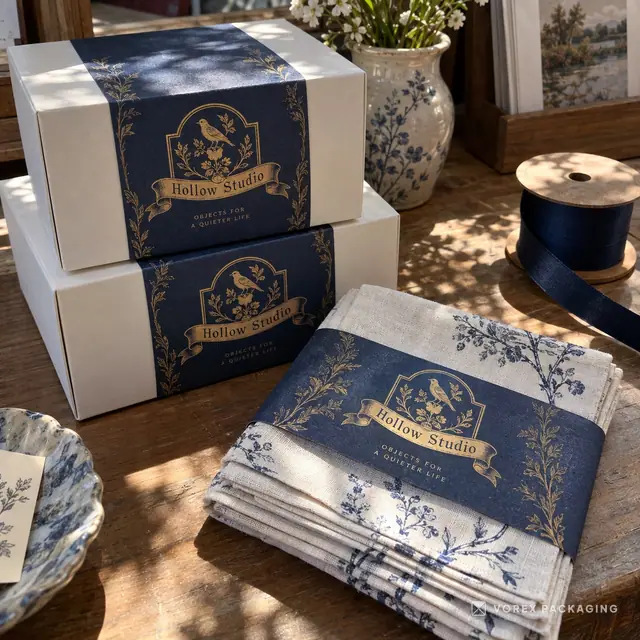
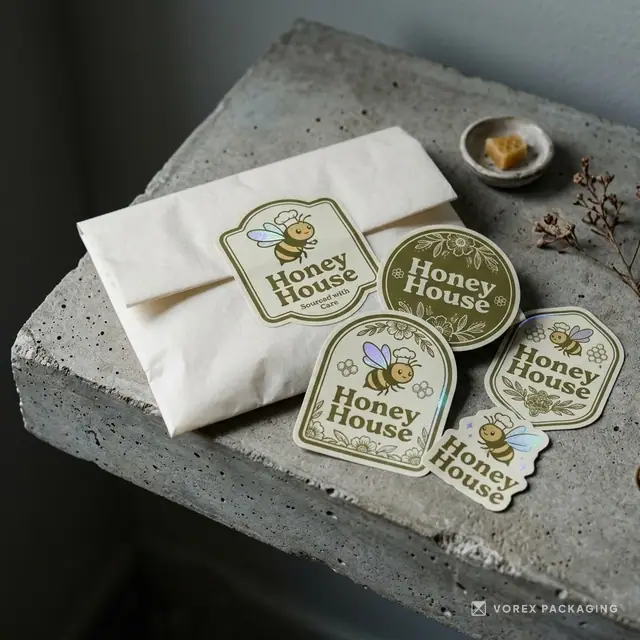
31:24 Jordan: Exactly. Keep your regular branded box, and add the season with something smaller. A printed sleeve that slides over the box. A belly band, which is a paper band that wraps around the middle. Or a custom sticker that seals the lid. All of those are on the Vorex website, and they're linked in the show notes.
31:43 Maya: And after the holiday, you just stop adding the band, and your boxes are back to normal.
31:48 Jordan: Right. Your main box stays evergreen, and the season lives on a smaller piece you can change every year.
31:55 Maya: And whatever you choose, it goes through the same proof process we talked about. A sleeve has its own dieline, a band has its own size, and the wording on a seasonal piece deserves the same read out loud check.
32:08 Jordan: Especially the year, if you print one.
32:10 Maya: Especially the year. Imagine a beautiful New Year box with last year's date on it.
32:15 Jordan: That's a hypothetical I never want to see in real life.
32:19 Maya: So, the short answer. Not sure about quantities, go festive but general. Sure about quantities, go fully seasonal in a small run. Want both, keep the box evergreen and add the season with a sleeve, a band or a sticker.
32:37 Jordan: That's our episode on dielines, proofs and the holiday calendar. Maya, how can people take the next step?
32:44 Maya: If you want to start designing today, try the free dieline generator at vorexpackaging.com/tools/dieline-generator. Pick a style, enter your inside size, download the template, print it at actual size and fold a test box.
33:00 Jordan: And when you're ready for real boxes, request a quote at vorexpackaging.com/quote. Tell them the box style, the inside size, the quantity, where it ships, and, after today, your in-hand date.
33:13 Maya: Yes, please include the date. That's the most useful thing you can add.
33:17 Jordan: You can also try the 3D design preview on the home page. Upload your logo, pick a box shape and color, and turn it around in your browser before you decide anything.
33:28 Maya: A few Vorex facts, so you have them in one place. There is no minimum order quantity: order 1 piece or 10,000. Production is seven days once you approve your proof. [Correction, 2 Nov 2026: shipping is free on every order.] And if they get your order wrong, there's a reprint for production errors reported within sixty days of delivery. [Correction, 8 Nov 2026: Vorex does not promise a set number of days; production is fast once you approve your proof, and your quote confirms the delivery estimate.]
33:47 Jordan: If you're new, the code FIRST20 takes twenty percent off your first order. It's for new customers, one per business, and it isn't combined with other offers. And for Halloween packaging, HALLOWEEN25 takes twenty-five percent off until October thirty-first. Remember, approve your proof by October fifteenth for the best chance of Halloween delivery, and ask about rush orders if you're past that.
34:13 Maya: A word on how Vorex works. Vorex Packaging is a packaging studio. They help with style, sizing and design, and they print and ship to customers across the United States.
34:26 Jordan: And the printed packaging catalog is still being put together. It isn't ready yet, and we'll tell you on the show when it is.
34:33 Maya: Everything we mentioned today, the proof policy, the dieline generator, the measuring guide, the seasonal pages and the sources for our stories, is linked in the show notes.
34:44 Jordan: If this episode helped, follow the show, and share it with a friend who's about to click approve on their first proof.
34:51 Maya: Read it out loud first.
34:52 Jordan: Read it out loud first. Thanks for listening to The Vorex Packaging Podcast. I'm Jordan.
34:58 Maya: And I'm Maya. See you next time.
Voices produced with AI text-to-speech.