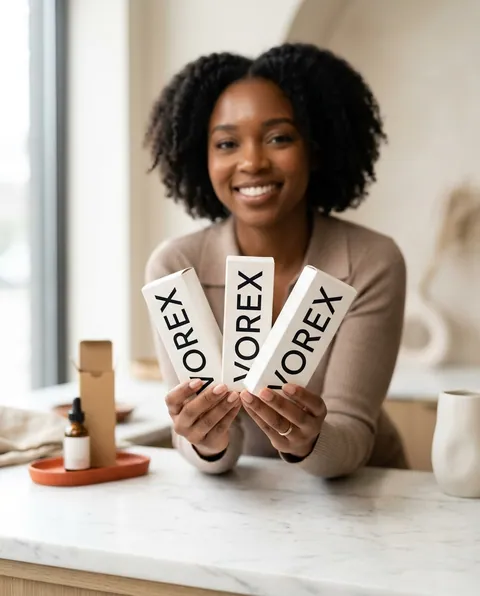
Packaging That Sells: What Your Box Says Before It's Opened
· 32 min · The Vorex Packaging Podcast
In our first episode, AI-voiced hosts Maya and Jordan look at packaging that sells: what your box says before it's opened, how to plan the unboxing as a sequence of moments, and how to choose a box style, material and finish. Then three real brand packaging stories from public sources (Tiffany Blue, Glossier's pink pouch and an Allbirds shoebox), a holiday 2026 planning checklist for US and Canadian small businesses, and two questions we hear a lot: do you need custom packaging when you are just starting out, and is eco-friendly packaging worth it (and what can you honestly print about it)?
This episode will play here as soon as it is live on Spotify. Apple Podcasts and YouTube are coming soon too. Until then, read the show notes and the full transcript below.
AI-voiced hosts. Maya and Jordan are AI-voiced hosts. Their voices are generated by AI, and every episode is written and checked by the Vorex Packaging team. Real brand stories come from public sources linked in the show notes; hypotheticals are labeled as examples.
In this episode
- The closed box is a promise: who you are, what you care about and how it should feel to open. One clear idea beats ten.
- Plan the unboxing as five moments (arrival, opening, reveal, product, after) and do one or two of them really well.
- Pick the style from the product's journey, the material from how it travels and looks, and use one or two finishes well.
- Tiffany: one consistent color, used for a very long time, becomes recognizable on its own.
- Glossier: packaging people keep can become part of the brand, and every extra still has to earn its place.
- Allbirds: the order of the reveal tells a story, and fewer box sizes can simplify operations.
- Holidays 2026: US Thanksgiving is Thursday, November 26 (Black Friday November 27, Cyber Monday November 30); Canadian Thanksgiving is Monday, October 12. Work backward from your launch date and ask for a timeline in your quote.
- Starting out? A good stock box with a sticker and card works; go custom sooner if the unboxing is part of why people buy.
- Eco-friendly packaging: pick recognizable materials, avoid needless mixed materials, right-size the box, and only print environmental claims you can support (see the FTC Green Guides in the US and the Competition Bureau's guidance in Canada).
Chapters
- 0:00 Cold open
- 0:57 Welcome to the show
- 2:30 The five-second box
- 6:50 The unboxing, moment by moment
- 11:08 Style, material and finish
- 16:01 Three real packaging stories
- 22:28 Planning for the 2026 holidays
- 26:31 Questions we hear a lot
- 30:31 Get started
Sources
The story segment uses public sources only. We paraphrase and state only what each source supports.
- Tiffany & Co.: Tiffany Blue (Wikipedia, accessed 6 Oct 2026). Company created in 1837 by Charles Tiffany and John Young; the color was used on the cover of the Blue Book, first published in 1845; registered as a color trademark since 1998; custom Pantone color with PMS number 1837.
- Glossier: Glossier Filed 2 Trademark Applications This Spring That Say a Lot About Modern Branding (The Fashion Law, 26 Nov 2019). Spring 2019 applications for pink bubble-wrap-lined pouches and pink-interior boxes; the USPTO's initial refusals (functional; decorative).
- Glossier: Glossier's Having a Hard Time Trademarking Its Iconic Packaging (Jezebel, 3 Mar 2020). Customers used the pouch to store makeup and other products and photographed it like an accessory.
- Glossier: Glossier finally responds to calls for sustainable packaging (Dazed, 30 Apr 2019). Criticism that pouches, stickers and extras were wasteful; Glossier's announced limited-packaging option.
- Glossier: Glossier Confirms Sustainable Packaging Options Will Be Available Soon (Hypebae, 30 Apr 2019). Glossier's statement: a limited packaging option without a pink pouch, stickers or extras for online orders, starting that summer.
- Allbirds: Red Dot Design Award: Allbirds Dasher VIP Packaging (Red Dot, accessed 6 Oct 2026). Compostable paper pulp shoebox with soy-based inks; unboxing reveals the shoe's materials and sustainability story first; one box for sizes 5 to 15; designed by Enlisted Design, Oakland; Red Dot Best of the Best 2021.
Packaging mentioned
- Mailer boxes
- Tuck end boxes
- Rigid boxes
- Two-piece boxes
- Magnetic closure boxes
- Sleeve boxes
- Window boxes
- Christmas packaging
- Holiday gifting packaging
- Thanksgiving packaging
- How to measure a box
- Eco-friendly packaging choices
- How to choose the right box style
- Unboxing experience for small brands
- Christmas packaging ideas for small businesses
Get a free quote Try the 3D design preview
Full transcript
0:00 Maya: Here is something we think about a lot. Your customer forms an opinion about your brand before they ever see your product. They form it on the porch, at the counter, or on a store shelf, while they are still holding a closed box.
0:13 Jordan: And that opinion is fast. The color, the weight in the hand, the way the lid opens. All of it is saying something, whether you planned it or not.
0:22 Maya: Today we are talking about packaging that sells. What your box says before it's opened, how to make the unboxing feel like a moment, how to pick a style, a material and a finish, and how to plan for the holiday season that is coming up fast.
0:36 Jordan: Plus three real brand packaging stories, and a question we hear a lot.
0:41 Maya: Before we start, one honest note. We're AI-voiced hosts for Vorex Packaging. I'm Maya.
0:47 Jordan: And I'm Jordan. Our voices are generated by AI, and the show is written and checked by the Vorex Packaging team. Let's get into it.
0:57 Maya: Welcome to the very first episode of The Vorex Packaging Podcast. This is a show for people who make and sell things: small brands, online stores, bakeries, candle makers, skincare founders, coffee roasters, and anyone else who ships a product in a box.
1:14 Jordan: We are going to talk about packaging, branding, starting and growing a product business, materials and finishes, and seasonal planning. We keep it practical. If you are running a business in the United States or Canada, this show is built for you.
1:29 Maya: We also have a few house rules, and we want to say them out loud on day one.
1:34 Jordan: Rule one. When we tell a story about a real brand, it comes from a public source, and you will find the link in the show notes. We only say what the source supports.
1:44 Maya: Rule two. When we use an example that is not real, we will tell you it is a hypothetical. No invented customers, and no made-up success stories.
1:54 Jordan: Rule three. We don't throw around numbers we can't back up. If you hear a statistic on this show, it has a source. Today, you will notice, we don't need any.
2:03 Maya: That's a good rule for packaging too, by the way. A box that makes promises it can't keep is worse than a plain box.
2:11 Jordan: So here is the plan. First, the five-second box: what a closed package tells people. Then the unboxing as a sequence of moments. Then style, material and finish. After that, our story segment, then holiday planning, a question we hear a lot, and how to get started.
2:29 Maya: Let's go.
2:34 Jordan: Let's start with the closed box. Maya, when you think about a package before it's opened, what is it actually doing?
2:42 Maya: I think of it as a promise. The outside of the box is a promise about what is inside. If the box feels careful, people expect a careful product. If the box feels rushed, people start to wonder what else was rushed.
2:55 Jordan: That's fair. And the interesting thing is that customers are not reading your box like a brochure. They are taking it in all at once. Color, shape, texture, weight, and maybe one or two words.
3:06 Maya: Right. Nobody reads the side panel first. They see a color and a logo, and they feel the board. Then they decide what kind of brand this is.
3:15 Jordan: It also matters where that first impression happens. There are really two very different places. One is the shelf, and the other is the doorstep.
3:24 Maya: On a shelf, your box is competing. It sits next to other boxes, and it has a few seconds to say what the product is and why it is worth picking up.
3:33 Jordan: On the doorstep, the box is not competing with anything. The customer already bought the product. So the job changes. Now the box is confirming the decision. It is saying, you made a good choice.
3:46 Maya: I love that framing, because it changes how you design. A retail box needs clear information, a strong front panel, and a reason to reach for it. A mailer box can be quieter on the outside and save the surprise for the inside.
4:01 Jordan: And for a lot of online brands, the shipping box is the first physical thing a customer ever touches from that company. Before the product, before the instructions, before anything else.
4:12 Maya: Which is why a plain brown box with a big shipping label can feel like a missed chance. It is not wrong. It works. But it says nothing about you.
4:21 Jordan: So what should the closed box say? If you only had room for a few things, what are they?
4:26 Maya: I would say three things. Who you are, what you care about, and how it should feel to open. Who you are is your logo and your colors. What you care about might be a material choice, like natural kraft board, or a single line of copy. And how it should feel is the finish and the structure.
4:43 Jordan: I'd add one more, which is restraint. Small brands sometimes try to put everything on the outside. The logo, the tagline, the website, the social handles, a discount code, three product photos.
4:56 Maya: And it ends up shouting.
4:58 Jordan: Exactly. A box with one clear idea usually looks more expensive than a box with ten ideas. You can put the extra information inside, on an insert card, where the customer is already paying attention.
5:12 Maya: Let's walk through an example, and to be clear, this one is a hypothetical. Picture a small candle brand that sells online. Their candles smell wonderful, and the jar is beautiful. But every order ships in a stock brown box with tape across the top.
5:28 Jordan: Nothing wrong with that on day one.
5:30 Maya: Nothing wrong at all. Now imagine that same brand moves to a printed mailer box. Maybe it is still kraft on the outside, so it feels natural, but it carries a small logo on the lid and the brand color on the inside. The customer opens the lid and sees that color first.
5:48 Jordan: So the outside stays calm, and the inside does the talking.
5:52 Maya: Yes. And the product did not change at all. The candle is the same candle. But the experience feels more like a gift, and that feeling becomes part of what the customer remembers about the brand.
6:03 Jordan: That's the thing people underestimate. Customers don't separate the product from the packaging as neatly as we do. To them, it is one experience. One more thing about the closed box, and that's the feel of it. We focus on how a box looks, but people hold it before they really look at it.
6:22 Maya: Weight, stiffness, and the surface under your fingers. A box that flexes when you pick it up feels different from one that holds its shape. A soft matte surface feels different from a glossy one.
6:33 Jordan: And none of that shows up in a photo on a screen. It only shows up in a hand. That's a good reason to look at physical samples before you commit to a big order, if you can.
6:44 Maya: Agreed. Screens are great for checking your layout. Hands are better for judging the board and the finish. Let's open the box. When people talk about the unboxing experience, it can sound fancy, like it is only for luxury brands. But I think of it as a simple sequence of moments.
7:05 Jordan: Walk me through the sequence.
7:07 Maya: Moment one is the arrival. The box on the doorstep or in the mailbox. Moment two is the opening, the tape, the tear strip, or the lid. Moment three is the reveal, the first thing you see when it opens. Moment four is the product itself. And moment five is what happens after, when the box is empty.
7:26 Jordan: I like that, because each moment is a decision you can make on purpose. And you don't have to make all five fancy. You can pick one or two and do them really well.
7:36 Maya: That's the key for a small budget. You don't need foil, ribbon, tissue, stickers, a custom insert and a printed interior all at once. Pick the moment that matters most for your product.
7:48 Jordan: Let's talk about the opening, because I think it is the most overlooked moment. If someone has to fight the box with a kitchen knife, the mood is gone before they see anything.
7:59 Maya: True. A mailer box with tuck flaps, or a box with a tear strip, makes opening feel smooth. Rigid boxes with a lift-off lid, or a magnetic closure, turn opening into a little ceremony.
8:11 Jordan: The magnetic closure is a fun one. That soft click when the lid closes is part of the brand, even though nobody designed it as a sound.
8:20 Maya: And it tells the customer, this box is worth keeping.
8:23 Jordan: Then the reveal. What is the first thing a customer should see when the lid comes up?
8:28 Maya: Ideally something intentional. That could be a printed message on the inside of the lid, a color that surprises them, tissue paper, or the product sitting snugly in an insert.
8:39 Jordan: Inside printing is one of my favorite tools for this, because the outside can stay simple for shipping, and the surprise is saved for the person who actually opens it.
8:50 Maya: Inserts matter a lot too, and not only for looks. An insert holds the product in place, so it arrives in the position you designed. A product that slid into a corner during shipping makes even a beautiful box look messy.
9:03 Jordan: That's a good point. The reveal you planned only happens if the product arrives where you put it.
9:09 Maya: Then there are the small touches. A thank-you card, a sticker to close the tissue, a short line of copy. These are inexpensive compared with the box itself, and they can carry a lot of personality.
9:21 Jordan: I'd say write the card like a person, not like a legal department. One or two sentences. Thank them, tell them how to use or care for the product, and point them somewhere useful.
9:32 Maya: And be careful with clutter. Five flyers falling out of a box feels like advertising, not like a gift.
9:39 Jordan: Let me try a hypothetical, so we can see the sequence in action. Imagine a new skincare brand that sells a starter kit with three small bottles.
9:48 Maya: Okay, I'm picturing it.
9:50 Jordan: In version one, the three bottles go into a stock mailer with some crumpled paper. They arrive rattling around, maybe one is lying sideways. In version two, the mailer has the brand color printed inside, there is a simple paperboard insert with three cutouts, and a small card explains the order to use them in.
10:11 Maya: Same bottles, very different first impression.
10:14 Jordan: And notice the card does a real job. It teaches the customer how to use the product, which probably makes them happier with the result. That is packaging working as customer service.
10:26 Maya: Then there's moment five, the after. What happens to the box once it is empty?
10:31 Jordan: Either it gets thrown away, recycled, or kept. If it is kept, it keeps working for you. It sits on a shelf, holds jewelry or cables or letters, and your logo stays in that person's home.
10:43 Maya: Rigid boxes and sturdy two-piece boxes tend to get kept. So do boxes that are simply beautiful. And if the box is going to be recycled, it helps to make that easy, with a material people recognize and not too many mixed parts.
10:58 Jordan: We'll actually see both sides of that in the story segment later. One brand whose packaging people kept and carried around, and the questions that came with it. Let's get practical. When someone comes to custom packaging for the first time, there are three decisions that shape almost everything. The box style, the material, and the finish.
11:23 Maya: Let's start with style, which is really the shape and how the box opens and closes.
11:28 Jordan: The most common style for online brands is the mailer box. It is a one-piece corrugated box with a lid that folds over and tucks in. It is strong enough to ship, it looks finished when opened, and it can be printed inside and out.
11:43 Maya: If you sell online and want one box that does both jobs, protecting the product and presenting it, a mailer is usually where people start.
11:51 Jordan: Next is the tuck end box. That is the folding carton you see on shelves for cosmetics, supplements, small electronics and lots of other products. It is lighter, it prints beautifully, and it usually goes inside a shipping carton when it travels.
12:07 Maya: So a tuck end box is really a retail box. It is designed to be seen and picked up.
12:13 Jordan: Then there are rigid boxes. These are made from thick chipboard wrapped in printed paper. They don't fold flat in the usual way, and they feel solid in the hand. Think of a two-piece box with a lift-off lid, a magnetic box that opens like a book, or a drawer box with a sleeve.
12:31 Maya: Rigid boxes are the keepsake category. Jewelry, watches, premium gifts, launch kits for press and influencers. They cost more to make and to ship than a folding carton, so they make the most sense when the box itself is part of the value.
12:46 Jordan: And there are lots of specialty styles. Window boxes for bakery items and products you want to show off, gable boxes with handles, pillow boxes for small gifts, and display boxes that sit on a counter.
13:00 Maya: My advice is to start from the product and the journey. How big and heavy is it, how fragile is it, will it ship on its own or inside another box, and will it ever sit on a shelf? The answers usually point to one or two styles.
13:14 Jordan: Now materials. There are four you will hear about most. SBS, kraft, corrugated and rigid chipboard.
13:21 Maya: SBS stands for solid bleached sulfate. It is a bright white paperboard that is white all the way through. It prints crisp colors and fine text, and you see it on a lot of cosmetics and retail cartons.
13:34 Jordan: Kraft is unbleached, so it keeps the natural brown color of the fiber. It has a slightly textured, honest look. Colors print deeper and warmer on kraft, and very light colors can almost disappear, so a dark ink or a white base layer is common.
13:51 Maya: Corrugated is the sandwich board, with a wavy layer called the flute glued between flat liners. That structure gives it strength and cushioning, which is why mailers and shipping boxes are made from it.
14:02 Jordan: And rigid chipboard is the thick, dense board inside rigid boxes. It is usually wrapped in printed or specialty paper, so the wrap is what the customer actually sees and touches.
14:14 Maya: One quick tip. Lots of people say cardboard for all of these. When you ask for a quote, it helps to name the style and describe how the box will travel, so the right material gets suggested.
14:26 Jordan: Then finishes, which are the details that change how the printed surface looks and feels.
14:31 Maya: Matte gives a soft, low-glare look that reads as calm and modern. Gloss makes colors pop and gives a shiny surface. Soft-touch is a velvety matte coating that people tend to stroke without thinking.
14:44 Jordan: Then there are the accent finishes. Foil stamping puts a metallic or colored foil onto part of the design, often the logo. Spot UV adds a glossy, raised layer to just one area, so a logo can shine against a matte background. Embossing raises part of the design, and debossing presses it in.
15:04 Maya: The trick with finishes is to use one or two well, not all of them at once. A matte box with a single foil logo can look more premium than a box covered in every effect.
15:14 Jordan: And think about where the finish will be seen. Foil on the inside of a mailer lid is a lovely surprise. Foil on the outside of a shipping box may get scuffed on the way.
15:25 Maya: If someone is stuck, here are the questions I'd ask. One, how does the product travel, on its own or inside another box? Two, where is the first impression, on a shelf or on a doorstep? Three, will the customer keep the box or recycle it? And four, what one feeling should the box give, natural, playful, premium or clinical?
15:46 Jordan: Answer those four, and most of the style, material and finish choices make themselves. And when they don't, that's what a quote conversation is for. You can describe the product, and a packaging specialist can suggest options.
16:05 Maya: Now it's time for our story segment. Every story here comes from a public source, and the links are in the show notes. We are paraphrasing, and we will only say what the sources support.
16:16 Jordan: We picked three brands that show three different lessons. One about color, one about packaging people keep, and one about packaging that tells a product's story.
16:26 Maya: Story one is Tiffany and Company, and the color most people simply call Tiffany Blue.
16:31 Jordan: According to the Wikipedia article on Tiffany Blue, the company was founded in 1837 by Charles Tiffany and John Young. The robin's egg blue color was used on the cover of Tiffany's Blue Book, a catalog first published in 1845.
16:50 Maya: So the color is older than most modern ideas about branding.
16:54 Jordan: Much older. The same article says Tiffany has registered the color as a trademark since 1998, and that it is matched to a custom Pantone color with the number 1837, taken from the year the company was founded.
17:11 Maya: What I take from this is consistency. The box itself is simple. It is a colored box. But the color has been used so consistently, for so long, that people recognize it before they see a single word.
17:24 Jordan: And that is a lesson a small brand can actually use. You probably can't build that kind of history overnight, but you can pick one color and use it every time. On the box, the tissue, the sticker, the website and the social posts.
17:38 Maya: Consistency is free. Changing your colors every season is how you make sure nobody remembers them.
17:44 Jordan: One more practical point. Color consistency on packaging is a printing question as much as a design question. Different materials and finishes can shift how a color looks, so the same brand color may look different on kraft, on white board and on a glossy surface.
18:02 Maya: That's why proofs matter, and why it helps to tell your printer the exact color reference you use.
18:07 Jordan: Story two is Glossier, the beauty brand, and its pink pouch.
18:12 Maya: Glossier's online orders were known for arriving in a pink, bubble-wrap-lined zip pouch. The legal news site The Fashion Law reported in November 2019 that Glossier had filed two trademark applications that spring, one for those pink bubble-wrap-lined pouches and one for boxes with pink interiors.
18:32 Jordan: And according to that same report, the trademark office initially refused both. It said the bubble wrap pouch looked functional, because bubble wrap protects goods in transit, and that the pink interior of the boxes was decorative rather than a sign of who made the product.
18:49 Maya: Which is interesting by itself. The packaging was clearly part of the brand, but a protective feature is hard to own as a trademark.
18:57 Jordan: The part I find most interesting is what customers did with it. A Jezebel article from March 2020 describes customers using the pouch, which looks disposable, to store makeup and other things indefinitely, and photographing it as if it were a new accessory.
19:15 Maya: So the shipping packaging became something people carried around. That's packaging people keep, in its purest form.
19:22 Jordan: But there's a second half to this story. In April 2019, Dazed and Hypebae reported that Glossier faced criticism online that the pouches, stickers and other extras included with every order were wasteful.
19:37 Maya: And Glossier responded publicly. According to both reports, the brand said it would offer a limited packaging option for online orders, without a pink pouch, stickers or packaging extras, starting that summer.
19:50 Jordan: So I see two lessons. The first is that a distinctive, useful piece of packaging can become part of your identity, and even part of your marketing, when people choose to keep it and show it.
20:02 Maya: And the second is that every extra has to earn its place. If people feel the packaging is waste, the same feature that made them smile can start to work against you.
20:11 Jordan: Listening to your customers, and giving them a choice, is part of good packaging design.
20:17 Maya: Story three is Allbirds, the shoe brand, and a packaging project for its Tree Dasher running shoe.
20:23 Jordan: This one comes from the Red Dot design award site, which has a project page for Allbirds packaging designed by Enlisted Design, a studio in Oakland, California.
20:34 Maya: According to that page, the shoebox is made from compostable paper pulp, and the lettering uses inks made from soy.
20:42 Jordan: The design idea is that the packaging matches the product. The shoes are made from natural materials, so the box is too.
20:50 Maya: What I really like is the unboxing sequence. The page describes the opening as revealing the recipe of the shoe, merino wool, tree fiber and sugar cane, along with the brand's sustainability story, before the shoes themselves become visible.
21:05 Jordan: So the box tells you what the product is made of before you even see it. It is storytelling through the order of the reveal.
21:13 Maya: And there's a very practical detail too. The page says the box was designed as one size for shoe sizes five to fifteen, which made production simpler and saved cost.
21:24 Jordan: I love that, because it shows that clever packaging is not only about looks. Using one box size for a whole range of products can make ordering, storage and packing easier.
21:36 Maya: Red Dot lists the project as a Best of the Best winner in 2021.
21:41 Jordan: So what can a small brand take from this one?
21:43 Maya: Two things. First, the order of the reveal is a design tool. What the customer sees first, second and third tells a story. Second, think about how many box sizes you really need. Fewer sizes, chosen well, can make your whole operation simpler.
21:59 Jordan: Let's sum up the three stories. Tiffany shows the power of one consistent color. Glossier shows that packaging people keep can become part of the brand, and that extras have to earn their place. And Allbirds shows how a box can tell the product's story, and how smart sizing can make operations simpler.
22:18 Maya: And none of those lessons require a huge budget. They require decisions.
22:23 Jordan: Links to all of the sources are in the show notes, so you can read them yourself. Let's talk about the calendar, because we are recording this in early October 2026, and the holiday season is closer than it looks.
22:42 Maya: Halloween is at the end of this month. American Thanksgiving is on Thursday, November 26 this year, so Black Friday is November 27 and Cyber Monday is November 30. Then December brings Hanukkah, Christmas and New Year's.
22:57 Jordan: And for our Canadian listeners, Canadian Thanksgiving is on Monday, October 12, which is very soon.
23:04 Maya: So the question for a product business is simple. What packaging do you need for your busiest weeks, and when do you need it in your hands?
23:11 Jordan: The best habit here is to work backward. Start from the date your holiday products go on sale, then leave time for packing, before that, time for delivery of the boxes, before that, production, and before that, design and proof approval.
23:27 Maya: We are not going to give you a number of days, because it really depends on the box style, the quantity and the finish. A simple printed mailer and a rigid box with foil are very different projects. The honest answer is to ask for a timeline when you request your quote, and to ask early.
23:43 Jordan: And build in a buffer for your own decisions. Design changes and proof rounds take time on your side too.
23:50 Maya: Here's a tip that saves a lot of stress. You don't always need a whole new holiday box. You can keep your everyday box and add a seasonal layer.
23:59 Jordan: Like a printed sleeve or a belly band that wraps around the box.
24:03 Maya: Exactly. A sleeve, a belly band, a holiday sticker, holiday tissue paper, or a seasonal insert card. Your core box stays the same, and the season is added on top.
24:14 Jordan: That also helps with leftovers. If you print a lot of Christmas-only boxes and don't use them all, you are stuck with them until next year. A sleeve or a sticker is a much smaller bet.
24:26 Maya: Another holiday idea is to design for gifting. A lot of holiday orders are bought by one person and opened by someone else.
24:34 Jordan: So the box should look good without the receipt in it.
24:37 Maya: Right. Consider leaving prices off the packing slip, adding a gift message card, and making sure the inside looks finished. If the box arrives at the recipient's door, it might be the very first thing they ever see from your brand.
24:50 Jordan: And there is the corporate side too. Lots of businesses send holiday gifts to clients and teams, and those orders often come with their own branding requests, like a company logo on the box or a printed card.
25:04 Maya: If you sell to businesses, a simple corporate gift box option, ready before the rush, can be a nice addition to the season.
25:12 Jordan: One more thing. Not every holiday fits every brand. Pick the moments that match your customers. A bakery might go big for Halloween and Thanksgiving. A jewelry brand might focus on the December gifting weeks and then Valentine's Day.
25:28 Maya: And whatever you choose, make the seasonal packaging feel like your brand dressed up, not like a different brand. Keep your color and your logo, and let the season be the accent.
25:39 Jordan: Let's turn all of that into a quick checklist people can use this week.
25:43 Maya: Good idea. Step one, write down the date your holiday products go on sale, and the date of your last shipping day before the holidays.
25:51 Jordan: Step two, count what you sold during your busiest weeks last year, if you have that data, so your box order is based on real numbers rather than a guess.
26:01 Maya: Step three, decide whether you need a new holiday box, or whether a sleeve, a sticker, tissue or a card will do the job on your everyday box.
26:10 Jordan: Step four, get your artwork ready early, and leave room for at least one round of changes after you see the proof.
26:17 Maya: And step five, ask for a quote with a timeline now, while there is still room in the calendar. Even if you decide to wait, you'll know your options.
26:25 Jordan: That's a solid list. Simple, but it removes most of the panic from December. Time for a question we hear a lot. It goes something like this. I am just starting out, my order numbers are small, so do I actually need custom packaging yet, or is that something for later?
26:47 Maya: It's such a good question, and the honest answer is that it depends on your product and your margins. Let me give the case for each side.
26:54 Jordan: Go for it.
26:56 Maya: The case for waiting is cash. When you are starting out, money spent on boxes is money not spent on product, ads or inventory. A clean stock box with a good sticker and a nice card can look really professional.
27:09 Jordan: Stickers and labels are underrated. A well-designed logo sticker on a plain kraft or white mailer looks deliberate, not cheap.
27:18 Maya: The case for going custom sooner is that packaging is part of the product experience, especially if you sell gifts, beauty, food treats, or anything people share online. If the unboxing is part of why people buy, waiting can cost you more than the boxes.
27:34 Jordan: Is there a middle path?
27:35 Maya: There usually is. Start with one simple custom box in the size that fits most of your orders. One color print on kraft, or your brand color inside a mailer. Then upgrade the finish and the extras as you grow.
27:49 Jordan: So rather than designing the dream box on day one, you design version one.
27:54 Maya: Right. And you learn from it. You'll see what customers photograph, what they comment on, and what goes straight into the recycling bin.
28:01 Jordan: And a practical note on sizing. Before anything else, measure your product properly, inside length, width and height, and think about any insert or padding. A box that fits well protects better and looks better.
28:15 Maya: We have a guide on how to measure a box on the website, if you want a walkthrough.
28:19 Jordan: So the short answer is, you don't need custom packaging to start a business. But if your product is a gift or a treat, or the experience is part of the sale, it is worth planning for sooner than you might think. Here's another question we hear a lot. Is eco-friendly packaging worth it for a small brand, and what can I actually say about it on the box?
28:42 Maya: That's a great one, because there are two separate questions in there. One is about choosing the materials, and the other is about the claims you print.
28:49 Jordan: Let's start with materials.
28:51 Maya: A few simple habits go a long way. Choose materials your customers recognize and know how to deal with, like paper-based boxes and kraft board. Avoid gluing lots of different materials together when you don't need to, because mixed materials can be harder to sort. And size the box to the product, so you are not shipping air and filling the gap with extra padding.
29:13 Jordan: Right-sizing is underrated. A box that fits the product well usually needs less filler, protects better, and looks more intentional when it's opened.
29:23 Maya: Then there's the second part, the claims. This is where we would be careful. Only print an environmental claim you can support for that exact packaging, and be specific about what it means.
29:34 Jordan: In the United States, the Federal Trade Commission publishes the Green Guides, which is its guidance on environmental marketing claims. In Canada, the Competition Bureau has published guidance on environmental claims too. If you plan to print words like recyclable or compostable, it's worth reading the current guidance first.
29:56 Maya: And when in doubt, describe the material plainly instead of making a broad promise. Saying what the box is made from is often clearer, and more honest, than a vague green label.
30:06 Jordan: Remember the Glossier story from earlier. Customers notice packaging that feels wasteful, and they also notice claims that don't hold up.
30:15 Maya: So the honest answer is yes, thoughtful materials are worth it, especially when they also make the box simpler. Just keep the claims as careful as the design. And if you have a question you'd like us to talk about, you can send it to hello@vorexpackaging.com.
30:35 Jordan: That brings us to the end of our first episode. Maya, how can people take the next step?
30:40 Maya: If you are thinking about custom packaging for your brand, you can request a free quote at vorexpackaging.com/quote. Tell us the box style, the size, the quantity and where it ships, and a packaging specialist will reply with options.
30:55 Jordan: And before you even ask for a quote, you can try the 3D design preview on the website. You upload your logo, choose a box shape and color, and see your design on a box you can turn around in the browser.
31:08 Maya: It's a quick way to see whether your idea works before you spend any money.
31:12 Jordan: A word on how Vorex works. Vorex Packaging is a packaging studio. We help with style, sizing and design, and our production partner prints and ships to customers across the United States and Canada.
31:26 Maya: And we have a quality guarantee. If there is a production error in your order, report it within two business days and we will reprint it free.
31:34 Jordan: We're also working on a packaging catalog with styles, materials, finishes and seasonal ranges. The catalog is coming soon, and we'll mention it on the show when it is ready.
31:45 Maya: Thank you so much for listening to the first episode of The Vorex Packaging Podcast. If you found it useful, follow the show, and share it with a friend who is building a product brand.
31:56 Jordan: All the sources from today's story segment are linked in the show notes, along with the full transcript.
32:02 Maya: As a reminder, we are AI-voiced hosts, and the show is written and checked by the Vorex Packaging team. I'm Maya.
32:10 Jordan: And I'm Jordan. Thanks for listening, and we'll see you next time.